
LONDON — Plotters trying to bring down the British prime minister. The capital rife with rumors. And the king’s bodyguards, dressed in their finery, conducting a torchlight search for explosives in the cellars beneath Parliament.
Prime Minister Keir Starmer’s defiant bid to face down a rebellion left his future in the balance Wednesday, but that wasn’t going to stop the United Kingdom playing dress-up for the ceremonial State Opening of Parliament.
Enter King Charles III.
The monarch delivered the King’s Speech — an address written by the government to set out its priorities for the coming parliamentary session.
Though the king was reading Starmer’s words, “there’s deep uncertainty as to whether Starmer will be leading the government over the next 12 months or so,” said Craig Prescott, who specializes in the constitutional and political role of the monarchy at Royal Holloway, University of London.
“So it’s a bit of a paradox,” he told NBC News.
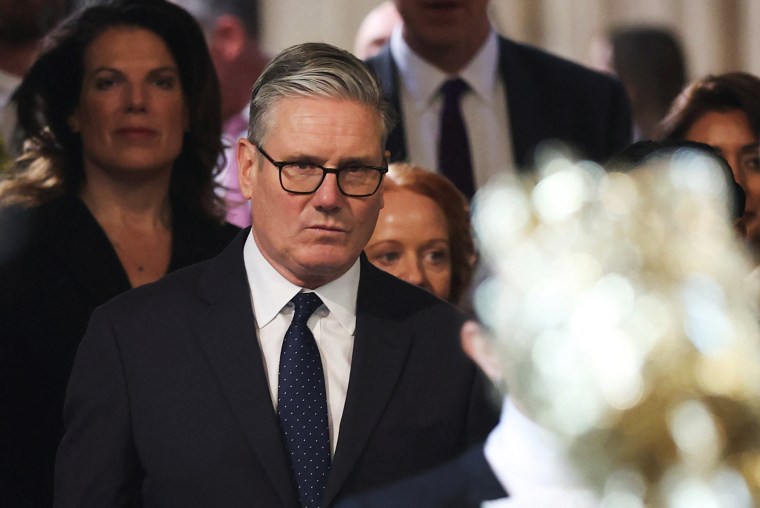
More than 80 Labour lawmakers have called for Starmer to resign, dismayed by two years of errors and policy U-turns that culminated in a disastrous showing in midterms-style elections last week.
Starmer has dared his mutineers to find the required numbers to challenge him or let him get on with the job.
One of his main rivals is Health Secretary Wes Streeting, who arrived for what was billed as a showdown with Starmer at No. 10 Downing St. early Wednesday. He left just 17 minutes later, still without declaring an open challenge to his boss.
Less than 300 yards away in Parliament, the day’s rituals were soon underway.
The state opening is part political necessity, part constitutional hangover, and part historical theater that makes the living museum of London such a global tourist magnet.
The timing of the speech is not set in stone, and its placement just after the local elections’ long-inevitable verdict on the unpopular Starmer was viewed by many observers as an effort for the government to reset.
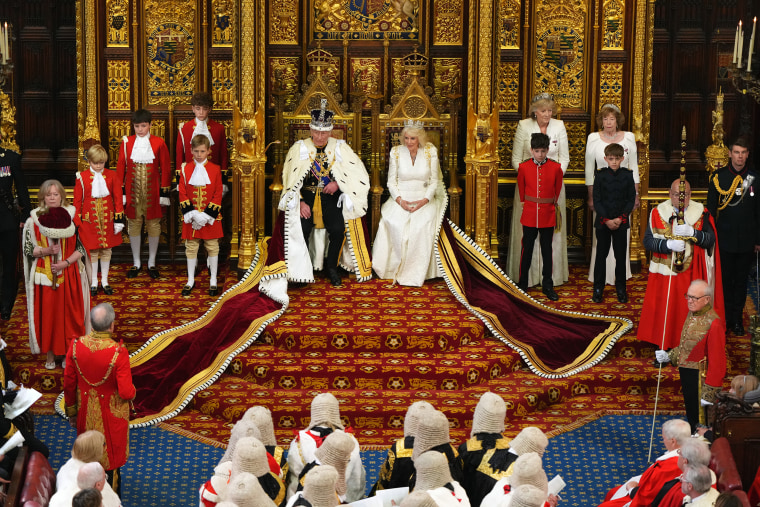
The event is specifically designed to showcase the ceremonial grandeur of political power in order to “excite and preserve the reverence of the population,” as put by Walter Bagehot, the 19th-century writer whose ideas have shaped British democracy.
Dating back to the 15th century, these rites and rituals are the only occasion that brings together the three elements of Parliament: the democratically elected lawmakers of the House of Commons, the unelected House of Lords and the monarchy. It is also an embodiment of the, at times violent, transition from absolute to constitutional monarchy that helped create the modern United Kingdom.
Starmer’s predicament is not entirely without precedent: The king’s speech went ahead in 1924 despite the widespread understanding that Stanley Baldwin would not be in the job for long. However, Baldwin’s Conservatives were in a far weaker position, having failed to win a majority at the recent election.
Starmer, by contrast, looks imperious on paper, with an overwhelming parliamentary majority and no way for opponents to challenge him until 2029.
Nonetheless, on Wednesday the king was “entering a Parliament that is febrile,” Prescott said. “The politics of all this is a bit too close for comfort.”
The day started with security measures both real and melodramatic.
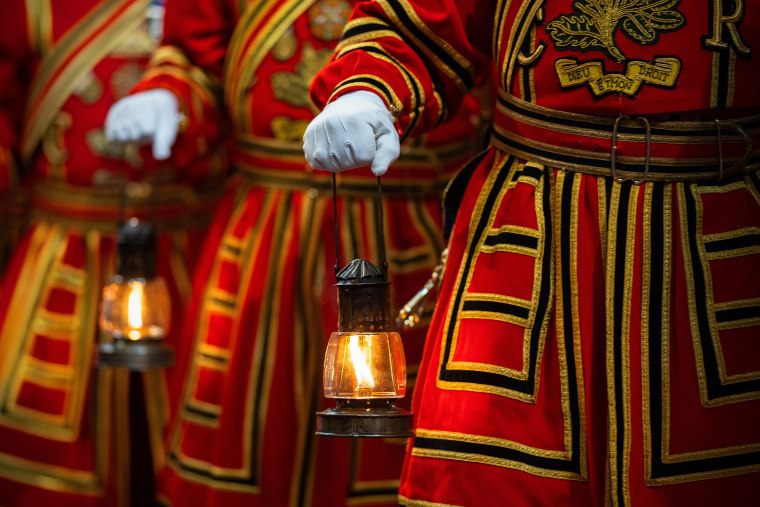
With the airspace above London restricted, deep in the dank cellars of the Houses of Parliament the yeoman of the guard, the king’s scarlet-clad bodyguards, re-enacted the 1605 Gunpowder Plot that saw Guy Fawkes’ plans discovered just in time.
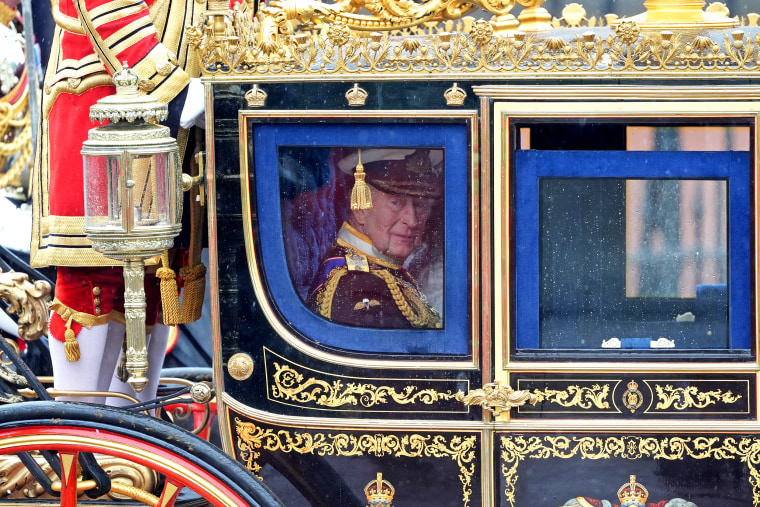
Charles traveled from Buckingham Palace to Parliament in a horse-drawn stage coach flanked by a 100-strong guard of honor. This included military bands and the mounted Life Guardsman, the rain pinging off their steel breastplates and ceremonial swords.
In a separate carriage was the Royal Regalia, transported from the Jewel House at the Tower of London to Westminster.
On the Mall, the wide avenue leading to the palace, a sudden downpour and a bitter wind buffeted a scant line of crowds, huddled under umbrellas against the barriers lining the iconic red roadway.
Most onlookers were tourists not overly concerned with the real-world drama playing out down the street. “I read about Keir Starmer but I don’t know too much about it,” said Tomaso Semola, 65, a vacationer from Venice, Italy, who had just watched Charles’ carriage roll by. “We have our own political problems in Italy!” he joked.
A lawmaker was held “hostage” at Buckingham Palace to ensure the monarch’s safe return. It’s a tradition that dates back to the current monarch’s namesake, Charles I, who attempted to storm Parliament in 1642 to arrest lawmakers for treason. That sparked a civil war and Charles’ eventual beheading.
This year, the role of hostage was played by Nic Dakin, a former English teacher from the northern town of Scunthorpe.
“Not sure I’m looking forward to it, but glad to play my part!” he posted to X early Wednesday.
The king arrived in Parliament dressed in the Robe of State, complete with velvet cape. The Imperial State Crown — all 3,000 precious stones and 2.87 pounds of it — was then placed on his head.
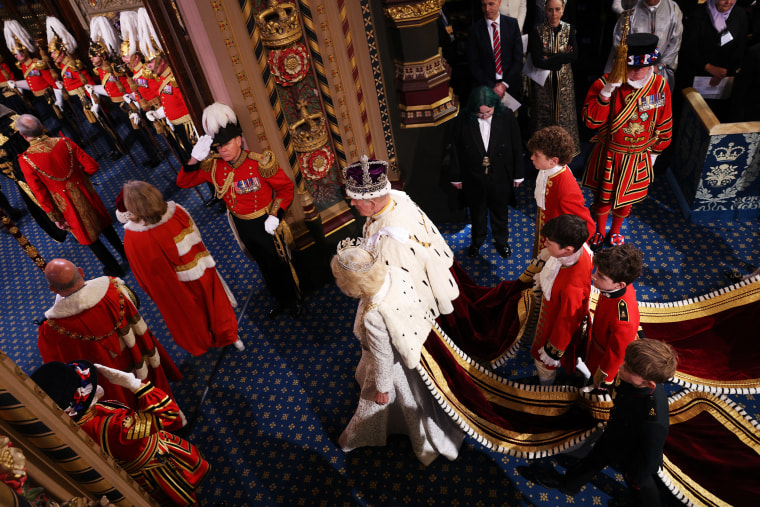
His procession into a packed House of Lords was followed by Charles dispatching a messenger known as “Black Rod” to summon elected lawmakers from the Commons.
He had the door slammed in his face to cries of “close the door,” another nod to Charles I’s attempted storming of the chamber. Rod struck the door three times before being let in, then leading the lawmakers to the Lords for the king’s speech.
This set out the government’s agenda, to be debated by both houses for around five days before they vote on it.
What’s unclear is whether Starmer will still be leading that government when they do.
