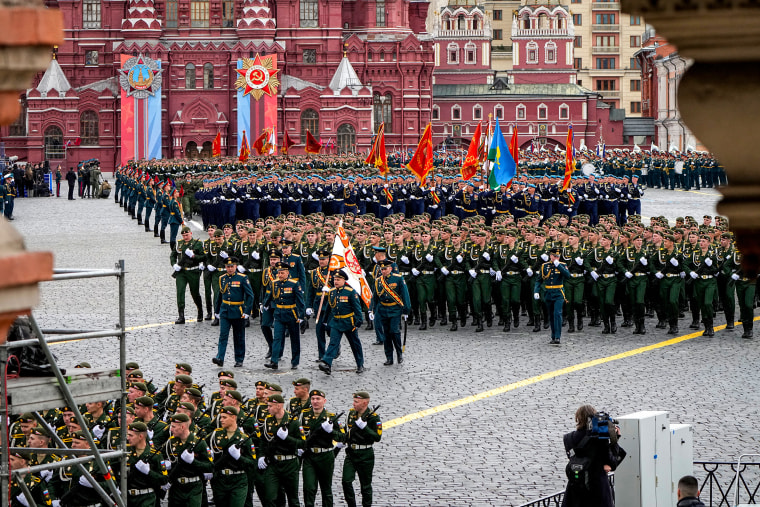
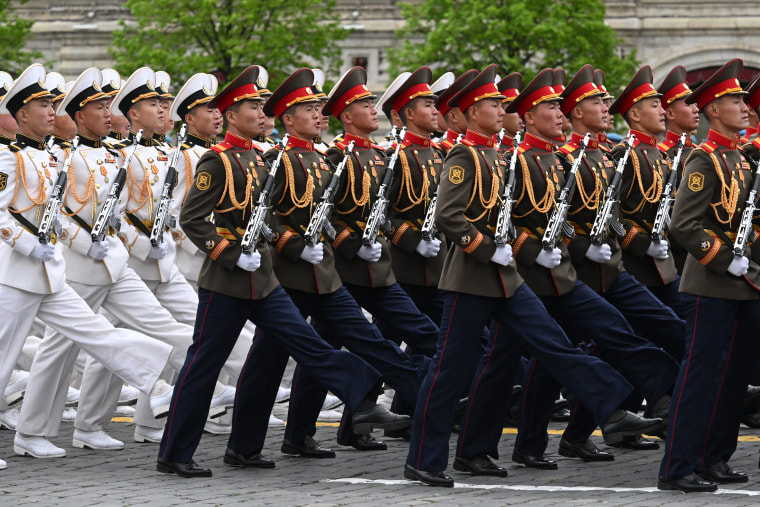
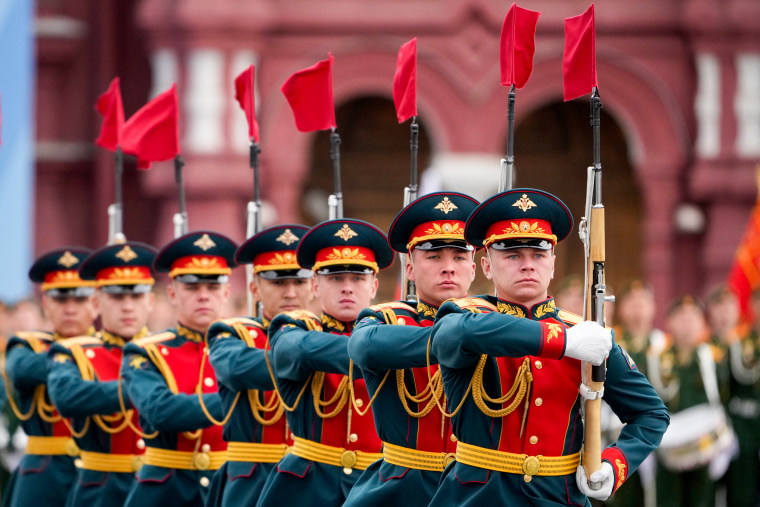
There were no neat rows of tanks or ballistic missile carriers rolling down the smooth cobbles of Moscow’s Red Square on Saturday, as Russia scaled back what is usually a grand militaristic Victory Day parade celebrating the Soviet Union’s role in defeating Nazi Germany.
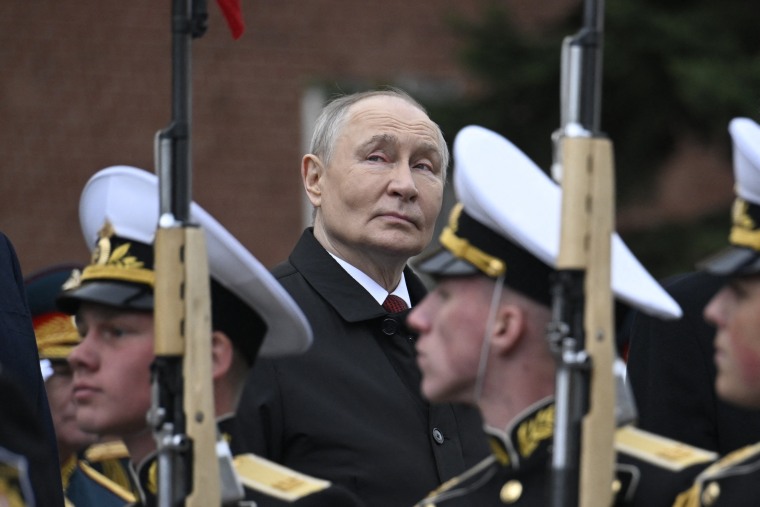
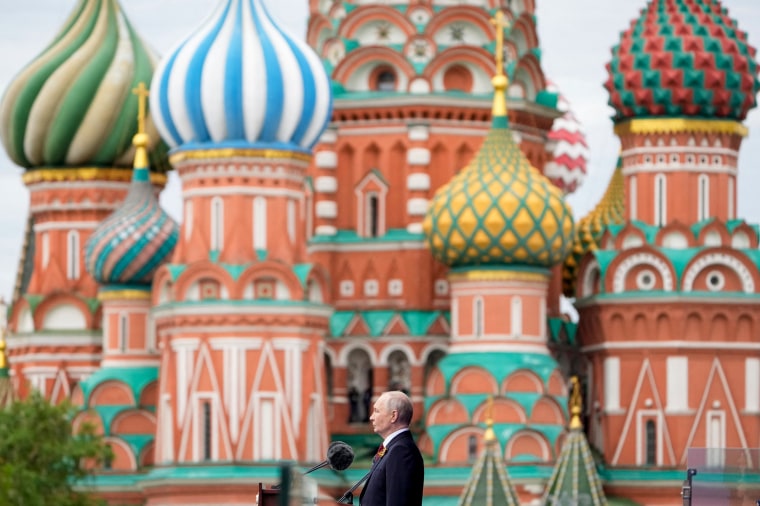
Instead, the parade was brief, with Russian President Vladimir Putin appearing amid tight security after a U.S.-led three-day ceasefire eased some concerns about Ukraine disrupting the occasion with drone attacks.
“Victory has always been and will be ours,” Putin said, addressing columns of troops. He vowed to fight on in Ukraine against “an aggressive force that is armed and supported by the entire bloc of NATO.”
More than four years into the war in Ukraine, Russia’s defense ministry last week cited the “current operational situation” as it announced the parade would be scaled back. A large amount of Russia’s military hardware is tied up in the conflict, but there were also signs the Kremlin was worried about the risk of Ukrainian drone attacks, and what appears to be Moscow’s diminishing ability to stop strikes deep inside Russia.
Ukraine’s Volodymyr Zelenskyy on Friday gave specific assurances that there would not be a strike on the event in Moscow’s Red Square, under the temporary ceasefire deal that includes a prisoner exchange to free 1,000 Ukrainian prisoners of war.
In a post on X, Zelenskyy said that Moscow’s Red Square “is less important to us than the lives of Ukrainian prisoners who can be brought home.”
Atypically, his statement came alongside a presidential decree specifying that “taking into account numerous requests,” there would be no attack on Moscow “to permit the holding of a parade.”
Kremlin spokesman Dmitry Peskov shrugged off Zelenskyy’s decree as a “silly joke.” “We don’t need anyone’s permission to be proud of our Victory Day,” Peskov told reporters.
Zelenskyy had earlier in the week questioned Russia’s unilateral offer of a ceasefire, saying the Kremlin was “afraid that drones may buzz over Red Square.” Russian officials interpreted his words as a threat to strike the parade, threatening to retaliate for any attack with a “massive missile strike on the center of Kyiv.”
President Donald Trump took credit for the three-day ceasefire deal in a Truth Social post on Friday, saying: “This request was made directly by me, and I very much appreciate its agreement by President Vladimir Putin and President Volodymyr Zelenskyy.”
Trump expressed hopes the deal could be “the beginning of the end” of the war, but Peskov downplayed those hopes on Saturday.
“It is understandable that the American side is in a hurry,” he said. “But the issue of a Ukrainian settlement is far too complex, and reaching a peace agreement is a very long way with complex details.”
Except for fighter jet flybys, Russia showed off little hardware on Saturday, but there were new appearances on the marching ground.
North Korean troops marched in the parade for the first time, a visible sign of Moscow’s deepening partnership with Pyongyang that has resulted in the deployment of over 10,000 troops to fight the war in Ukraine, according to Kyiv and Seoul estimates.
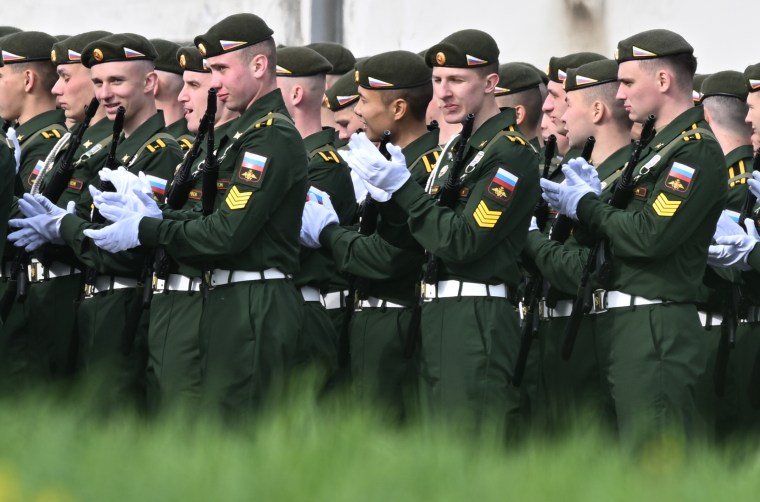
Military officers with the newly established Russian military drone forces were also present.
Ukrainian drone strikes have become an increasing headache for Putin. Days ahead of the parade, a Ukrainian drone crashed into a building just four miles away from the Kremlin.
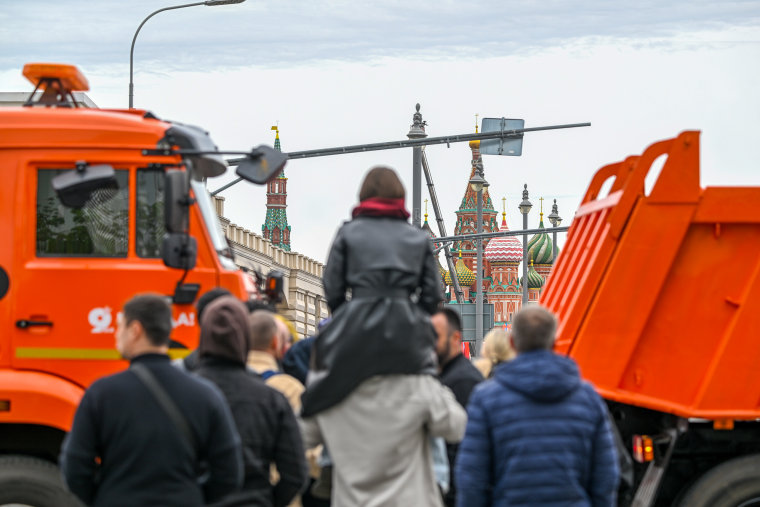
The Kremlin said “additional measures” would be taken to protect Putin during the parade, and authorities had warned about mobile internet outages in the capital to “ensure the safety of Victory Day celebrations.”
In other Russian cities, local Victory Day parades and celebrations were canceled or scaled down out of “security considerations.”
Across his years in power, Putin has put a particular emphasis on the Soviet Union’s victory over Nazi Germany in what Russians call the “Great Patriotic War,” a grounding pillar of national identity.
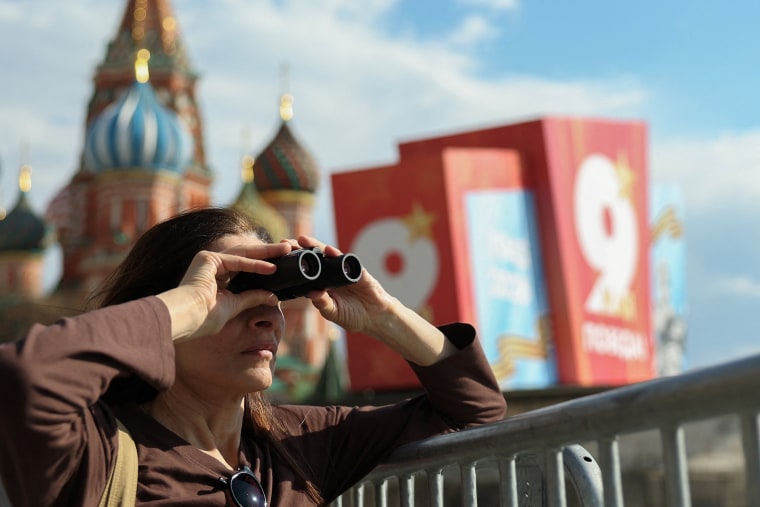
Putin himself reintroduced military hardware to the annual celebration back in 2008, showing off Russia’s stockpiles of tanks and munitions in a shift toward a more aggressive posture.
“It’s not saber rattling,” he declared then. “We don’t threaten anyone, we don’t intend to,” Putin said. “It’s a demonstration of our growing defense capabilities.”
Rena Marutian, a professor of global and national security at Taras Shevchenko National University in Kyiv, said that in 2008, Putin wanted the world “to start fearing Russia again and him personally as its leader.” Now, she said before the ceasefire announcement, “all these tanks, rockets and columns of military equipment” have turned from a projection of strength into “a target.”
For most Russians, May 9, the date when the Soviet Union signed Germany’s capitulation in 1945, holds huge sentimental value, with nearly every family touched by the war that claimed roughly 27 million Soviet lives. But under Putin, the Russian government has chosen to concentrate on the spectacle of the parade over solemn commemoration.
“It’s a holiday that has always been widely celebrated in Russia, but Putin has appropriated it,” said political analyst Kirill Rogov, who runs Russia-focused think tank Re: Russia. “And in that sense, this holiday has become Putin’s holiday, and that of his militaristic and imperialist politics.”
The Kremlin has also tried to symbolically link its victory over Nazi Germany to its war in Ukraine, portraying the fight with Kyiv as the continuation of its struggle against fascism. Russian soldiers fighting in Ukraine have taken part in the Victory Day parades in Moscow since the 2022 invasion.
Ukraine previously warned a handful of Russia’s allies planning to attend the festivities in Moscow against being in the capital on May 9, while Russia warned people to avoid Kyiv as it threatened retaliatory strikes there.
Speaking before the ceasefire announcement, Kyiv resident Anna Kalitvetseva told NBC News she was worried about retaliation from Russia on May 9, although she said there is hardly anything, “short of a nuclear weapon,” that Russia can do to surprise the capital’s residents with after years of deadly strikes.
While her grandfather and uncle died in World War II and May 9 has always been an important day for her family, Kalitvetseva, 52, said the “pure evil” of Putin’s invasion has left her indifferent to Russia’s Victory Day celebrations.
Ukraine marked its own Day of Remembrance on Friday, having shifted since Russia’s invasion to adopt the date commonly celebrated on the continent as Victory in Europe (VE) Day. Millions of Ukrainians were part of the Soviet forces who fought during the war, suffering steep casualties.
There are definitely “traces of paranoia” in Putin’s actions around the parade and request for a ceasefire, Rogov said. “I think he has been greatly impacted by the killing of [Supreme Leader] Ali Khamenei and the leadership of Iran. It has shown the vulnerability and possibility of such a step,” he added. “Clearly, something has shifted for Putin in his perceptions.”
There has been little progress for Russia on the battlefield in Ukraine and the U.S.-mediated peace talks remain stalled. While criticism of Putin is rare in Russia, a growing wave of public discontent has spilled out in recent weeks, including through some of the country’s influencers, against the country’s ailing economy, soaring prices and tightening restrictions on what Russians can do online.
Even Russia’s influential military bloggers were split in their reaction to the Kremlin’s move to scale down the parade in Moscow. Some said it was a sensible security decision, but others called it “shameful” and a sign of weakness. “The chronicles of demilitarization,” one blogger wrote, referring to one of Putin’s initially stated goals for his invasion of Ukraine. “This is such a disgrace!”
It’s unusual for Putin to project anxiety, so the scale-down of the Moscow parade and cancellations of Victory Day events elsewhere are surprising, said Sam Greene, a professor of Russian politics at King’s College London. “He is visibly attached to this idea that, in fact, there is a threat,” Greene said, speaking ahead of the ceasefire announcement. “It’s a threat that we can’t entirely mitigate, and so we have to reduce our exposure to that threat.”
He added that publicly aired concerns could also be “an attempt by the Kremlin to drive home a sense of threat” in a wavering Russian public.