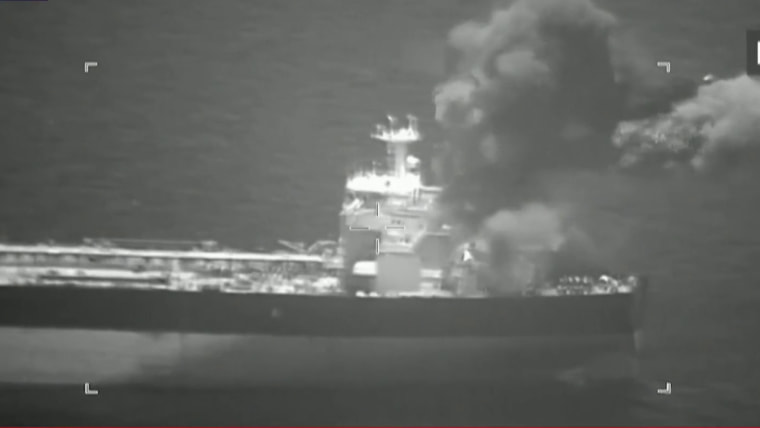
The U.S. and Iran exchanged fire near the Strait of Hormuz on Thursday, adding new strain to the ceasefire and raising questions about negotiations to end the war.
Hours later the United Arab Emirates, a key Gulf ally of the U.S., said it was responding to a missile and drone attack.
President Donald Trump said on Truth Social that the attacks happened as three U.S. military ships were transiting through the strait.
“There was no damage done to the three Destroyers, but great damage done to the Iranian attackers. They were completely destroyed along with numerous small boats,” he wrote.
In a phone interview Friday with NBC News, Trump said, “No” when asked if the conflict with Iran was over.
“It’s over when it’s over,” the president said. “But we certainly have won militarily. We have to get people to come out of the caves [in Iran] and sign something.”
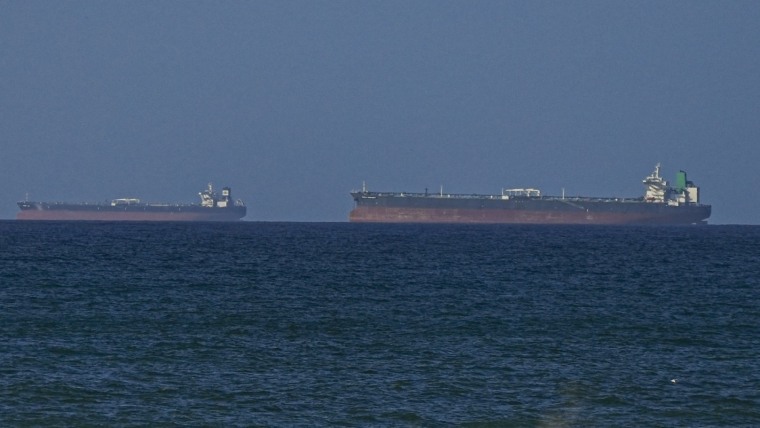
On Friday, U.S. Central Command said it had fired on two more tankers that allegedly violated its blockade of Iranian ports.
The attacks highlighted the fragility of the ceasefire in the area around the Strait of Hormuz, which 20% of the world’s oil used to pass through before the U.S. and Israel attacked Iran on Feb. 28.
No ships transited the strait Thursday, the second day in a row that the critical waterway has had no traffic at all, according to S&P Global Market Intelligence. It’s also the first time since March 12-13 that there have been two back-to-back days without marine traffic.
In the interview, Trump said of the critical waterway: “We really control it; they don’t. And we’ve taken the business away from them.”
There are “no boats going into Iran,” he added. “They’re dying.”
More important than bringing about an immediate end to the conflict is striking a deal that is in the best interests of the U.S., he suggested.
“I don’t want to get there if it means I can’t make the best deal,” he told NBC News. “I’ve got to make good deals. We’re pretty close.”
“There is another concept: Demolish the country and keep the oil,” Trump added. “I’ve said that for years.”
Asked if he might take that step, Trump said: “I don’t know. It depends.”
“If I thought I could do that politically, I would do that. I just don’t think the American people” would understand that rationale, he added.
Talks are continuing over U.S. efforts to end Iran’s nuclear program, the president said.
“We’re negotiating that,” he said. “I think we have a deal on a lot of these things.”
“But you know, they’re stone-cold crazy,” he added.
Secretary of State Marco Rubio told reporters on Friday that the U.S. expected a response from Iran.
“We should know something today. I mean, we’re expecting a response from them. We’ll see what the response entails,” Rubio said. “The hope is it’s something that it can put us into a serious process of negotiation.”
A U.S. official told NBC News that the U.S. strikes in Bandar Abbas and Qeshm Island on Thursday were defensive and do not constitute a resumption of major combat operations against Iran.
U.S. Central Command said on X that three U.S. Navy guided-missile destroyers came under attack as they transited the Strait of Hormuz to the Gulf of Oman and responded with “self-defense strikes.”
CENTCOM said the Iranian military “launched multiple missiles, drones and small boats” at the vessels.
“No U.S. assets were struck. U.S. Central Command (CENTCOM) eliminated inbound threats and targeted Iranian military facilities responsible for attacking U.S. forces including missile and drone launch sites; command and control locations; and intelligence, surveillance and reconnaissance nodes. CENTCOM does not seek escalation but remains positioned and ready to protect American forces.”
The Iranian military said it fired at U.S. military ships only after the U.S. military violated the ceasefire and attacked an Iranian oil tanker.
“The invading, terrorist and pirate U.S. military violated the ceasefire by targeting an Iranian oil tanker moving from Iran’s coastal waters in the Jask area towards the Strait of Hormuz, as well as another vessel entering the Strait of Hormuz opposite the port of Fujairah in the United Arab Emirates,” said the spokesperson for Iran’s Khatam al-Anbiya military command headquarters, according to the semiofficial Mehr news agency.
The spokesman also said the U.S. had carried out air attacks on “civilian areas” along Iran’s coast and Qeshm Island.
Iran’s state-owned Press TV later reported that following the exchange of fire, the situation on Iran’s islands and in coastal cities near the Strait of Hormuz was “back to normal now.”
Separately, the State Department announced in a statement on Friday that it was sanctioning three Chinese “entities” for “providing satellite imagery that enables Iran’s military strikes against U.S. forces in the Middle East.”
The State Department added, “The United States will continue to take action to hold China-based entities accountable for their support to Iran and ensure Iran cannot reconstitute its proliferation-sensitive programs following Operation Epic Fury.”

