BEIJING — Old Cheng was waiting patiently at the bottom of a steep mountain ridge as the minivans carrying our news team snaked their way through the Yan mountains to meet him. The 70-year-old native of Huairou, a district north of Beijing, had agreed to take us up a hiking trail to one of the so-called wild sections of the Great Wall.
Even at 9 a.m., when we emerged from our vehicles blinking in the mid-May sun, the heat was beating down hard as everyone strapped on their backpacks, checking their water supplies as often as their cameras.
For the next two hours, led by Cheng in a shiny red safety helmet and a bright blue work vest, the team made its way across a flat road that quickly morphed into a vertical, narrow dirt path strewn with loose stone and rock. Three mules ferrying bags of cement clambered past us on their own dirt track that ran shorter and even steeper up to the top.
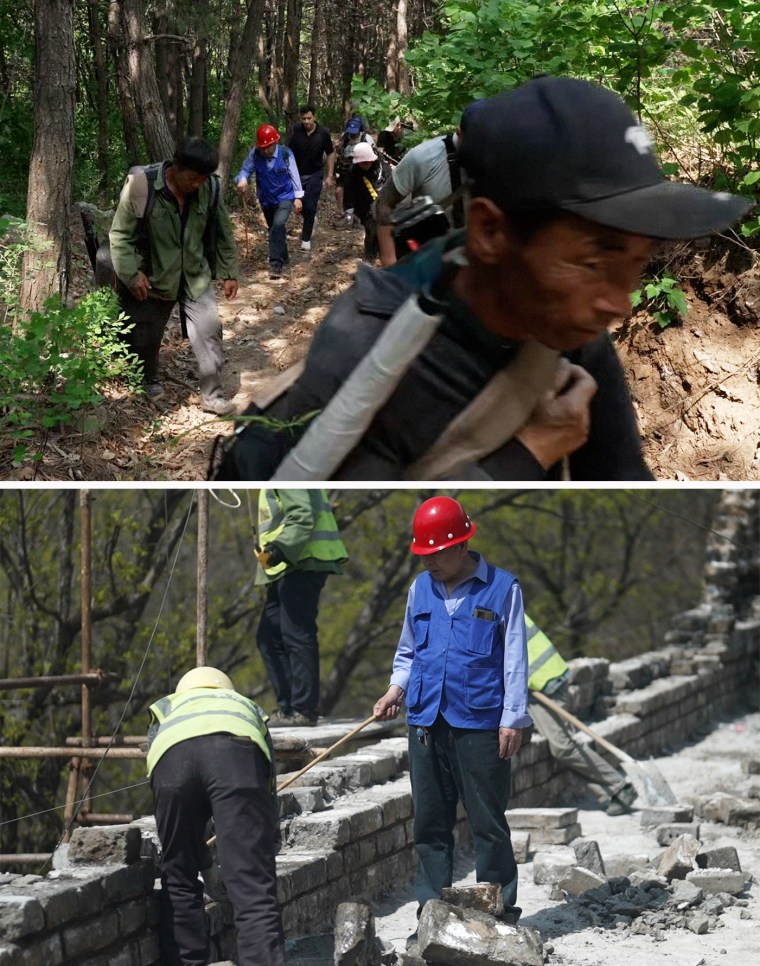
Mosquitoes buzzed in and out of faces as everyone bent over to balance their footing against the steep angle. Shards of sunlight beamed through a canopy of deciduous oak, mixed in with pine trees, that protected the trail from overwhelming heat. But rivulets of sunblock still ran down everyone’s necks.
Old Cheng, however, did not break a sweat with his steady, meditative pace. He stopped only when a crew member paused to film something, taking the opportunity to fish out a slightly wrinkled pack of Chunghwa cigarettes from inside his cotton vest. One hand would hold the lit cigarette, the other a trekking pole — the one concession to his age.
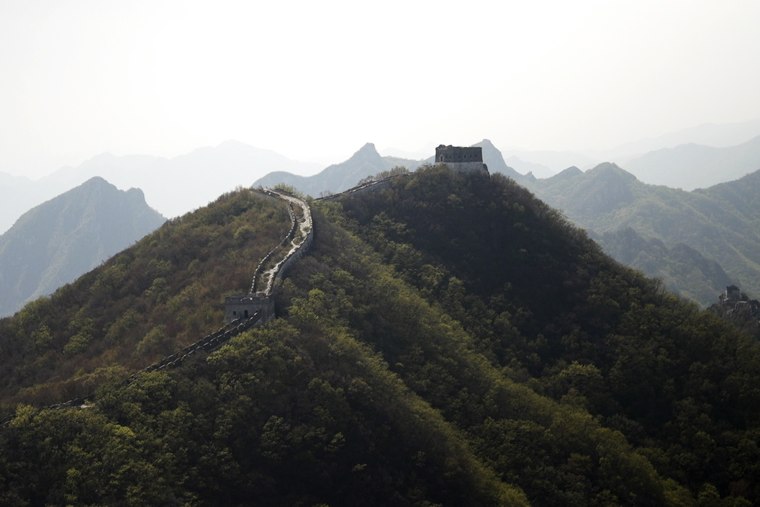
For the past two decades, Old Cheng, whose full name is Cheng Yongmao, has been helping restore this section of the Great Wall. Not many people realize it, but the 13,000-mile-long wall is not, in fact, one contiguous structure but many segments built over several dynasties — from the Qin to the Qing — spanning about 2,000 years.
Jiankou is among the wall’s “younger” sections, built in the Ming Dynasty — starting around 1368 and reinforced with brick and stone sections throughout the dynasty’s 276-year reign.
As a technical adviser to the restoration project— a combined state and local volunteer effort — Old Cheng has dedicated his retirement to saving and restoring more than 13 miles of the Jiankou segment.

“It’s my life’s calling,” he told NBC News, saying he carries the responsibility to protect this precious national heritage.
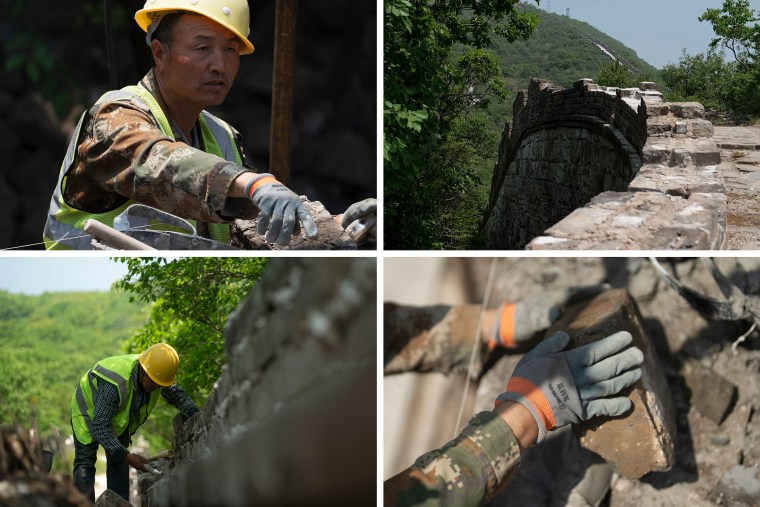
Well before he earned the diminutive Old Cheng, he started as a bricklayer in 1973. He was 18 years old and apprenticed under his uncle to learn masonry. “Being able to master a skill is something to be proud of,” he said.
Over 10 years, Cheng mastered techniques not only for new construction but also for small-scale traditional buildings in a folk style. In 1991, he became a founding member of the Ancient Architecture Company of Beijing Huairou Construction Corp.
The company’s first conservation project was the Main Hall of the Hongluo Temple, a Buddhist temple in northern Beijing. Cheng was put in charge of the masonry work, and it was here that his story with ancient architecture began.
Cheng later sought guidance from Piao Xuelin, a 15th-generation descendant of the Xinglongmen masonry tradition (of the Jing generation), learning about material processing, construction methods and operational techniques for ancient building masonry. Xinglongmen was one of the workshops that helped build and repair the Forbidden City and other imperial buildings during the Ming and Qing dynasties.
Thanks to his solid foundational skills, Cheng quickly earned Piao’s recognition and became the 16th-generation inheritor of the Xinglongmen masonry tradition, receiving the master’s true teachings.
In 2004, Cheng took on his first large-scale Great Wall restoration project — the Huanghuacheng section in Huairou. His repair expertise has taken him from Huanghuacheng to other sections of the wall, including Mutianyu, Qinglong Gorge and Yaoziyu, and he finally started the restoration work in Jiankou in 2016.
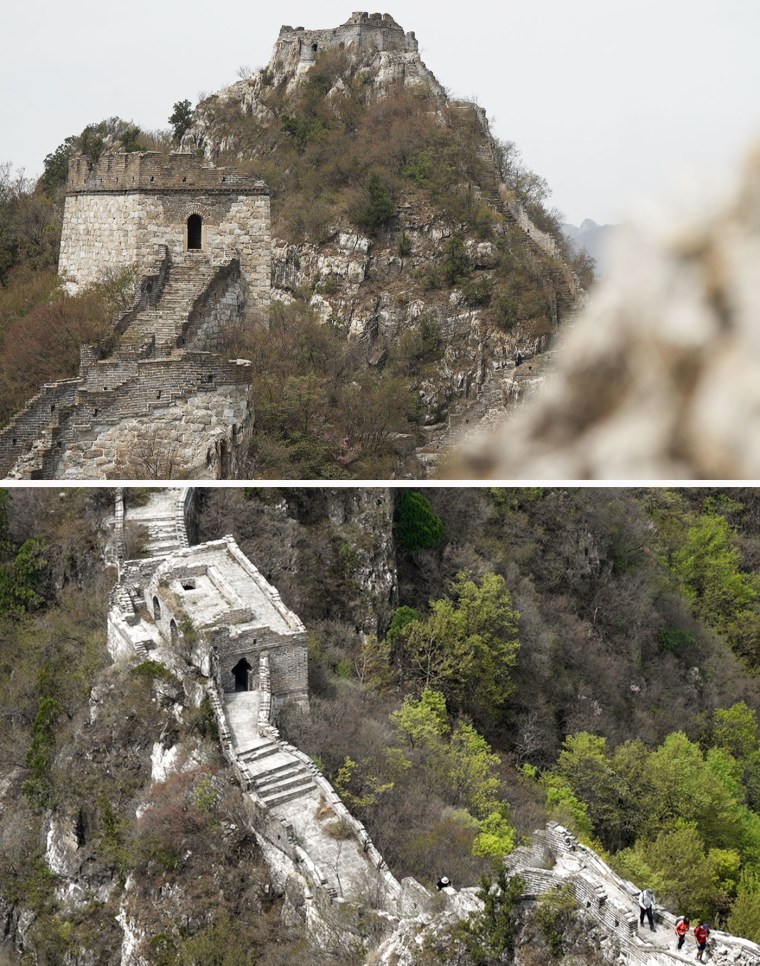
The second half of the hike felt like a straight vertical climb. The path finally flattened at the bottom of a watchtower covered on one side with steel scaffolding. The three mules that had overtaken the group a mile earlier had finished resting, bags of cement removed from their backs, and were starting the climb back down.
Two Chinese hikers nimbly scaled up the scaffolding, and the NBC News team followed suit with all of its camera equipment.
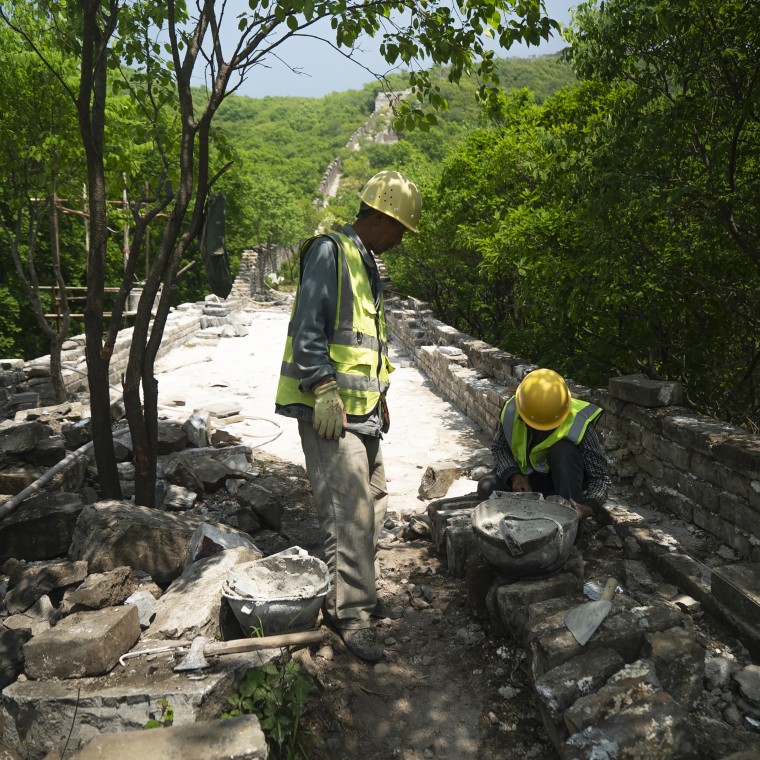
A minute later, everyone was rewarded with an impressive vista of the wall on either side of the watchtower. Bricklayers were repairing a segment of the tower and the small patch of flat ground. But they could not prevent the bursts of wild grass sprouting up between the stones.
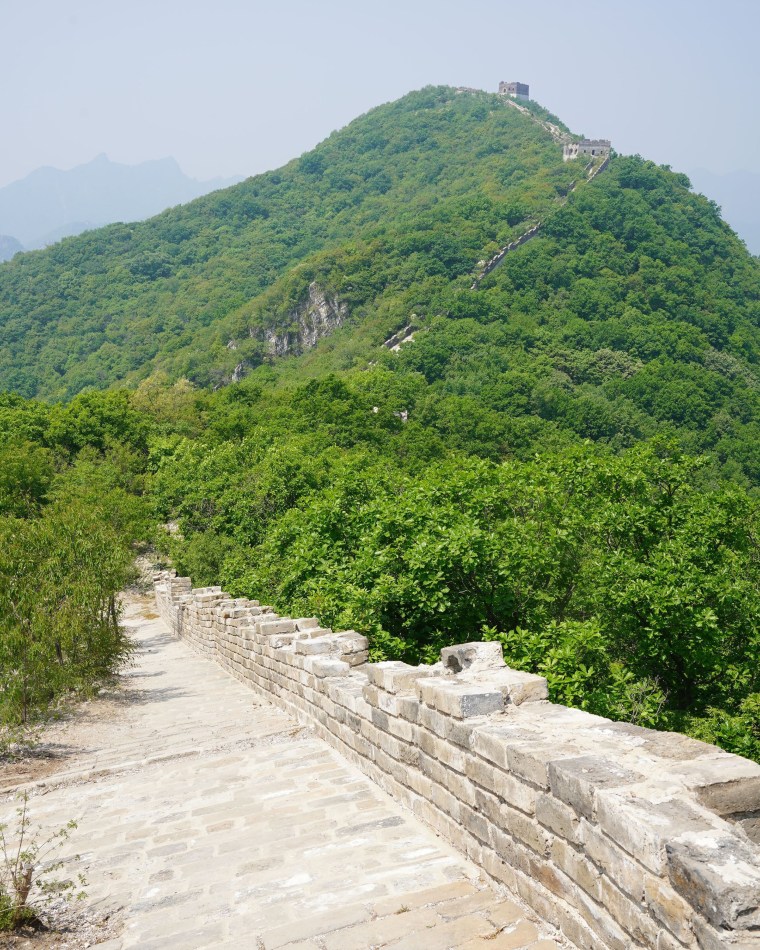
Cheng said that the Great Wall embodied the spirit of the Chinese nation and that the main principle for repairing it is “repair old to keep old.”
“Our ancestors left us this precious World Heritage site,” he said, “so we must protect it well.”
