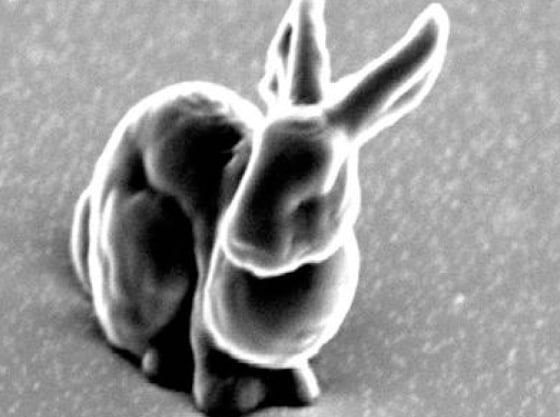
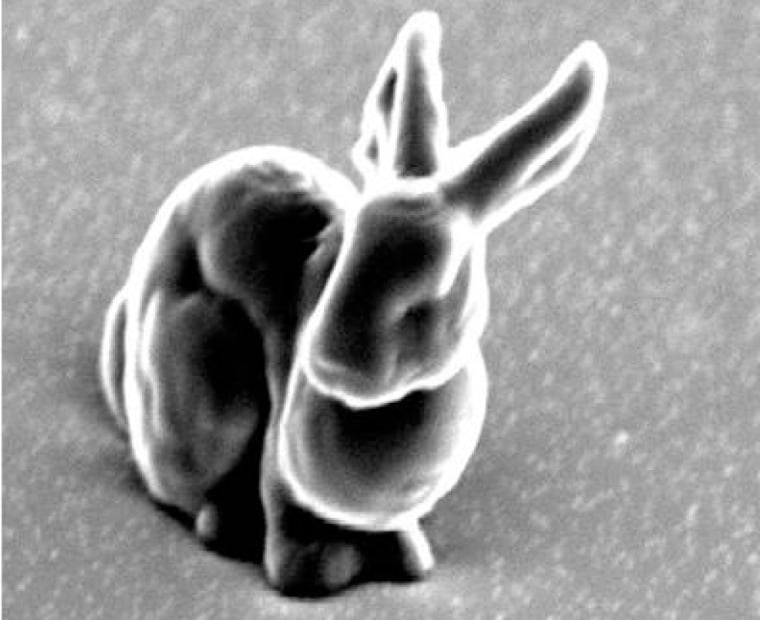
The tiniest bunny you will ever see is the size of a bacterium and a tough little fellow that has survived temperatures up to 800 degrees Celsius.
The photograph to the right is a scanning electron microscope image of a bunny sculpture that is about one-hundredth of a millimeter tall. It was created in Japan by scientists and engineers out of a new light-sensitive material. This bunny was shaped and solidified with a laser and then baked.
The material could by used for bioelectronics — as sensors and electrodes in the brain — or in batteries, the scientists say. They describe their technique in Wednesday's issue of Optical Materials Express.
Tinycarbon electronics are very good conductors. As a bonus, when it comes to electrodes that are implanted in the body, carbon plays along better than traditional electronics like silicon. The hard part is shaping the fickle carbon compounds, some of which are liquid resins, into structures that will make them useful as electrodes or energy stores.
By sculpting a bunny and an assortment of other 3-D shapes including a flat platform, and tiny pyramids, the engineers showed that the stuff could be molded using existing technology, and remained stable, even if the end result is ... oddly shaped.
Nidhi Subbaraman writes about technology and science. Follow her on Facebook, Twitter and Google+.