If you've ever played a game on your smartphone, it was probably something like like "Angry Birds" or "Temple Run" — seemingly simple apps that can be enjoyed in short spurts. Recently, the runaway success of flinging birds at cartoon pigs has attracted game industry heavyweights like Activision and Electronic Arts to the mobile playing field as well. But as bigger and bigger publishers flock to the emerging market, many gamers and developers who'd rather play "World of Warcraft" for 10 hours than "Candy Crush Saga" for 10 minutes are still hoping that some knight in shining armor will come in to save them from a dystopian future where the only games being made are different proprietary versions of "FarmVille."
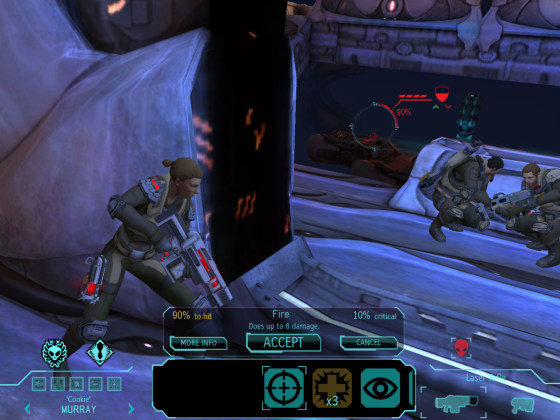
That's exactly what 2K Games is trying to do with "XCOM: Enemy Unknown," a title that's synonymous with the hardest of hardcore gaming. A turn-based strategy game that pits humans against aliens, "XCOM" is so difficult it can scare away the uninitiated. And while the 2012 remake was critically acclaimed, it never achieved the popular appeal of other 2K console games like "BioShock Infinite."
So why, of all games, choose "XCOM" as your entry into a market where customers expect "Plants vs. Zombies?"
"It is important to remember that mobile games cater to a different audience than consoles," Jack Kent, a mobile analyst at IHS global insights, told NBC News. "Smartphones and tablets are not specialist games devices and as such are used to consume a wide variety of content and services so it makes sense that the nature of games — and the business models used to monetize them — differ from what is common on console."
Sales categories aside, porting a game like "XCOM" to a tablet actually makes perfect sense, simply because the isometric viewpoint of a strategy game suits the board game-y feel of an iPad.
"Optimizing the controls for a touch interface seemed like a natural fit for a game like 'XCOM: Enemy Unknown,'" a representative from 2K told NBC News. "The game works very well with the 'game anywhere' style of titles that are so popular on iOS, with the turn-based approach lending itself to players who may be on the go."
For someone who can't really handle the game's crushing difficulty, I'm still a big fan of "Enemy Unknown." But like many people who enjoyed the game and were pleasantly surprised by its transformation into an effective console title (the originals were strictly PC games, which, again, leant itself to their arcane mystique), I didn't really believe that a game that required such tact and precision could work on a tablet.
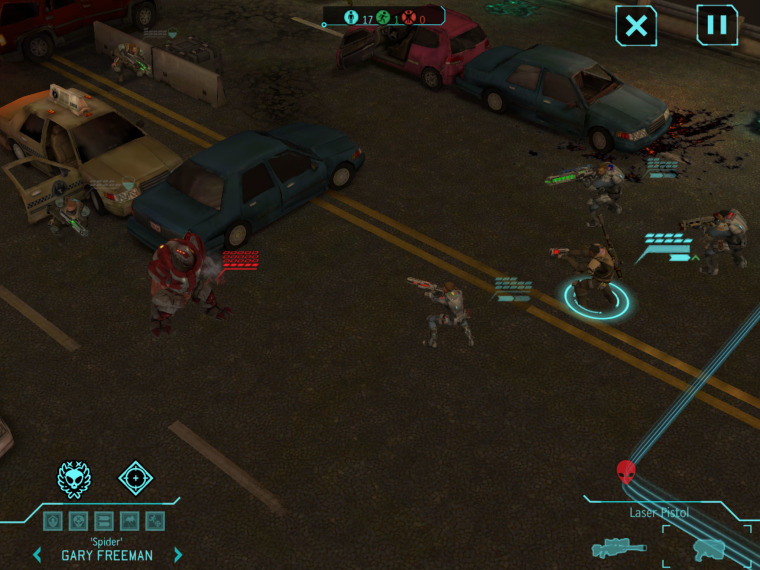
But weirdly enough, it does. I played through the first two levels of "XCOM's" single player campaign last week on an iPad, and except for some initial awkwardness transitioning to a touch-screen interface, it still felt like the same game. Rather than having to press X or Y to select a soldier and send him towards the enemy, I was simply able to touch down on the character himself and slide my finger across the screen to direct him. Firing rockets or chucking grenades at aliens was just as easy.
The only real drawback was that the screen, even for a full-sized iPad, still felt cramped. I can't imagine what it would be like to try to play the game on a screen as infinitesimal as an iPhone, though 2K and "Enemy Unknown" developer Firaxis is also making that an option.
But as fun as "XCOM: Enemy Unknown" is, 2K may face a bigger problem than the tininess of the screens on which prospective customers can play. While the publisher didn't give specific information about the price or release date of the iOS port, it emphatically said that any new version of "XCOM" will not be a freemium app. That means no free downloads, and no microtransactions.
Given how critical of free-to-play game design Firaxis co-founder Sid Meier sounded in a recent interview with NBC News, this makes sense from a creative standpoint. But analysts like Kent worry that it bucking the general commercial trends of the mobile ecosystem will limit any reach that a game like "XCOM" could have.
"With hundreds of thousands of titles available via application stores, most developers have little choice but to embrace the freemium model since it is extremely hard to get consumers to part with their cash up front with out knowing what to expect," Kent said. "This is not to say that premium paid downloads will go away, established developers with popular brands and well known IP will still be able to succeed, albeit in a niche part of the wider multi-billion dollar mobile games market."
But, Kent concluded, "the vast majority of mobile games revenues — over 80 percent — will come from freemium in-app purchases rather than paid downloads."
Yannick LeJacq is a contributing writer for NBC News who has also covered technology and games for Kill Screen, The Wall Street Journal and The Atlantic. You can follow him on Twitter at @YannickLeJacq and reach him by email at: ylejacq@gmail.com.