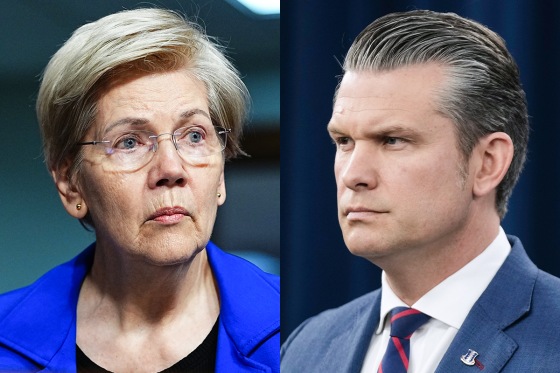
Sen. Elizabeth Warren, D-Mass., sent a letter to Defense Secretary Pete Hegseth on Monday demanding information about the Pentagon’s reported decision to give Elon Musk’s xAI access to classified networks.
In the letter, Warren raised concerns that xAI and its AI-powered chatbot, Grok, could present critical safety and reliability risks to America’s military. Warren cited the possibility that Grok could leak classified information to adversaries, be manipulated based on biased or inaccurate data, or lack critical safety controls and put service members in danger.
“I am concerned that Grok’s apparent lack of adequate guardrails could pose serious risks to the safety of U.S. military personnel and to the cybersecurity of classified systems,” Warren wrote in the letter, seen by NBC News, “especially if Grok is given sensitive military information and access to operational systems.”
“It is unclear what assurances or documentation xAI has provided to the Department of Defense about Grok’s security safeguards, data-handling practices, or safety controls, and whether DoD has evaluated those assurances before reportedly allowing Grok access to classified systems,” Warren wrote.
In late February, the Pentagon and xAI reached a deal that would pave the way for xAI’s systems to be used on classified networks, according to Axios, citing an anonymous Defense Department official. The announcement came in the middle of the Pentagon’s rupture with rival AI company Anthropic, which had insisted on stronger guarantees that the Pentagon would not use its AI systems for domestic surveillance or direct use in deadly weapons.
It is unclear whether xAI’s reported deal with the Pentagon allows for a wider range of uses than Anthropic’s proposed contract. In her letter, Warren requested a full copy of the agreement reportedly reached between the Defense Department and xAI.
In July, xAI received a contract worth up to $200 million from the Pentagon to develop new AI applications for the Defense Department. In a statement, the military’s Chief Digital and Artificial Intelligence Office said the deal would “broaden DoD use of and experience in frontier AI capabilities and increase the ability of these companies to understand and address critical national security needs.”
In recent months, xAI has come under intense scrutiny at several government agencies, according to The Wall Street Journal, due to concerns about the safety and reliability of its Grok services. The Journal reported that the Pentagon had previously raised concerns about Grok and “questioned whether it was aligned with government ethics and standards.”
In late December and early January, xAI received widespread attention for Grok’s ability to manipulate images of people, primarily women and children, to remove subjects’ clothing. The phenomenon prompted California’s Attorney General Rob Bonta to launch an investigation into the company, while countries including Indonesia and Malaysia banned Grok over the sexualized photos.
Grok has been framed by Musk as being more permissive and less “woke” than AI models from competitors like Anthropic, OpenAI and Google. These lower guardrails have led the chatbot to generate controversial or incendiary outputs at times, for example churning out antisemitic posts after a technical update in July. Similar comments from Grok in November prompted the French government to open an inquiry into xAI.
In February, the European Union’s data privacy office launched an investigation into X, the social media platform closely associated with Grok and xAI, over concerns that X was spreading sexualized AI-generated images of women and children.
Musk called similar moves in February from the Paris prosecutor’s office “a political attack.”
Warren’s letter asked Hegseth to share how the Defense Department plans to mitigate the risks of inaccurate responses and other safety shortcomings, along with all communications that led to the reported agreement.
Warren asked for an unclassified reply by March 27.
