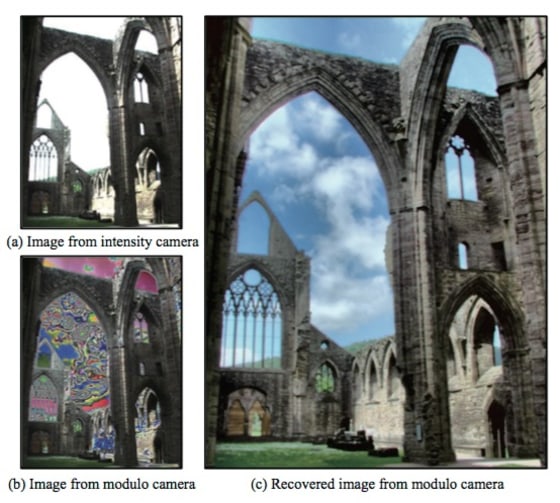
A new type of camera technology developed by the MIT Media Lab may put an end to overexposed photos. Camera sensors are covered in tiny pixels that measure the amount of light that falls on them — and when too much light comes in, it renders a pixel totally white in the final photo.
Exposing a picture so this doesn't happen can be tricky when there is, for example, a bright sky behind a dimly lit face or object. But the MIT device, which creator Hang Zhao calls a "Modulo camera," never lets a pixel "fill up" when there's too much light.
Related: Canon ME20F-SH Camera Can Take Full-Color Shots in Near-Total Darkness
A mathematical algorithm tracks how much those pixels would have been overexposed, and compares that with the rest of the scene. By doing so, it can reconstruct the parts of the image that would have been too bright, recovering a blue sky or reflection on a shiny object.
Right now it only exists in a lab-bound black-and-white camera, but the team believes the tech can be applied to ordinary cameras to produce the kind of results seen in the color simulations. A camera that never overexposes would be invaluable not just to ordinary photographers, but to engineers and scientists worldwide.
