Scientists say they have discovered the "missing link" to modern iguanas, a new species of lizard named Gueragama sulamericana that lived approximately 80 million years ago.
Nearly all of the 1,700 species of iguana today live in the Southern United States and South America. Its closest relatives, like the chameleon and bearded dragon, live exclusively in the "Old World," meaning Europe, Asia and Africa.
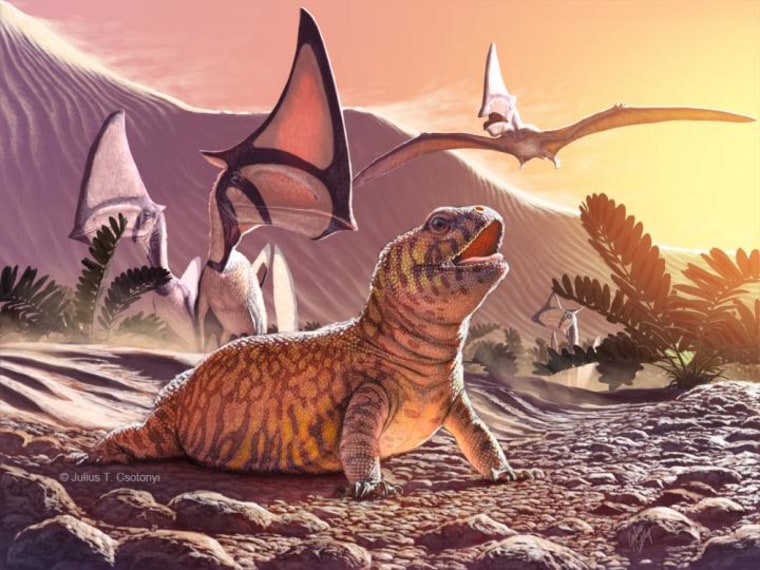
The newly identified ancient lizard was found by University of Alberta paleontologists in the state of Paraná in southern Brazil. It was an acrodontan -- meaning its teeth were fused to the top of its jaw -- like most Old World iguanians. The fact that it was found in the New World means it was probably a common ancestor to lizards on both sides of the Atlantic Ocean.
After the break-up of the supercontinent Pangea, the lizards on the Old World side developed into chameleons and other acrodontans, while the lizards on the New World side evolved into modern iguanas.
The study was published on Wednesday in the journal Nature Communications.
Iguanas were isolated in South America until about 5 million years ago, according to study author Michael Caldwell, when the continent bumped into North America and some lizards migrated north.
Related: Long-Necked 'Rain Lizard' Dinosaur Was Early Ancestor of Brontosaurus
"This is an Old World lizard in the New World at a time when we weren't expecting to find it," Caldwell said in a statement. "It answers a few questions about iguanid lizards and their origin."
