Editorial Standards

Latest News Today maintains rigorous editorial standards. Our team verifies information from trusted sources and provides context to help readers understand complex stories.

Last Updated: Sunday, May 17, 2026 at 04:31 PM
Category: Science

Editor's Note

Latest News Today provides comprehensive coverage and analysis of breaking news stories. This article is part of our ongoing coverage of what act rosetta probe spots rare balancing rocks comet n360951, bringing you verified information from trusted sources with added context and expert perspective.

Why This Matters: Understanding the full context of this story helps readers make informed decisions and stay updated on developments that impact our community.

What an Act! Rosetta Probe Spots Rare 'Balancing Rocks' on Comet

Three rocks on Comet Churyumov-Gerasimenko seem to be balanced on their tiptoes in a cosmic pas de trois, as seen in images from the Rosetta mission.
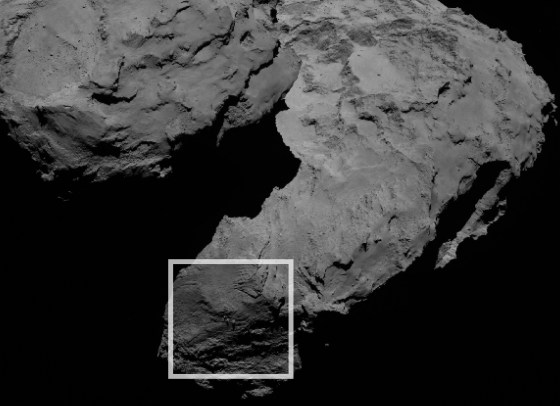
Image: Balanced boulders
An unusual formation of three balanced boulders can be seen in the Aker region of Comet 67P/Cheryumov-Gerasimenko, in a region highlighted by the white box in this image.ESA / Rosetta / MPS for OSIRIS Team

Three rocks on Comet 67P/Churyumov-Gerasimenko seem to be balanced on their tiptoes in a cosmic pas de trois, as seen in images sent back by the European Space Agency's Rosetta spacecraft.

One of the rocks measures 100 feet (30 meters) across, with its pointy end apparently perched on the rim of a small depression on the comet's surface.

Such balancing rocks are set into place naturally on Earth — either because they're pushed into position by glaciers, or because wind and water erode the ground beneath them while leaving the more resilient rock balanced on top.
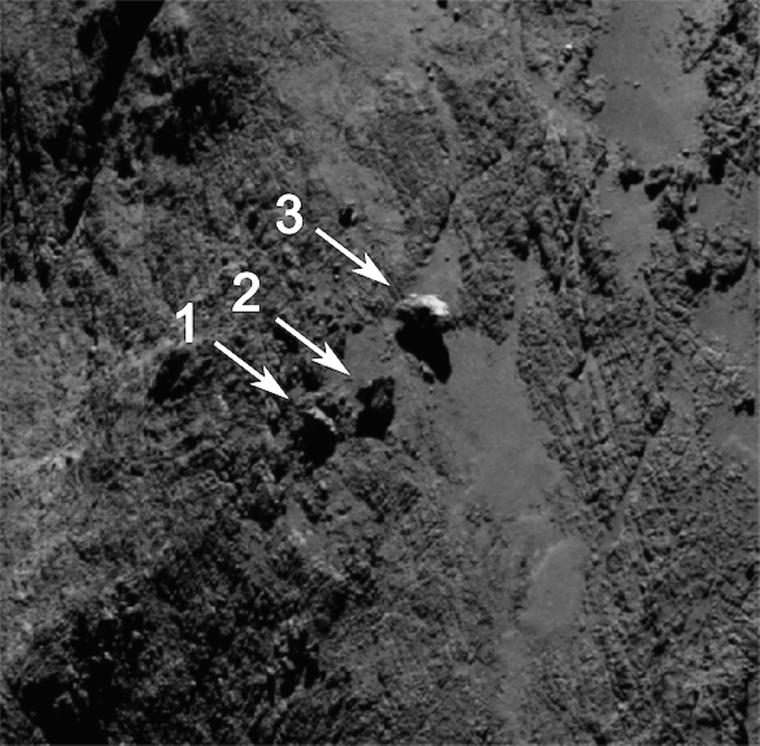
Image: Balanced boulders
This picture of the three balanced rocks was taken by Rosetta's OSIRIS camera from a distance of 18 miles (29 kilometers) on Sept. 16, 2014. Boulder 3 measures about 100 feet (30 meters) across.ESA / Rosetta / MPS for OSIRIS Team

"How this apparent balancing rock on Comet 67P/C-G was formed is not clear at this point," Holger Sierks, the principal investigator for Rosetta's OSIRIS camera, said in an image advisory issued Monday. The mission's scientists say cometary activity may have caused the boulders to roll into their seemingly precarious positions. The images were taken last August and September.

Churyumov-Gerasimenko is becoming more active as the comet nears the sun and warms up. Jets of dust and gas already have been seen rising from the surface. In the months ahead, Rosetta will be perfectly placed to watch the comet's transformation — and perhaps re-establish contact with the mission's hibernationg Philae lander as well.

Will the "Three Ballerinas" stay on their tiptoes as the comet rounds the sun, or will they tumble into the icy dirt? Stay tuned.
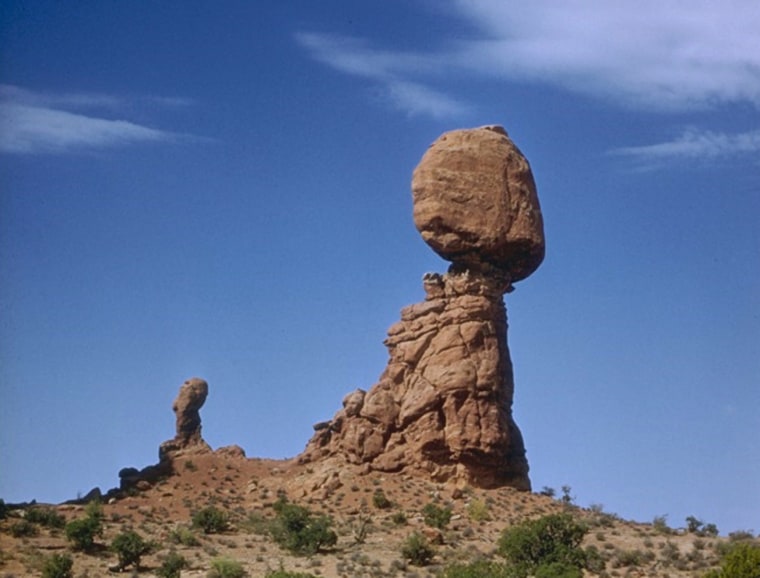
Image: Balancing rock in Utah
A balancing rock seems to perch on a pedestal in Utah's Arches National Park. Wind and water erosion have eaten away at the formation, but a layer of more resistant rock remains on top. Earthquakes can cause balanced rockst to topple, so the existence of balanced rocks on Earth suggests tectonic stability.John Lockridge / Longmont, Colo. / NOAA / NGDC