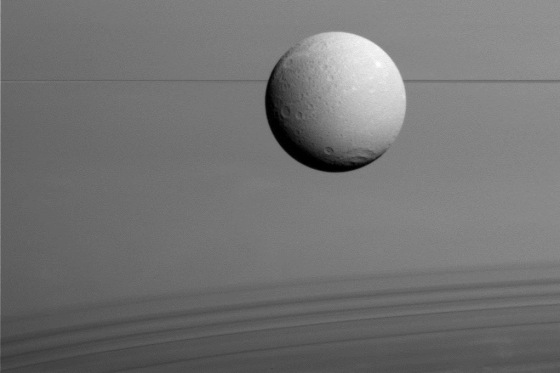
The Cassini spacecraft, which has been orbiting Saturn since 2004, has just taken its last look at the planet's icy moon Dione, resulting in some of the most extraordinary images from a mission famous for its extraordinary imagery.
Above, Dione is seen from a distance of about 45,000 miles with the rings of Saturn as its background. But the view from Cassini's narrow-angle camera is much more detailed:
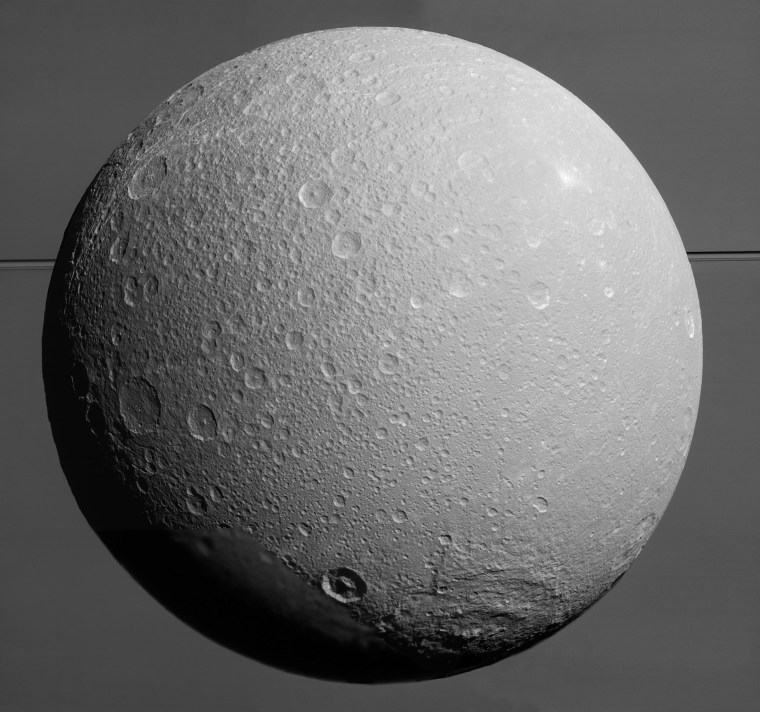
This composite of multiple images is close to the angle you might see if you were to look at Dione from Earth — though no telescope could ever resolve this much detail. The many craters and "wispy" surface features of the 700-mile-wide moon are clearly visible.
Related: Saturn's Spongy Moon, Hyperion, Gets Final Close-Up from Cassini Probe
Last is a shot taken from just 365 miles away from Dione, showing a region at the shadowy boundary between night and day. The overall view is from the wide-angle camera, but the high-contrast square above the middle is from the narrow-angle camera, which at this moment was taking the most detailed images ever of Dione's pocked surface.
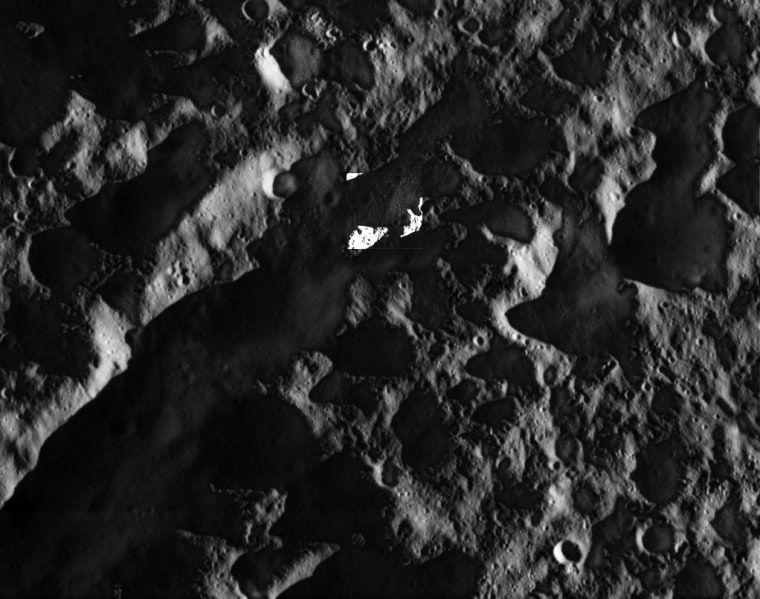
With a resolution of just 12 feet per pixel, you could make out a car or alien spacecraft if it was parked there.
The flyby was actually used to perform some gravity science intended to help understand Dione's interior before Cassini moves on. In October it will near the moon Enceladus, passing within an incredible 30 miles — close enough to "taste" the icy spray emerging from its surface. But this was the last time the probe will be putting Dione in the foreground.
Related: Enceladus' Ice-Covered Sea Gets Warm Enough for Life, Scientists Say
"I am moved, as I know everyone else is, looking at these exquisite images of Dione's surface and crescent, and knowing that they are the last we will see of this far-off world for a very long time to come," said the Space Science Institute's Carolyn Porco, Cassini imaging team lead, in a NASA news release.
"Right down to the last, Cassini has faithfully delivered another extraordinary set of riches. How lucky we have been."
