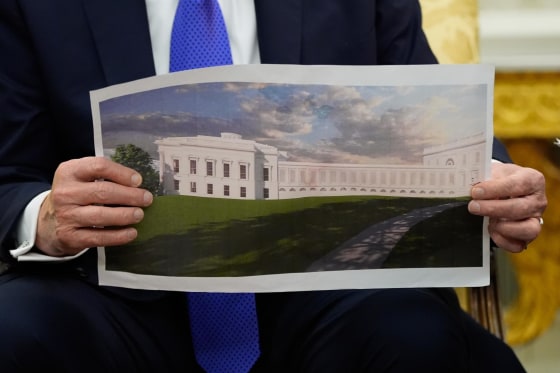
A GOP bill seeking $1 billion for the Secret Service to help finance President Donald Trump’s White House ballroom is in jeopardy as it faces pushback from a top Senate official.
The Senate parliamentarian, Elizabeth MacDonough, said Saturday that the budget bill, which aims to fund ICE and Border Patrol alongside $1 billion to help fund the ballroom, needs to be rewritten to account for jurisdictional issues.
“A project as complex and large in scale as Trump’s proposed ballroom necessarily involves the coordination of many government agencies which span the jurisdiction of many Senate committees,” MacDonough told Senate offices Saturday. “As drafted, the provision inappropriately funds activities outside the jurisdiction of the Judiciary Committee.”
The parliamentarian wrote that the bill would be subject to a 60-vote threshold to pass, meaning it can’t move forward with a simple majority, unlike similar bills advanced using budget reconciliation.
Budget reconciliation is a parliamentary tool used to get around the Senate’s 60-vote filibuster threshold, but it comes with restrictions on what provisions can be included.
The development is a blow to the Republican bill, but it is not the end of efforts to include ballroom funding. Senate Republicans had already been redrafting the provision’s language before Saturday’s ruling based on feedback from Senate officials, a GOP leadership aide told NBC News.
A spokesperson for Judiciary Committee Republicans also told NBC News that “conversations and revisions are continuing, as they have been for days.”
It’s not clear if Republicans can rewrite the provision in a way that would fully resolve the parliamentarian’s issues. The budget resolution detailing what can be included in the bill only allows language to originate from the Senate Judiciary Committee and the Senate Homeland Security and Governmental Affairs Committee.
If Senate officials again find the ballroom project falls under the jurisdiction of a committee other than those two, Republicans may be forced to leave that funding out of the bill, as they likely won’t find the 60 votes needed to overrule the parliamentarian.
Senate Budget Committee ranking member Jeff Merkley, D-Ore., said in a statement Saturday that “the American people shouldn’t spend a single dime on Trump’s gold-plated ballroom boondoggle.”
“While we expect Republicans to change this bill to appease Trump, Democrats are prepared to challenge any change to this bill,” Merkley said. “We cannot let Republicans waste our national treasure on a mission of chaos and corruption while turning a blind eye to the needs of the American people.”
Ryan Wrasse, a spokesman for Senate Majority Leader John Thune, downplayed the setback for the GOP bill Saturday.
“Redraft. Refine. Resubmit. None of this is abnormal during a Byrd process,” Wrasse wrote in a post on X.
The “Byrd process” refers to an informal process in which the parliamentarian reviews proposed budget reconciliation bills to make sure they comply with the Byrd Rule. That rule ensures provisions in a budget reconciliation measure are directly tied to federal spending and revenue, without extraneous additions.
Senate Budget Committee Chairman Lindsey Graham, R-S.C., did not immediately respond to a request for comment.
Some Senate Republicans had already shown hesitance toward the GOP plan to use $1 billion in taxpayer dollars to fund the ballroom project, which Trump had repeatedly touted would cost “no government funds.”
Republican senators were shown a proposal for the funding earlier this week that outlined $220 million to harden the White House complex, $180 million for a visitors screening facility, $175 million for training and another $175 million to enhance security for Secret Service protectees, according to a memo obtained by NBC News.
“I still got some more questions, and they’re going to send us more information,” Sen. Roger Marshall, R-Kan., said after the meeting. “I’m undecided.”
Sen. Rand Paul, R-Ky., and Sen. Susan Collins, R-Maine, both said that the project should be carried out with private funds, as Trump had initially promised.
Trump previously said the ballroom project would cost $400 million and be privately funded. Comcast Corp., the parent company of NBCUniversal, is one of the corporate donors.
The White House has said the requested taxpayer funds would be specifically earmarked for “security adjustments and upgrades” associated with the overall ballroom project.