
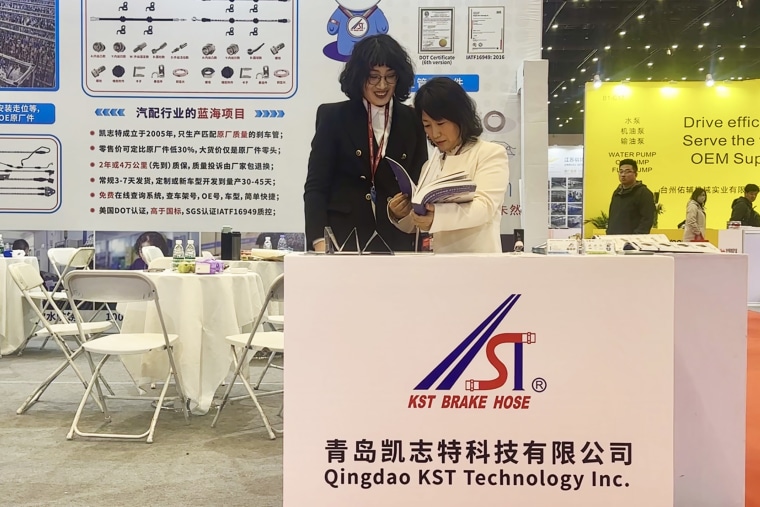
BEIJING — If you’ve ever fixed your own car brakes, the part you bought could very well have been made by Chinese auto parts supplier Judy Zhang.
Zhang’s company, which is based in the eastern Chinese city of Qingdao and supplies brake hoses for thousands of car models in the U.S., is among those targeted by a 25% U.S. tariff on imports of automobiles, including automobile parts, that is set to take effect Thursday.
That’s on top of a 25% tariff imposed during President Donald Trump’s first term, plus 20% tariffs he has imposed on Chinese imports since returning to office in January. On Wednesday, Trump announced an additional 34% levy on Chinese imports as part of “reciprocal” tariffs imposed on countries around the world, bringing the total combined tariff on Chinese goods to at least 54%.
Though Trump insists that China, among other countries, will pay for the U.S. tariffs, Zhang and other auto parts suppliers say that the tariffs will most likely be shouldered by American consumers and that they won’t bring manufacturing in their industry back to the United States.
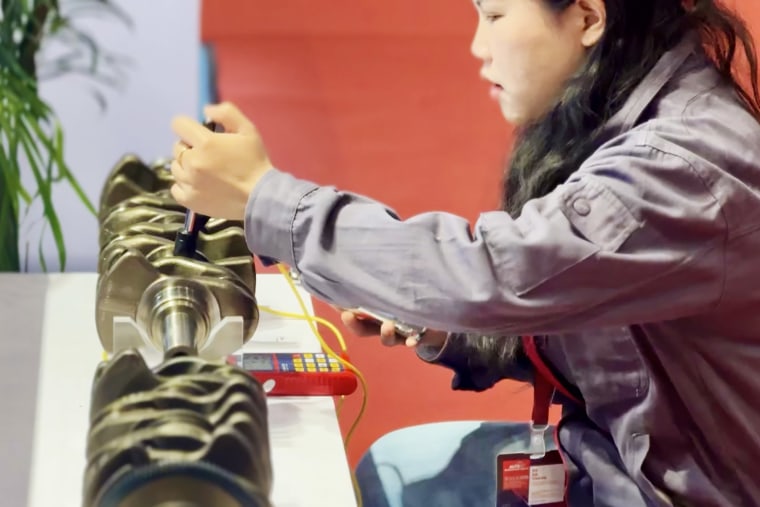
Zhang said she had managed to push the existing 45% duty on her products onto American customers.
“Very few manufacturers can do what we do,” she said in an interview Monday at an auto parts show in Beijing that drew 1,200 Chinese suppliers. “Or make as many types.”
Zhang said she would consider absorbing up to 15% of the new tariffs but only if her U.S. clients made bigger orders.
“If they want to keep doing the business (with us), they’ll have to absorb it and maybe increase their own price to consumers,” she said.
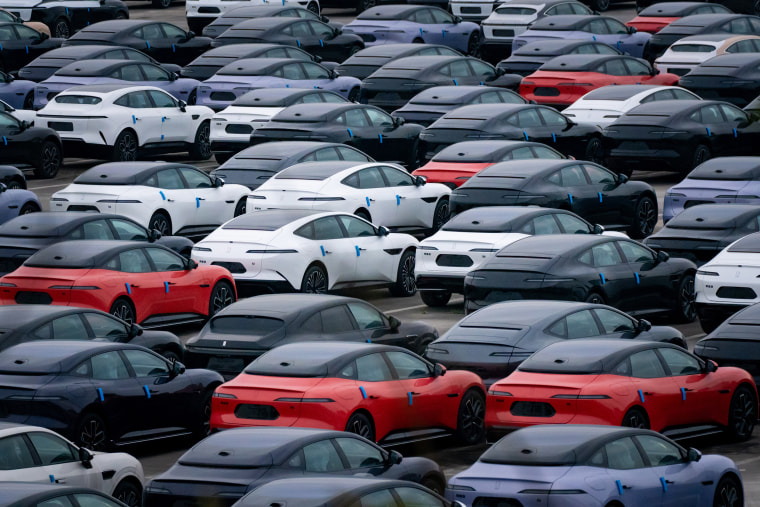
Though Chinese-made vehicles are not widely sold in the U.S., China is crucial to the American aftermarket, which serves customers looking to fix their own vehicles.
Auto parts stores such as AutoZone, O’Reilly and NAPA count on Chinese suppliers with their flexible production lines and cheaper labor to provide a broad range of parts at low cost — requirements not easily replaced by other countries.
“For Ford, GM, Toyota, BMW, every car that’s sold in the United States, you’re going to want parts for that,” said Jack Perkowski, founder and managing partner of Beijing-based merchant banking firm JFP Holdings. “The Chinese have gotten very good at figuring out how to make those parts differently, and tooling costs in China tend to be a lot lower.”
At a booth not far from Zhang’s, Gosven Zuo, who makes engine mounts for cars from Ford and General Motors, among others, said he was paying no more than 5% out of the 45% in U.S. tariffs.
His U.S. buyers have absorbed most of the cost of the existing tariffs, Zuo said, though he agreed to take some of the loss when Trump imposed an additional 10% tariff in February.
But the higher the tariffs go, the harder it becomes to push off the cost.
“We don’t have much room to compromise anymore, to be honest,” he said. “We are a manufacturer, we don’t have high margins.”
Zuo, who sells about 30% of his products to Americans, is trying to expand to new markets, looking for more buyers at home in China as well as in Europe and the Middle East.
“It’s partially because of the tariffs, but also what we need to do to survive as a factory,” he said. “All we know is we can’t take orders that make us lose money.”
While Trump says his tariffs will drive manufacturing from countries such as China back to the U.S., Zuo and others say that is unlikely.
“I have dozens of suppliers,” he said. “It’s not realistic to move them all to the U.S.”
Zhang also said she had no plans to avoid the tariffs by moving production to the U.S., especially when there is so much uncertainty around Trump’s policies.
“We aren’t a big company,” she said. “We can’t afford setting up an American factory. The cost is too much.”
Eunice Yoon reported from Beijing, and Peter Guo from Hong Kong.

