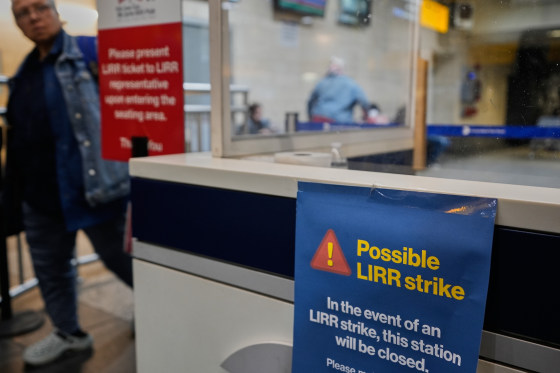
New York’s Long Island Rail Road, North America’s largest commuter rail system, was shut down Saturday after unionized workers went on strike for the first time in three decades.
Labor unions representing about half the system’s workers announced the walkout after negotiations with the Metropolitan Transportation Authority ended Friday without a new contract. The five unions, which represent about half the system’s 7,000 workers, including locomotive engineers, machinists and signalmen, are legally allowed to go on strike at 12:01 a.m. Saturday.
The railroad system, which serves New York City and its eastern suburbs, ceased operations just after midnight after five unions representing about half its workforce walked off the job.
“Avoid nonessential travel and work from home if possible,” the railroad service said in a post on X. “We will have limited shuttle bus service on weekdays for essential workers and those who cannot telecommute.”
Kevin Sexton of the National Vice President of the Brotherhood of Locomotive Engineers and Trainmen said no new negotiations have been scheduled.
“We’re far apart at this point,” Sexton said. “We are truly sorry that we are in this situation.”
The strike will force the roughly 300,000 people who ride the system each weekday to find alternative routes into New York City from its Long Island suburbs or to work from home. That means more cars on traffic-choked highways and longer work commutes.
“It’s gonna be such a nightmare trying to get in,” said Rob Udle, an electrician who takes the LIRR at least five days a week into Manhattan.
The strike will even make it challenging for some sports fans to get into Manhattan to watch the NBA’s New York Knicks playoff run or see the baseball rivals the New York Yankees battle the crosstown Mets this weekend.
Gov. Kathy Hochul has urged LIRR riders to work from during the walkout as the MTA plans to provide free but limited shuttle buses during the work day rush hours geared toward essential workers.
In a statement, she said she stands with LIRR riders “and will fight to preserve the long-term stability of the MTA,” adding that the rail system is essential for Long Island commuters. Hochul also criticized the unions’ decision to strike as “reckless.”
“These unions represent the highest paid workers of any railroad in the nation, yet they are demanding contracts that could raise fares as much as 8%, pit workers against one another, and risk tax hikes for Long Islanders,” Hochul said. “This is unacceptable. My priority is protecting affordability for riders and ensuring fairness across the workforce.”
On Friday evening, dozens of union picketers could be seen at Penn Station chanting: “What do we want? Contract! When do we want it? Now!”
One picketer, Duane O’Connor, said he feels “terrible” about the strike.
“This is going to hurt,” O’Connor said. “This is going to hurt the island, this is going to hurt the city, they think they can push us around and we’re supposed just fall in line. All we are asking for is fair wages.”
First LIRR walkout since 1994
The walkout, the first for the LIRR since a two-day strike in 1994, promises to cause headaches for sports fans planning to see the Yankees and Mets battle this weekend or to watch the Knicks’ playoff run at Madison Square Garden, which is located directly above the railroad’s Penn Station hub in Manhattan.
The railroad’s Manhattan hub, Penn Station, was devoid of its usual weekend bustle on Saturday afternoon. Only a few dozen people were seen traversing the main concourse, many dragging rolling luggage from departing or arriving Amtrak trains, which aren’t affected by the strike.
Departure boards normally showing upcoming trains by destination instead listed ghost trains marked “No Passengers.” A few signs affixed to customer service windows explained that the railroad was shut down because of a strike.
Access to platforms was blocked off with bicycle-rack style barricades and roll-down gates as MTA police officers stood sentry, directing people to alternative transportation.
Dispute over wages
The union has demanded a total raise of 16% over four years, saying it is needed to help workers keep up with inflation and rising living costs. The MTA argued that the union’s initial demands would lead to fare increases. The authority has agreed to a pay raise of at least 9.5% over the next three years, plus what would effectively amount to a 4.5% raise in year four.
“The difference between those two positions is not unbridgeable,” Gary Dellaverson, the MTA’s chief negotiator, suggested during a news conference Wednesday.
“The key question is: Will MTA and Gov. Hochul create frustration and gridlock for commuters, spend millions on buses during a strike and lose millions in revenue over what amounts to roughly a one percent difference in wages?” Nick Peluso, national vice president for the Transportation Communications Union, said in a statement.
One of the unions with members partaking in the strike, the Brotherhood of Locomotive Engineers and Trainmen, blamed the MTA and LIRR for the disruption, accusing management of refusing “the reasonable terms the government recommended multiple times.”
“We hope LIRR gets serious soon to avoid further unnecessary disruptions for hundreds of thousands of New Yorkers,” BLET President Mark Wallace said in a statement. “They know where to find us when they’re ready: on the streets.”
In a statement, MTA CEO Janno Lieber said the board has been clear that it “cannot responsibly make a deal that implodes MTA’s budget.”
“And we refuse to make a deal that puts it on riders and taxpayers to fund outsized wage increases — far beyond what anyone else at the MTA is getting — and for folks who are already the highest-paid railroad workers in the country,” Lieber said. “We cannot and will not do a deal that shifts huge costs to our riders by forcing fare hikes.”
Commuters brace for the worst
If the shutdown continues into the workweek, the roughly 250,000 people who ride the system to and from work each weekday will be forced to find other routes to the city from its Long Island suburbs. For many, that likely means navigating the region’s notoriously congested roads.
Susanne Alberto, a personal trainer from Long Island, said she has already made plans with her Manhattan clients to hold virtual sessions in the event of a shutdown.
She said the union likely has the upper hand.
“The MTA is going to cave, and they know that,” Alberto said. “Why don’t they just do it now instead of waiting until virtually millions of people get inconvenienced?”
Udle, the electrician, said he will likely use his vacation days rather than navigate the “nightmare” of commuting into Manhattan if the rail service shuts down.
A union member, he sympathized with the unions’ affordability concerns, but he said he didn’t agree with their strong-arm tactics.
“I get it, the cost of living is going up and stuff like that,” Udle said while waiting at Penn Station for a train home. “But they shouldn’t hold everybody hostage to do it. There’s a better way. You’re affecting a lot of other people.”
A strike was temporarily averted in September when President Donald Trump’s administration agreed to help with negotiations. Those efforts ended without a deal, giving both sides 60 days — ending 12:01 a.m. Saturday — to again try to resolve their differences before the union is legally allowed to go on strike or the agency could lock out workers.