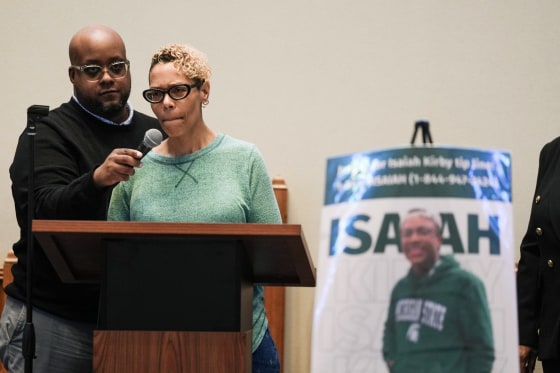
A Michigan State student appeared to be brandishing a knife and running toward officers when he was shot in multiple waves of police gunfire, according to body camera video of the deadly confrontation released Friday.
MSU senior Isaiah Kirby, a 21-year-old Maryland native, was killed on April 15 and Friday marked the first time video of the fatal gunfire was shown to the public.
East Lansing police were called to Lake Lansing and Abbot roads on a theft call that “evolved into a stabbing by a suspect, which turned into an officer-involved shooting,” the department has said.
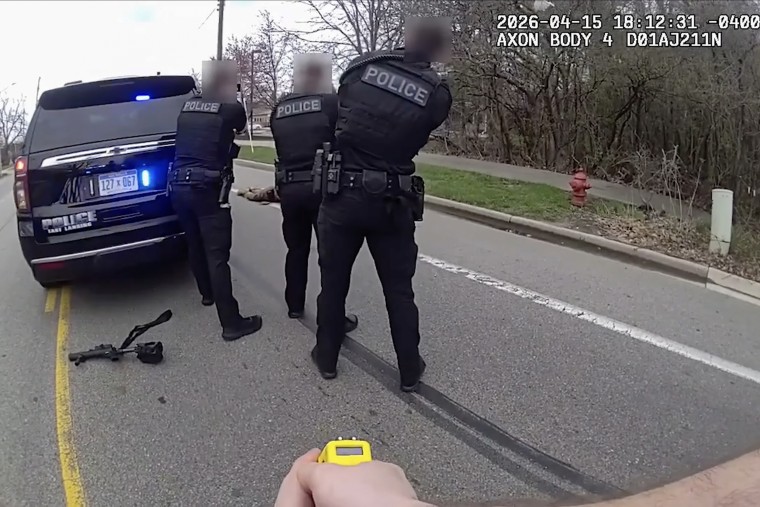
The officers’ video showed them driving to the scene when a man, identified by police as Kirby, came running toward them in the middle of the road. Kirby was brought down by an initial hail of gunfire as he came in their direction, video showed.
Kirby, screaming in agony, was on his knees as officers ordered him to drop a knife, according to video. Police then shot Kirby in two more hails of gunfire, with the first and last shots coming about 17 seconds apart, video showed.
Ed Obayashi, chief investigator for the district attorney’s office in Modoc County, California, who is not involved in Kirby’s case but reviewed the video, said he believes the first round of shots was justified.
Obayashi conceded the second and third rounds of gunfire could appear problematic to those outside of law enforcement.
“I get the perspective from a citizen’s point of view (that Kirby was wounded and not a threat) and it’s a valid, valid observation,” said Obayashi, who has served as an expert witness in use of force cases.
“But as I point out in my training and as courts have recognized consistently, officers are entitled to not to stop firing until they perceive that the threat has stopped.”
Teresa Bingman, an attorney for the Kirby family, said police did not need to use deadly force.
“After reviewing multiple complete, unedited body camera footage, dash camera footage and eyewitness videos, it is clear that Isaiah Kirby was met with an immediate and overwhelming use of deadly force,” Bingman said in a statement.
“Within moments of arriving on the scene, East Lansing police officers did not use non-lethal options and immediately fired more than 20 rounds.”
Kirby’s family was shown heavily redacted footage last week that the slain student’s loved ones said didn’t show why deadly force was necessary.
“The raw video is consistent with what Isaiah’s mother, Karyn Kirby, observed when she viewed her son’s body and reported seeing 17 gunshot wounds to his body, including gunshot wounds to his back,” Bingman’s statement said.
“After seeing the videos, we now believe that there were more than 17 gunshot wounds that will be revealed once autopsy results are released,” she said. “Nothing we have seen justified this extraordinary level of force that was neither necessary nor warranted under the circumstances.”
The Michigan State Police are continuing to investigate the use of force by East Lansing officers, officials said.
East Lansing police identified the four officers involved in the shooting: field training officer Beck Martin, who has been on the job for three years; two-year veteran officer Brennan Surman; officer Benjamin Saylor, who has been on the job for one year; and officer Zane Johnson Chasteen, who has been on the job for three months and was paired with Martin.
“I want to thank the officers and employees of the East Lansing Police Department for their continued professionalism during this investigation,” said East Lansing Police Chief Jennifer Brown, who narrated the video.
“Furthermore, I want to thank the East Lansing community for their patience and understanding as this investigation proceeds,” she said.