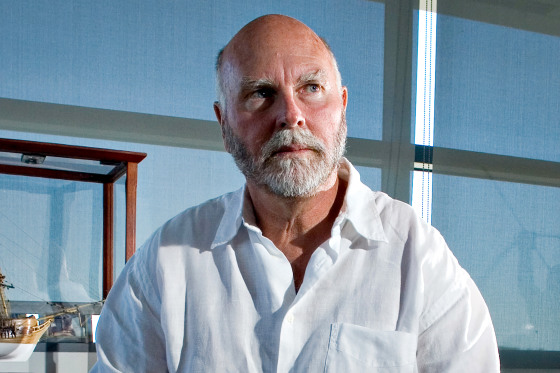
J. Craig Venter, one of the lead scientists in sequencing the human genome and a pioneer of modern genomics, died Wednesday, his research institute announced.
He was 79.
The J. Craig Venter Institute said in a statement that he died in San Diego after he was hospitalized because of complications related to cancer.
Venter was a revolutionary scientist who helped define modern genomics and consistently argued that scientific discovery should translate into “real-world impact,” his institute said. He also played a central role in launching the field of synthetic biology.
Venter was a Navy corpsman in Vietnam from 1967 to 1968. He later received a bachelor of science degree in biochemistry and a Ph.D. in physiology and pharmacology from the University of California, San Diego.
His most influential work centered on genomics. Venter “helped move genomics from slow, gene-by-gene discovery to scalable data-driven science — and then helped take the next step: demonstrating that genomes could be designed and constructed." his institute said.
Venter led the effort to produce one of the first draft sequences of the human genome. He later published, with colleagues, the first “high-quality” diploid human genome, highlighting the importance of capturing genetic variation inherited from both parents.
A human genome is a person's complete set of genetic information, stored as DNA within the nucleus of nearly every cell in the body, according to the J. Craig Venter Institute.
In the 1990s, Venter and a team at the National Institutes of Health developed expressed sequence tags, which allowed for the rapid discovery of new genes.
In 1995, Venter and collaborators used "whole-genome shotgun sequencing" to unravel the DNA sequence of the first free-living organism, the bacterium Haemophilus influenzae.
Venter then co-founded Celera Genomics in 1998.
His team at Celera entered a race against rivals to sequence the human genome. The primary competitor was the NIH–backed Human Genome Project, which was supported by both U.S. government funding and British research partners.
In 2000, when he was president of Celera, Venter and a public consortium announced that they had assembled the first draft of the human genome, a major milestone in biological science.
In addition to his contributions to genomics, Venter led the World Ocean Sampling expedition in metagenomics, revealing extraordinary microbial diversity.
Scientists around the world paid tribute to Venter and his extraordinary contributions to science.
“Craig Venter was a force of nature and a hugely important, though controversial, figure," Sir John Hardy, professor of neuroscience at University College London, said in a statement. "The race to complete the human sequence was a testosterone driven competition between the US and UK consortia ... there is no doubt that this competition speeded things up enormously and it ended really in a score draw with both sides publishing simultaneously in Science and Nature."
Dr. Roger Highfield, science director at the Science Museum Group, said Venter was "a swashbuckling, restless pioneer of genome sequencing and synthetic biology."
"I was emailing him only a few weeks ago about a new writing project," Highfield said in a statement. "He mentioned a new diagnosis, but the news still came as a shock. Craig was a divisive figure, but he had huge chutzpah and was always driven by the science.”
Venter received numerous honors, including the 2008 National Medal of Science, the 2002 Gairdner Foundation International Award, the 2001 Paul Ehrlich and Ludwig Darmstaedter Prize and the King Faisal International Award for Science.