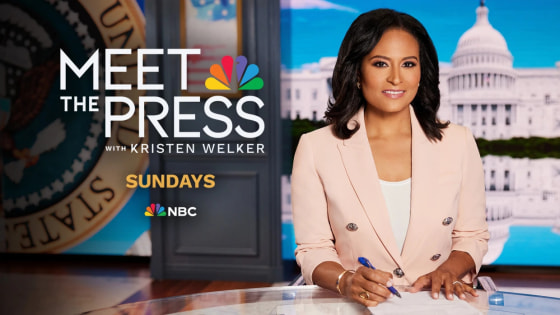
KRISTEN WELKER:
This Sunday: Waiting game. The U.S. and Iran exchange fire in the Strait of Hormuz as peace talks drag on and Americans feel the squeeze from rising gas prices.
SEC. MARCO RUBIO:
Only stupid countries don’t shoot back when they are shot at and we’re not a stupid country.
PRES. DONALD TRUMP:
And they better sign their agreement fast.
KRISTEN WELKER:
Could a deal be within reach? I’ll talk to Energy Secretary Chris Wright and Democratic Senator Cory Booker of New Jersey. Plus: Shifting battlegrounds.
PROTESTERS:
Shut it down. Shut it down.
KRISTEN WELKER:
Democrats lose ground in the redistricting fight after Virginia’s new map is rejected by the state Supreme Court and Republicans in red states move quickly to redraw their lines. What will it mean for control of Congress in the midterms? And: Delivering solutions. On this Mother’s Day, our bipartisan “Common Ground” conversation on the maternal health crisis with Republican Governor Sarah Huckabee Sanders and Democratic Governor Wes Moore. Joining me for insight and analysis are: Jonathan Martin of POLITICO, Ashley Etienne, former communications director to Vice President Harris, Republican strategist Matt Gorman and New York Times White House correspondent Tyler Pager. Welcome to Sunday, it’s Meet the Press.
ANNOUNCER:
From NBC News in Washington, the longest-running show in television history, this is Meet the Press with Kristen Welker.
KRISTEN WELKER:
Good Sunday morning. A fragile ceasefire is holding in the Middle East this morning. As negotiations continue between the United States and Iran despite the two sides exchanging fire earlier in the week.
[BEGIN TAPE]
REPORTER:
After these strikes, is the ceasefire with Iran still on?
PRES. DONALD TRUMP:
Yeah, it is. They trifled with us today. We blew them away. They trifled. I call that a trifle.
REPORTER:
Could you give us an update on what is the latest in those talks?
PRES. DONALD TRUMP:
No — it’s going, the talks are going very well, but they have to understand if it doesn’t get signed, they’re going to have a lot of pain.
[END TAPE]
KRISTEN WELKER:
This, after a volatile week with President Trump announcing Operation Freedom, a plan to escort international ships through the Strait of Hormuz, the waterway vital to the world’s energy supply, before abruptly walking back the plan just 36 hours later. NBC News learning exclusively Saudi Arabia feared the Trump administration’s plan could provoke Iran to attack Gulf allies and risk reigniting the conflict. Meanwhile, uncertainty in the Strait of Hormuz is already hitting Americans at the pump. Gas prices topped $4.55 a gallon this week, the highest prices since the conflict began. But President Trump saying those price spikes are temporary.
[BEGIN TAPE]
PRES. DONALD TRUMP:
When the war is over, gas will fall down at levels that you’ve never seen before. You’ll be down to where you were, maybe even lower.
[END TAPE]
KRISTEN WELKER:
And joining me now is Energy Secretary Chris Wright. Secretary Wright, welcome back to Meet the Press.
SEC. CHRIS WRIGHT:
Thanks for having me, and happy Mother’s Day.
KRISTEN WELKER:
Thank you so much. Thank you for being here on Mother’s Day, a lot to discuss. I do want to start on these negotiations between the United States and Iran. President Trump saying that the United States was anticipating a response from Iran to its latest proposal. Has Iran in fact responded to the United States?
SEC. CHRIS WRIGHT:
I don’t think we’ve heard a clear resolution from Iran yet. Given the state of the government in Iran, things just move slowly. Communications are difficult, there are multiple factions. This is a regime under serious stress.
KRISTEN WELKER:
Would the United States ever agree to a deal with Iran that does not address its nuclear program, even if it’s a short-term deal?
SEC. CHRIS WRIGHT:
Oh, I mean, I don’t know about interim deals or whatever, but we know where the endpoint is going to be. The endpoint is going to be free flow of traffic through the international waters that are the Strait of Hormuz and to the Iranian nuclear program. That’s where we’re going to end. The pathway from here to there, we’re going to find out, but that’s the endpoint.
KRISTEN WELKER:
So it’s possible an interim deal might not address all of the concerns regarding Iran’s nuclear program?
SEC. CHRIS WRIGHT:
Certainly that’s got to be possible.
KRISTEN WELKER:
Well, I guess, and just to clarify in terms of the Strait of Hormuz, what is the administration’s top priority, dealing with Iran’s nuclear program or reopening the Strait of Hormuz?
SEC. CHRIS WRIGHT:
Well, the top priority is ending Iran’s nuclear program. The world simply cannot have a nuclear-armed Iran. They’ve got nearly 1,000 pounds of 60% enriched uranium. You know, this is close to weapons-grade uranium, there’s no commercial or peaceful use of nuclear weapons. They always lie and say they’re doing this for their nuclear power industry, just total nonsense. They have been, you know, on a dash to build a bomb, and they have enriched material — almost fully enriched — to make 10 nuclear bombs. We cannot have that for the world. We cannot have that in the Middle East, we cannot have that in the United States of America.
KRISTEN WELKER:
I do want to talk about the big issue for Americans, gas prices, of course, you just heard me discuss how high they went this week. Here’s what you said in this program in March about gas prices. Take a look.
[BEGIN TAPE]
KRISTEN WELKER:
Are you confident that gas will be back under $3 a gallon by the busy summer travel season, Mr. Secretary?
SEC. CHRIS WRIGHT:
There’s a very good chance that’ll be true. You know, there’s no guarantees in war, the time frame’s still not entirely clear. But I think that’s certainly a goal of the administration, and very possible.
[END TAPE]
KRISTEN WELKER:
Do you think it’s still very possible that gas prices will dip below $3 a gallon in time for summer which is about six weeks?
SEC. CHRIS WRIGHT:
I can’t make any predictions about, you know, oil prices or gasoline prices. The military part of the conflict took about what we expected. I think the president was guiding four to six weeks, it took five and a half weeks. After the military, main military operations have ceased, now we’re in a negotiating period. We’re using economic leverage against Iran, and this regime is trying to cling on to their nuclear program, so obviously this part of the conflict has gone a little longer.
KRISTEN WELKER:
President Trump hasn’t ruled out still using a military option. Are you saying military options have ceased, have officially come to an end?
SEC. CHRIS WRIGHT:
No — there’s I mean, yeah — again, we’re not going to take any options off the table going forward, but as far as our goals to destroy their industrial capability to build missiles, to build missile launches, to build drones, to completely degrade their air defense system, to sink their navy and their air force, all of that went well, and that was a critical part of this mission.
KRISTEN WELKER:
Just to go back to this central question, though, do you anticipate gas prices will drop below $3 a gallon this year?
SEC. CHRIS WRIGHT:
I can’t make predictions about that. I can say that when we start to get free flow of traffic through the Straits of Hormuz, energy prices will come down. And by ending Iran’s ability to get a nuclear weapon, they are the biggest threat in the world to the flow of global energy. They’ve killed more American soldiers over the last two decades than any other power. They’re the giant force of destabilization. They’re the largest sponsor of terrorism around the planet. So ending Iran’s nuclear program, that is massively positive for the flow of energy, meaning more energy will flow in the future, meaning lower energy prices for Americans and the rest of the world. Long-term this is a great move, short-term it’s causing some discomfort.
KRISTEN WELKER:
So you’re saying that ultimately gas prices will start to come down once the Strait is reopened. Here’s what analysts are saying about how high gas prices could ultimately go: “U.S. gasoline prices have a legitimate chance of rising to $5 a gallon as refiners prioritize jet fuel production at the expense of other products, according to analysts at JPMorgan Chase.” Should Americans be prepared for the possibility of paying $5 a gallon for gas?
SEC. CHRIS WRIGHT:
Look, again, I can’t predict the price of energy in the short-term or even the medium-term, but what we’re doing is ending a 47 year conflict. Iran has fought, “Death to the United States,” for 47 years, “Death to Israel,” and as we saw when the conflict broke out, they attacked all of their neighbors in the Middle East that had no involvement in the conflict whatsoever. If you have a hostile, unstable power like that, you simply cannot allow them to have nuclear weapons. That was a consensus opinion all my adult life. I’m shocked to see Democrats come out of the woodwork now somehow not worried about Iran getting nuclear weapons.
KRISTEN WELKER:
I know you’re saying you can’t predict how high gas prices will go, but I don’t hear you ruling out the possibility that they could in fact go to $5 a gallon.
SEC. CHRIS WRIGHT:
Well, I’m just avoiding price predictions. But I will say the United States is in a tremendous position. We’re by far the world’s largest producer of oil. We’re by far the world’s largest producer of natural gas. There’s been no rise in the price of natural gas. That’s the largest primary energy source for the United States, that’s for home heating, that’s for electricity. Gasoline, diesel prices are up, and they will remain up while this conflict’s in place, and then they will come back down. And ultimately they’ll come back down lower than they were before.
KRISTEN WELKER:
You’re saying they’re going to come back down. The head of the International Energy Agency says more than 80 Persian Gulf energy facilities have been damaged, about a third of them severely, and it could take up to two years to fully restore production. Why should Americans believe that prices will fall quickly when experts say it could take up to two years even once this war ends?
SEC. CHRIS WRIGHT:
That’s to bring all of those facilities back on, that’s one region of the world. Oil production in Venezuela today is growing rapidly. Venezuela’s neighbor Guyana has rapid oil production growth, rapid growth in Brazil. We’re bringing on new oil in the Gulf of America, and in Alaska in the United States. There’s an incredibly bright outlook for growing global energy production which allows the economy to grow and prices to remain low.
KRISTEN WELKER:
Let’s talk about this debate over the gas tax. States like Georgia, Indiana, Utah, have suspended their gas taxes, and there’s a bill in Congress actually that would temporarily suspend the federal gas tax which is $.18 a gallon, currently. Would you support suspending the federal gas tax to give families relief right now?
SEC. CHRIS WRIGHT:
Yeah, all measures that can be taken to lower the price at the pump and lower the prices for Americans, this administration is in support of. We are constantly looking for different ideas. We’ve taken a number of actions, releasing oil from our strategic petroleum reserves, getting 30 other nations to do that in coordination with us. We revised the EPA regulations on summer gasoline blend to make it easier for American refineries to produce more gasoline. We’ve been in contact with all American refiners, asking them to do shorter maintenance work this spring so they can keep pumping out more products. So we are working every day to offset this rise in prices because of a critical conflict in Iran to drive prices down, and we’re open to all such ideas.
KRISTEN WELKER:
This is significant what you’re saying. You’re saying that you, that President Trump, would be open to suspending the federal gas tax?
SEC. CHRIS WRIGHT:
We’re open to all ideas, everything has trade-offs, all ideas to lower prices for American consumers and American businesses.
KRISTEN WELKER:
All right. Let me ask you about what we’ve been discussing at the top, the Strait of Hormuz. Before the war, more than 100 ships transited the Strait every single day. This week just seven ships transited the Strait of Hormuz. Who is in control of the Strait of Hormuz right now, Mr. Secretary?
SEC. CHRIS WRIGHT:
Well, the United States has a blockade. We are not allowing any ships to come out from Iranian ports or to go into Iranian ports. Iran, after decades of spending a large percent of their entire economy building a giant weapons arsenal, all to shield their nuclear program so ultimately they would be untouchable, they have an ability to cause trouble in the Straits of Hormuz, and they are doing it.
KRISTEN WELKER:
So is the U.S. in control of the Strait of Hormuz?
SEC. CHRIS WRIGHT:
We, we are today, we are controlling no flow of Iranian ships. We have escorted out several American ships. And if need be, if we don’t get to a deal with Iran, we will, we will use military force to open the Strait to everyone.
KRISTEN WELKER:
Why —
SEC. CHRIS WRIGHT:
Today, today traffic through the Strait of Hormuz is challenged.
KRISTEN WELKER:
Why didn’t the U.S. secure the Strait of Hormuz when the war first began in February?
SEC. CHRIS WRIGHT:
It’s about focus. It’s about focus. We wanted to as quickly as possible take away Iran’s military capabilities to defend their airspace and to destroy their industrial complex. We challenged the long-term things first. We needed to degrade their infrastructure to project terror around the Middle East, to threaten oil supplies in the long run, and we’ll deal with this. In the middle of the conflict the thing was about getting the war aims done. Now as we move back out the other side it’s to establish the free flow of commerce.
KRISTEN WELKER:
Let me ask you this. This week the president announced Project Freedom, as you know, an operation to escort ships trapped in the Persian Gulf through the Strait of Hormuz. NBC News reported this week that he canceled the operation just 36 hours later over Saudi Arabia’s concerns that the plan would trigger potentially catastrophic attacks from Iran. Did the U.S. back away from Project Freedom because of risks of further military action?
SEC. CHRIS WRIGHT:
The U.S. backed away, or just suspended briefly, Project Freedom, because of Iran’s concerns. Iran has one card. They can cause trouble in the Straits of Hormuz, they are keen to get a negotiated deal. If we open that militarily without Iran, they have no cards left, they can cause trouble in the meantime. They said, “wait, wait, wait, let’s talk. Let’s get a deal. We’re going to open this more quickly in a simpler fashion,” and we’re given that chance to have a negotiated settlement which is the best end here.
KRISTEN WELKER:
All right. Well we will continue to track whether that negotiated settlement happens. Thank you so much, Secretary Wright, we really appreciate your being here.
SEC. CHRIS WRIGHT:
Thank you, Kristen, great to be with you.
KRISTEN WELKER:
Great to have you here. When we come back, Democratic Senator Cory Booker of New Jersey joins me next.
KRISTEN WELKER:
Welcome back. And joining me now, Democratic Senator Cory Booker of New Jersey. Senator Booker, welcome back to Meet the Press.
SEN. CORY BOOKER:
It’s really good to be here in studio. Thank you.
KRISTEN WELKER:
Thank you so much for being here in person. We really appreciate it. Let’s start with Iran. I wonder, for the sake of bringing these hostilities to an end, would you support a short-term deal with Iran that leaves the broader issue of Iran’s nuclear program to be solved in later negotiations?
SEN. CORY BOOKER:
So remember, the Strait of Hormuz was not closed at the beginning of this conflict. This conflict has been a massive disaster, and Donald Trump himself is an embarrassment on the world stage. I hear it from allies all around the world. He has got us into a trap, and we’re effectively in a stalemate with Iran. And the people that are paying the price — was American military, hundreds injured, 14 lives lost, and the American people collectively were spending billions of dollars more in the price spikes that we’ve seen as a result of this. This president has no way out. This is going to go on for months. And that pain is going to continue to be felt by people he promised to lower prices for and keep us out of foreign entanglements.
KRISTEN WELKER:
If that way out included a short-term deal that punted dealing with the nuclear program, is that something you would back?
SEN. CORY BOOKER:
Well remember, I’ve been leading in the Senate with a handful of my other colleagues to end this conflict. That’s what we’re demanding. I am sorry that the United States Senate, Republicans who are leading that, have done nothing, truly, to hold President Trump accountable, to provide sufficient oversight, or any checks and balances. My work is to end this conflict. And again, unfortunately Donald Trump has made us less safe. He has created more chaos in that region. He has given more long-term strength and leverage to Iran, a more radical regime. There’s still fissile material, highly enriched, that was not there at the beginning of his first term. He has dug us deeper and deeper into a quagmire, a hole. And he is a danger. As many of his first-term national security advisors said to us, he would be a danger to national security. Sadly, that’s playing out.
KRISTEN WELKER:
I do want to talk about the Senate. The U.S., of course, is partnering with Israel with this war. You joined a record number of Democrats, 40 senators, who recently voted against sending more arms to Israel. A similar effort a year ago only got 15 Democratic votes, for example. Are you now opposed to the U.S. sending arms to Israel going forward?
SEN. CORY BOOKER:
Let’s be clear, I’m opposed to a reckless war that has made the United States and Israel less safe, as well as our other Arab allies. I will not support arms to the United States or any of our allies, including Israel, in the context of a war that is endangering our national security and Israel’s. I continue to support our U.S. military being the strongest in the world. I continue to support Israel having a qualitative military edge, the ability to defend themselves, and offer deterrence. But in the context of this war, I will not support more military armaments to conduct what I think is a disaster that’s endangering American lives, Israeli lives, and as we see in the UAE and Saudi Arabia, our regional allies as well.
KRISTEN WELKER:
So just to be very clear, you would vote to approve arm sales for Israel in a future entanglement if you thought that was necessary?
SEN. CORY BOOKER:
Again, we have a longstanding commitment to Israel having a qualitative military edge. I will continue to support that. I will not support this kind of war. And we have a nation now that’s looking at our disastrous president, a disastrous leader of Israel, who in this war are hurting our nation, their nation and that region. I cannot support this war effort.
KRISTEN WELKER:
Let’s turn to the battle over redistricting, one of the big headlines this week. A recent U.S. Supreme Court ruling placed new limits on the Voting Rights Act, as you know, which has prompted states across the South to start redrawing their maps. Supreme Court Justice Samuel Alito wrote in the majority opinion — I’m going to read some of what he said and get your reaction — “Allowing race to play any part in government decisionmaking represents a departure from the constitutional rule that applies in almost every other context.” Do you think race should be used as a factor to draw congressional lines?
SEN. CORY BOOKER:
So first of all, this court is profoundly hypocritical. They said you can use race in immigration stops. So this is not about race, this is about stripping political power from millions of people. And obviously this decision would result — and they knew this — in stripping political power and representation from African-Americans. The Voting Rights Act was perhaps one of the most important acts in the history of our country in securing our democratic ideals: all are created equal, all are imbued with certain unalienable rights. And what they have done right now is sent us backwards in time, back to the 1870s and ‘80s, where the South and southern legislators, through terrorism, intimidation, and worse were able to stop African-Americans from having representation in Congress. This is wrong. It’s as wrong as Plessy versus Ferguson. It’s as wrong as Korematsu. And I’m telling you right now, this will go down in history as one of the most wrongheaded decisions the Supreme Court has ever made, and effectively undercut our democracy.
KRISTEN WELKER:
I wonder what you make of some of the messaging we’ve heard. House Democratic Leader Hakeem Jeffries had very strong words for the Supreme Court, calling it, “illegitimate,” and accusing the court of trying to suppress the vote and rig the midterm elections and beyond. Do you agree that the Supreme Court is illegitimate, and actually trying to rig U.S. elections? Or do you think that language goes too far?
SEN. CORY BOOKER:
I think the Supreme Court is wrong. I think they’ve been making decisions to strip rights from Americans, whether it’s stripping rights for reproductive rights from Americans, whether it’s stripping voting rights from Americans. This court is setting us back. And we have to understand that this is one of those moments where what the Supreme Court is doing is making a decision, but the people have the last word. This is not the end of this story. We have seen setbacks before. The question is, is this the time for people to understand that this is not left or right, it is right or wrong. Is it going to spark another movement? And so most important right now is people to understand we are not helpless. Six people cannot determine 300 million plus. We have to fight. We have to mobilize and organize.
KRISTEN WELKER:
Well, you take me to my next question. Because this decision has revived the debate within the Democratic Party about potentially adding more seats to the Supreme Court. Would you, Senator, support an effort to add more seats to the Supreme Court, to expand the court?
SEN. CORY BOOKER:
Well remember, there’s a corrupt shadow hanging over the Supreme Court. Some of these same members that are voting on decisions like this are accepting gifts from billionaires. We have RVs, lavish vacations. It’s a corrupt court. The highest court in the land has the lowest ethics laws. Number two is the Supreme Court, clearly within our power — I lead one of these pieces of legislation with Senator Whitehouse and others — to give term limits to Supreme Court members. That could go a long way in curing this. The Supreme Court desperately needs reform. It is a corrupt court. And in my opinion, it is a court that needs reform. And I will continue to lead on those things.
KRISTEN WELKER:
Do you support, though, adding additional seats? Is that something you would back?
SEN. CORY BOOKER:
Again, I want this court reformed from its ethics, to having people stay on there well into their 80s or 90s is very problematic. There are ways we can reform this court. But as a precursor to that, it means changing Congress. Because this Congress, even when the Supreme Court said in Rucho v. Common Cause that partisan gerrymandering was antidemocratic, the vote in the Senate and the House was along party lines. Republicans supporting partisan gerrymandering, and every Democrat saying, “We should end this.” If we want change to what the Supreme Court is doing, we have to change Congress.
KRISTEN WELKER:
I want to ask you big picture, Senator, the implications of this for the midterms. Do you believe that Democrats have lost their advantage heading into the midterms?
SEN. CORY BOOKER:
Again, I know this is seen through a political lens. But there are many of us — I was just down in Birmingham. This goes a lot deeper than partisan politics. This is Mother’s Day, and that word, “mother,” is an honorific in the Black community often given to great women of stature. The mothers of the movement, people like Fannie Lou Hamer, beat nearly to death in a Mississippi prison for voting rights. Amelia Boynton, beaten on the Edmund Pettus Bridge, marching for voting rights. Ella Baker, Septima Clark, these are extraordinary women who today the Supreme Court has dishonored their legacy and their sacrifices. On this Mother’s Day, when so many people are hurting, let us refocus on the urgency. This is not left or right. This is a moment where, what will stand for in America? Ultimately, this nation stands for fairness at the polls, representation, we’re a representative government, and most importantly, making sure our democracy in its very most important act of voting, is secured.
KRISTEN WELKER:
But just very quickly, before I move to my last question, are you confident that Democrats can take back the House?
SEN. CORY BOOKER:
I am confident that the people of America can take back the House. There are so many dissatisfied Trump —
KRISTEN WELKER:
But can Democrats win the House?
SEN. CORY BOOKER:
Yes. Absolutely. And it means appealing to all of America. I think there’s 75%, 80% of Americans who just don’t agree with this president raising their prices, involving us in disastrous wars. This is a chance for America to reject a president that is making their lives more difficult and betraying the people. We need to take back the House and the Senate, and begin to hold him accountable, and begin to restore the pillars of our democracy.
KRISTEN WELKER:
Before I let you go, Senator, NBC News is reporting that former Vice President Kamala Harris has been telling donors she believes the Democratic National Committee should release its autopsy of her failed 2024 campaign, something the DNC chair had initially promised to do. Seems to have walked that back. Do you think the DNC should release that autopsy report?
SEN. CORY BOOKER:
Yeah, release the autopsy. But we’re six months before an election. If there’s not enough reason to vote, the president’s stripping away our health care for millions of Americans, seeing rural hospitals close. If there’s not enough reason to vote, your prices skyrocketing, interest rates up. If there’s not enough reason to vote, prioritizing ballrooms over people’s child care and healthcare. This is six months before an election. We need to be mobilizing and organizing in this election. Fine, DNC, release it. They should do that. But the most important thing is for people to get out and vote in record numbers.
KRISTEN WELKER:
As you have heard, former Vice President Harris has said she’s thinking about running again in 2028. Do you think that Vice President Harris is the strongest person to represent Democrats in 2028?
SEN. CORY BOOKER:
I think that it was a disservice to Kamala Harris that we did not have a primary in the last election. I hope we have the most robust ‘28 primary there is, with a lot of great leaders involved in that primary, so that the Democratic Party can choose who’s going to be their standard bearer.
KRISTEN WELKER:
Senator Cory Booker, thank you so much for being here, weighing in on a lot of topics this morning. Really appreciate it.
SEN. CORY BOOKER:
Thank you. Thank you very much.
KRISTEN WELKER:
When we come back, do Republicans now have the edge in the redistricting fight? The panel is next.
KRISTEN WELKER:
Welcome back. The panel is here. Jonathan Martin, senior political columnist and politics bureau chief for POLITICO; New York Times White House correspondent Tyler Pager; Republican strategist Matt Gorman and Ashley Etienne, former communications director for Vice President Harris and Speaker Pelosi, and our newest Meet the Press contributor. Ashley, congratulations.
ASHLEY ETIENNE:
Thank you.
KRISTEN WELKER:
Welcome to all of you. J-Mart, I’m have to start with you. We have to talk about redistricting. You heard my conversation with Senator Booker. Who has the edge right now heading into the midterms?
JONATHAN MARTIN:
Well, on the topic of reapportionment, clearly it’s the GOP.
KRISTEN WELKER:
Yeah.
JONATHAN MARTIN:
On the broader question of who is I think better for this fall in terms of the political environment, Democrats still have an advantage. I think you have an environment right now in which a sitting president is in the 30s in terms of his approval rating. That bodes well for the party out of power. That said, I think this climb got a little steeper this past week for the Democratic Party because of the combination of what happened in Virginia and obviously the Supreme Court ruling on the VRA. It’s going to be harder for them to get back the majority. I still think the odds are that it happens. But make no mistake, this was the best week Donald Trump has had in months. And I think it’s now going to be more of a challenge for Democrats this fall. I just think that the environment is unlikely to get better for the GOP this fall unless gas prices come down significantly by Labor Day. It’s hard to see how Democrats wouldn’t still take back the House and still have a chance to take back the Senate.
KRISTEN WELKER:
Tyler, given those headwinds, given what J-Mart lays out, what are your sources inside the White House telling you about how they feel about this moment?
TYLER PAGER:
They feel vindicated and validated in a strategy that drew a lot of criticism from Republicans around the country. This was a ambitious gambit led by Donald Trump and his top advisors to redraw the maps nationwide. And there was a lot of Sunday morning quarterbacking after Democrats won that referendum in Virginia. Republicans inside the White House, Donald Trump’s top aides and allies weren’t confident in their strategy that this was going to give them a fighting chance to recapture or to maintain the majority in the House. I think they still recognize the political realities that J-Mart just laid out, of just how different this environment is. But they feel a lot more confident in this strategy after the latest development.
KRISTEN WELKER:
Matt, take us inside your conversations in Republican circles. What are folks saying about the prospects of holding onto the House, the Senate in the wake of this week, which was by all accounts a very strong week legally for the GOP?
MATT GORMAN:
Yes, the words I keep hearing are “measured optimism.” Exactly right, this is the best week President Trump and our party’s had probably all year. Indiana, Virginia, the jobs numbers, even the NRCC had some pretty good battleground polling coming out. I mean, look, I’m not naïve. History is not on our side on this. Gas prices need to come way down. The president’s job approval needs to go up. That’s going to take real work. I think also Virginia changed the psychology around redistricting a little bit. You know, the conduct of Louise Lucas, Democrats, breaking of the constitution, it was the release valve in many respects. So expect in the, you know, weeks ahead, Southern legislatures may have gone one or two, or waited till 2028 to change their districts. They’re all systems go, all gas, no brake for this year.
KRISTEN WELKER:
Ashley, what strategy should Democrats employ? You heard the language from Hakeem Jeffries accusing the Supreme Court of trying to rig the election, really strong language there. Is that the right tactic? Do you think Democrats can still win?
ASHLEY ETIENNE:
I absolutely think that’s the right tactic. And I think Democrats feel very optimistic, not measured, overwhelmingly optimistic about the chances come November. And that’s because you cannot gerrymander out the reality of what’s happening on the ground in the American people’s lives. You’ve got skyrocketing gas prices. You’ve got the president who’s underwater on everything from the war in Iran to the economy. So Democrats are going to continue to weaponize and capitalize on that, you know? And so if we say that the Republican Party had an incredible week, the biggest loser over the last two weeks has been American democracy. We’ve seen an undermining of the Voting Rights Act and a systematic attempt, as the senator said, on the part of this administration to undermine the economic and political power of Black Americans. They’re not going to stand by and take that. I’m hearing now that there’s going to be protests all over the country starting in Selma, Alabama, next weekend on the Edmund Pettus Bridge. And they’re going to continue to make this point that not only do we need a high voter turnout, but it’s going to be necessary if we want to reverse these maps at some point.
KRISTEN WELKER:
Ashley, I’m going to stick on you. Because I want to ask you about this big debate boiling inside the Democratic Party. Should the DNC release its autopsy report? You just heard Senator Cory Booker say yes. Chair Ken Martin was asked about this this week. Here’s what he had to say. I’m going to get your reaction on the other side.
[BEGIN TAPE]
JON FAVREAU:
Why not release the full report? What’s in the report that you wouldn’t want –
KEN MARTIN:
Well, first off there’s no –
JON FAVREAU:
– to publicize?
KEN MARTIN:
– smoking gun in the report. And I know that’s what everyone’s so eager to learn, the smoking gun. Guess what, Jon?
JON FAVREAU:
But if there’s no smoking gun, why wouldn’t you just release it then?
KEN MARTIN:
Because we want to keep the focus on the lessons.
[END TAPE]
KRISTEN WELKER:
No smoking gun, but we want to keep the focus on the lessons, a really extraordinary exchange there, Ashley. Do you think Ken Martin and the DNC will be pressured into releasing this report?
ASHLEY ETIENNE:
Absolutely. I said on this show about a month ago that the DNC should release the autopsy. Vice President Harris has amplified that call. Here’s what I’m being told, Kristen. I’m being told that the Democratic Party is going to release the autopsy in a matter of weeks. And it’s going to –
KRISTEN WELKER:
Wow.
ASHLEY ETIENNE:
– include four things. It’s going to include one, an assessment of the organizing infrastructure of the party, an assessment of messaging and media strategy as well as fundraising, and how and where the money was spent. And that’s going to be the most explosive part. Because there’s speculation that decisions were made by campaign leadership to line their pockets rather than actually advance the strategy to win the election. That is really the question that’s on the table here that I think is causing a lot of people to want to discard and brush this under the rug. And I’m also hearing that Ken Martin is suffering a lot of pressure. He wants transparency, but there’s pressure from within the party, the DNC, and campaign leadership to bury this report.
KRISTEN WELKER:
J-Mart, weigh in on that. That would be explosive.
JONATHAN MARTIN:
There’s no reason to keep hiding this thing. Because the stories are going to keep coming out, speculating what’s in there. Memorial Day weekend, Ken, come on. Friday afternoon, man, you can do this. It’s primetime, baby. Let’s get it out. It’s an easy call. You’re on the verge of having a fantastic cycle. And by the way, I’ve covered past midterms in which there was unhappiness for party chairs. Howard Dean in 2006, Michael Steele in 2010. And guess what? It didn’t matter because the political environment matters a lot more than who the DNC or the RNC chair is. Put the thing out. Talk about what happened in ‘24. And then move on to 2026. I don’t know for the life of me why they’re keeping this debate going because it’s only going to cause more and more stories. So the moment’s here.
KRISTEN WELKER:
Tyler?
TYLER PAGER:
Yeah, I mean, I think there has just now become this cycle of: Are they going to do it or are they not going to do it? And it’s just a way for Democrats to express their anxiety about the political moment and the opportunity that they see ahead. And there’s not a whole lot of upside to continuing this cycle. And so as J–Mart said, the pressure valve, as Cory Booker is calling, Kamala Harris is calling, there’s very few Democrats saying, “Don’t release this.” And so at a certain point.
JONATHAN MARTIN:
Anxiety of Democrats? Is that right?
ASHLEY ETIENNE:
Well, they’re not saying it publicly. But they’re definitely saying it behind the scenes. And there’s a lot of people who are going to be implicated in what actually happened.
KRISTEN WELKER:
Matt, let me just get you to weigh in on the buzz within the Republican Party which is: Will it be Rubio or JD Vance?
JONATHAN MARTIN:
Here we go.
MATT GORMAN:
There’s some structural differences I think that people haven’t pointed out yet. Two people can’t be affected by the Hatch Act. One of them can’t run, the other is JD Vance. So JD can fly around, campaign, raise money, and stay VP. Rubio would have to resign. If all of that stuff has to be paid for by hard campaign dollars, dollars that would be disclosed within 100 days to who? The White House’s political operation, and the sitting vice president. So everybody should keep that in mind as well. We should talk about this drama, which I think is a large part manufactured.
JONATHAN MARTIN:
Matt knows who the stronger nominee will be for his party in 2028. But he won’t say it on the air. Come on, Gorman.
MATT GORMAN:
The sitting vice president always has an advantage.
KRISTEN WELKER:
Alright, well, look, we are going to continue to track all of this very carefully. What a great Mother’s Day conversation. Thanks everyone for being here. Thank you. And still ahead, our common ground conversation on maternal health with Republican Governor Sarah Huckabee Sanders and Democratic Governor Wes Moore. Stay with us.
KRISTEN WELKER:
Welcome back. This week, President Trump travels to China for a high stakes meeting with President Xi Jinping, while the war in Iran remains unresolved in the Middle East. My colleague and anchor of NBC Nightly News, Tom Llamas, will be heading to China to cover the president’s trip. Tom, what exactly will you be watching for on this historic trip?
TOM LLAMAS:
So many things. Kristen, we’re so excited about this assignment, because the stakes could not be higher. You have two super global powers racing for dominance across this planet, and there are so many issues, namely the war with Iran and China’s vested interest there, the AI race, the race for chips, along with the military buildup, and what exactly China wants and what they’re doing. These two leaders will come together in Beijing. We will be right there, taking our viewers every step of the way, talking about the most important issues facing Americans at home, but also people all across the world, because this meeting and what is decided here could affect not only this term for the president, but also his legacy as an American president. So we’re going to be watching all of that, and then along the way, we will take our viewers to really give them a slice of life of what China is like right now. The technology there, the way they are surveilled by their own government, what is happening with AI, how it’s changing everything in their life, and how, in some ways, they are maybe more advanced than we may think back here in the United States. And of course, the big issue of Taiwan there, the U.S. has some treaties and some big promises with Taiwan. What does that mean? And what will President Trump have to do if he wants to negotiate with Xi Jinping. All of these things will come together, hopefully in that week, and we’re going to be there for the entire week — Nightly News and Top Story — live from Beijing. We’re so excited.
KRISTEN WELKER:
Tom, just extraordinary. We will be watching all of your coverage. We really appreciate your joining us, and you can watch NBC Nightly News with Tom Llamas live from Beijing this week. And when we come back, this Mother’s Day, finding common ground on maternal health. That conversation is next.
KRISTEN WELKER:
Welcome back. This Mother’s Day, a “Common Ground” conversation on the maternal health crisis in America. With two governors of different parties, Republican Sarah Huckabee Sanders of Arkansas and Democrat Wes Moore of Maryland along with philanthropist Olivia Walton, founder of Healthy Moms, Healthy Babies America.
KRISTEN WELKER:
Olivia, I want to start with you because you lead organizations that focus on the health of mothers and children. So I want you to really set the stage for us. Some of the statistics are staggering. In the United States, the reported maternal death rate has doubled in just the last 20 years. The CDC says 80% of these deaths are preventable. What more can be done to prevent these deaths? How do we as a society come together to achieve that?
OLIVIA WALTON:
It is shocking. But the good news is, we really do know how to fix it. As you said, the CDC consistently finds that over 80% of these deaths could have been prevented if these mothers could’ve gotten care. So what we’re launching is Healthy Moms, Healthy Babies America. We are a nonpartisan national campaign, uniting a broad coalition of business leaders, of faith leaders, of employers, of policy makers, and health care providers with one clear goal, which is to cut the U.S. maternal mortality rate in half in five years. It sounds audacious, but I’m confident in large part thanks to the incredible leadership here at this table that we really can get this done.
KRISTEN WELKER:
Governor Moore and Governor Sanders, I want to bring you both in. You’ve both worked on this issue. You’ve enhanced funding to maternal health, which has led to more access to doulas, health care, ultrasounds, for example. Governor Sanders, what is the hardest part about making progress in this area and what more needs to be done?
GOV. SARAH HUCKABEE SANDERS:
I think that one of the hardest parts for us is that Arkansas has consistently ranked at the bottom. And so bringing about the kind of change and awareness that is needed is a heavy lift. We started Healthy Moms, Healthy Babies Arkansas and we have put $45 million towards addressing maternal health in our state. We have about 35,000 pregnancies in Arkansas every year. Ten thousand of those women are not seeing a doctor until after their first trimester and over 1,100 never see a doctor until they go into labor. We’re already seeing the positive impact by raising that awareness and opening up a lot of access. We have 75 counties in Arkansas. Every single county has a Arkansas health unit. And we’ve started an ad campaign where all women can go and receive services there for free in order to help change the trajectory of our state.
KRISTEN WELKER:
Governor Moore, how do you see this issue and what do you see as the biggest challenges?
GOV. WES MOORE:
You know, I think I really want to both thank and congratulate the work that’s happening. And also what it does is it highlights the reality that oftentimes these discrepancies, they are generational. They are concentrated. And oftentimes intentional. And so the way we have to address it has to be just as intentional in addressing it in the way that these problems have been created. And it has to be bipartisan. And it has to be something that brings in other sectors. And in fact, we’re just now announcing something called the Bridge Project, where it is something that’s going to focus on providing cash assistance to mothers — who are both prenatal and then postnatal mothers — to be able to provide cash assistance for them to be able to have additional measurements of support. It’s going to happen for 150 families in the most areas of Maryland that you’ve had concentrated poverty being a long-term challenge.
KRISTEN WELKER:
Yeah, and that takes me to the next section of this conversation. We have to talk about Black maternal health, Black women in the United States. Olivia, I mean, again, you talk about the statistics. They’re three times more likely to die from pregnancy-related causes than white women. This impacts Republicans. It impacts Democrats. It impacts non-voters, independents, everyone. What solutions do you think exist to address this crisis in Black maternal health?
OLIVIA WALTON:
Well, a lot of it is about visibility. So first of all, awareness of the problem is lowest where outcomes are the worst. So talking about it, having leaders of color actually going out there. Leaders who have proximity to these issues getting onboard goes a long way.
KRISTEN WELKER:
Governor Moore, what are you doing to address this staggering surge in Black maternal deaths due to pregnancy?
GOV. WES MOORE:
I mean — and this is also a very personal issue for us, where I watched my father die in front of me when I was three years old because he didn’t get the healthcare that he needed. We know that this is both about how are we really focusing on bias training, understanding that when people are coming in with specific needs that there is an implicit bias that oftentimes does happen. And so we need to make sure that our physicians and our nurses are trained up. But also, what we’ve got to do is we’ve got to strengthen the pipeline to get more physicians and nurses of color who are actually in there to increase the probability that when a person comes in they’re going to have someone who’s going to be treating them and supporting them who looks like them, who represents them. And so we do think that type of training and those types of pipelines are crucial in this conversation about being able to deal with the Black maternal health challenge that we have within this country.
KRISTEN WELKER:
Governor Sanders, how do you see it?
GOV. SARAH HUCKABEE SANDERS:
I think one of the points Olivia made was the coverage of doulas and community workers and having somebody that helps support throughout the process. That’s been one of the things that we opened up coverage for. But I think one of the big pieces that so often gets left out of the conversation, especially when it comes to government, is the faith community. And this is a place where there is an implied trust and there’s a relationship that already exists.
KRISTEN WELKER:
Well, I do want to talk about the fact that for all of you this is personal. Because as you’ve all alluded to, you are all parents. This is an issue you all care very deeply about. And I’m just curious how that experience of being parents has changed, has impacted how you see maternal health. Governor Sanders, why don’t you start it off.
GOV. SARAH HUCKABEE SANDERS:
Certainly, being a mom I think influences everything I do. I firmly believe I’m a better governor because I’m a parent. Every decision I make I know will have a direct impact on the life of my kids, as well as every kid growing up in my state. That’s not something I take lightly and I am living a lot of the decisions, as are you. I mean, we were talking just before, our kids are the same age. So when we’re working on getting phones out of the classrooms, we’re fighting that at home too. We’re working on trying to do certain things. We’re living that in real time.
KRISTEN WELKER:
Governor Moore, how has being a dad impacted how you see this critical issue of maternal health?
GOV. WES MOORE:
Being a dad has impacted everything about my life. It’s given a sense of perspective. But especially when it comes to maternal health, it’s also reminding me of the importance of making sure that we have representative voices in there. You know, I think about it in context of my own mom, who’s an immigrant single mom, who is an angel. There are also just certain nuances of being a man that she couldn’t teach me because she didn’t know it. So I had to learn it from other people. I think the same thing with my daughter, who I love with all of my heart, my 14-year-old daughter. And there is nothing that I won’t do for her. I also know that there are certain nuances of being a woman that I can’t teach her. And I think that’s part of the takeaway from the policy-making conversation, where there is so much that we can do. But if we’re not making sure that impact in communities aren’t just the subject of the conversation but are actively part of the conversation, we’re going to miss things.
KRISTEN WELKER:
Olivia, I’m going to give you the final word. How has being a mom impacted and informed your passion for addressing this issue of maternal health?
OLIVIA WALTON:
So our kids are eight, five, and three. I’m thrilled to say we’re sleeping through the night now. It’s just a little more fresh. And I have so much privilege. I am healthy, thank goodness. I have resources. I have family. And it was still so hard. But just seeing how much help I needed when I had all that privilege was just a rude awakening in how hard this is for millions of Americans who we really count on to raise the next generation of Americans.
KRISTEN WELKER:
You can watch my full “Common ground” conversation with Governor Sanders, Governor Moore, and Olivia Walton at MeetThePress.com. That’s all for today, thanks for watching. Happy Mother’s Day to my mom, my mother in law and to all the moms out there. We’ll be back next week, because if it’s Sunday it’s Meet the Press.
Follow here for more Meet the Press transcripts