Editorial Standards

Latest News Today maintains rigorous editorial standards. Our team verifies information from trusted sources and provides context to help readers understand complex stories.

Last Updated: Sunday, May 17, 2026 at 04:06 PM
Category: Id

Editor's Note

Latest News Today provides comprehensive coverage and analysis of breaking news stories. This article is part of our ongoing coverage of wbna9856071, bringing you verified information from trusted sources with added context and expert perspective.

Why This Matters: Understanding the full context of this story helps readers make informed decisions and stay updated on developments that impact our community.

Co-discoverer of ‘buckyballs’ dies

Rice University says Richard Smalley, who shared a 1996 Nobel Prize in chemistry for the discovery of “buckyballs,” has died of cancer at the age of 62.
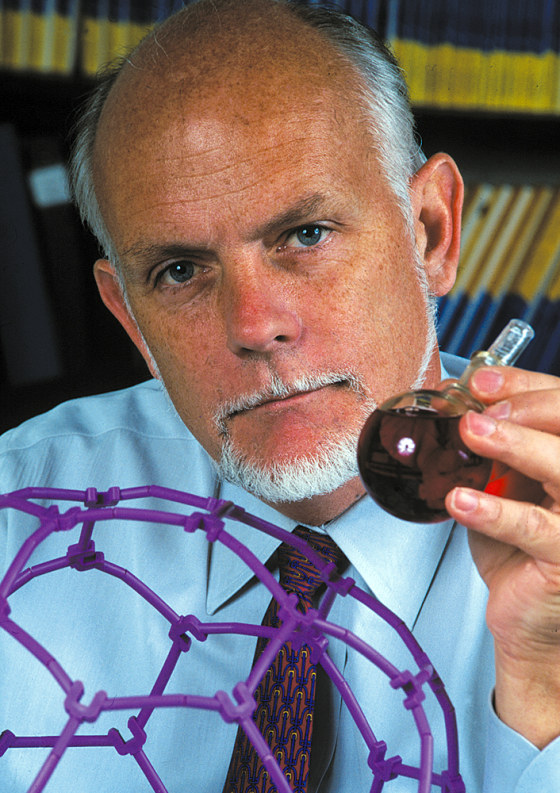
Rice University professor Richard Smalley won a share of the 1996 Nobel Prize in chemistry for discovering buckminsterfullerenes, 60-atom carbon molecules that are arranged in a hollow spherical shape. Rice announced that Smalley died Friday at the age of 62 after a long battle with cancer.
Rice University professor Richard Smalley won a share of the 1996 Nobel Prize in chemistry for discovering buckminsterfullerenes, 60-atom carbon molecules that are arranged in a hollow spherical shape. Rice announced that Smalley died Friday at the age of 62 after a long battle with cancer.Rice University

Rice University professor Richard Smalley, who shared a 1996 Nobel Prize in chemistry for the discovery of “buckyballs,” has died of cancer at the age of 62, the university said Friday.

Buckyballs, short for buckminsterfullerenes, are a form of carbon that has 60 atoms arranged in a hollow sphere, whose discovery in 1985 opened the way for the development of the field of nanotechnology.

Smalley, fellow Rice chemist Robert Curl and British chemist Harold Kroto shared the prize for their work on buckyballs, which were named for architect and geodesic dome inventor Buckminster Fuller.

After winning the Nobel, Smalley became a strong advocate for the development of nanotechnology as a means of solving global problems, particularly in the field of energy.

“We are about to be able to build things that work on the smallest possible length scales, atom by atom, with the ultimate level of finesse,” Smalley told the U.S. House of Representatives in 1999 during testimony in support of the National Nanotechnology Initiative. “These little nanothings, and the technology that assembles and manipulates them — nanotechnology — will revolutionize our industries and our lives.”

Smalley became ill with cancer in 1999 and fought the disease for six years. He died on Friday at M.D. Anderson Cancer Center in Houston surrounded by family and friends, the university said.