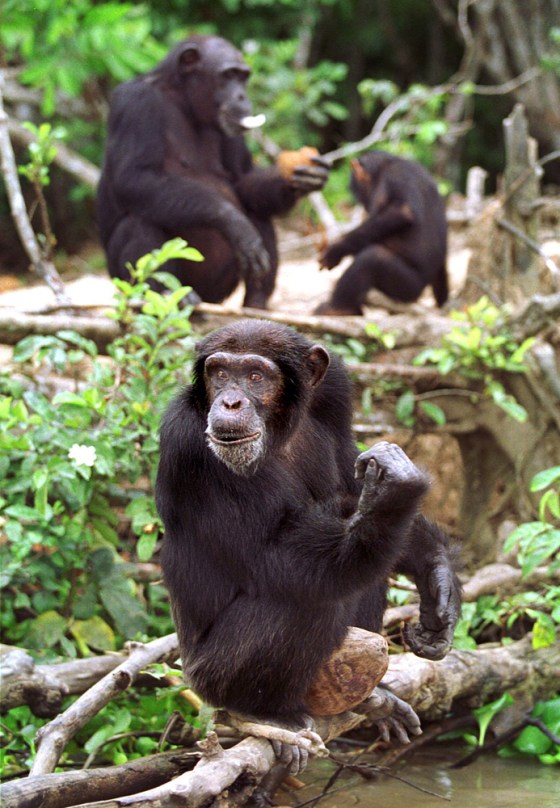
Chimpanzees share many traits with humans but altruism, it seems, is not one of them, scientists said on Wednesday.
Although chimps live in social groups and co-operate and hunt together, when it comes to helping non-related group members, they don't put up with any monkey business.
When given the opportunity to help themselves and other chimps they often choose the selfish option.
"This is the first experiment to show that chimps don't share the same concern for the welfare of others as do humans, who routinely donate blood ... volunteer for military duty and perform other acts that benefit perfect strangers," said Joan Silk, an anthropologist at UCLA in the United States.
To test how altruistic chimps are, Silk and researchers from Emory University, the University of Texas and the University of Louisiana studied the behaviour of two separate groups of chimps in captivity.
They devised an experiment in which chimps on one side of a window could pull a handle to provide a tray of food for themselves or to also give the same reward to a monkey in another room on the opposite side of the window.
Both groups of unrelated chimpanzees behaved in a similar way. They decided to reward themselves but not others, according to the research reported in the science journal Nature.
The scientists said it is possible that the chimps did not understand they could deliver food to the other room.
"Yet, potential recipients sometimes displayed begging gestures, suggesting that at least they had some understanding of the other's role in delivering reward to them," Silk said in a statement.
"Nevertheless, chimpanzees were clearly motivated to obtain rewards for themselves, but not to provide rewards for other group members."