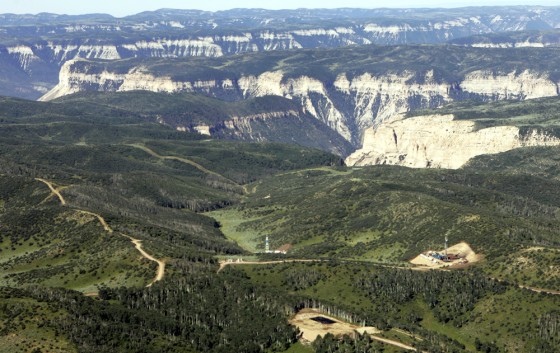
Environmental groups set off a war of words with energy companies by releasing a report that they said puts taxpayers on the hook for the cost of cleaning up after the Rocky Mountain region’s oil and natural gas fields are tapped.
Drilling across the region is expected to boom in coming years amid growing demand for oil and natural gas and as federal policies encourage further development, the author of the report said.
“In Wyoming, we’re talking about essentially doubling the number of sites that can be drilled in the next 10 years from the number of sites drilled in the past 80 years,” said Jim Kuipers of the engineering consulting firm Kuipers and Associates in Butte, Mont.
“In the Powder River Basin of Wyoming and Montana, we’re talking about possibly 77,000 new wells over the next 10 to 20 years,” he said.
The report, released Wednesday, was commissioned by the Western Organization of Resource Councils, a regional network of environmental groups, based in Billings, Mont.
Industry view
Ken Wonstolen of the Colorado Oil and Gas Association said taxpayers are not at risk as Kuipers warns.
“Even if an operator disappears overnight, you’ve got productive assets producing oil and gas that some other company will assume,” Wonstolen said. “I’m not aware of the taxpayer ever having to step in.”
Bruce Hinchey, president of the Petroleum Association of Wyoming, said that in his state, taxpayers have never had to pay to clean up well sites because the cost has been covered by individual companies and the drilling industry.
Aiming for fees, royalties and jobs, Rocky Mountain states are in varying degrees giving drilling companies the green light to explore private and public lands.
Mining history cited
While the companies must give the states financial assurances they can afford to clean up drilling sites, the promises may not be kept if the companies go under, Kuipers said.
“We’ve seen this in the history of mining, so we can expect to see this in oil and gas drilling,” Kuipers said. He added that taxpayers would have to shoulder the financial burden of clean-up work if drilling companies fail.
A site’s environmental liability may range from $100,000 to $6 million or more, suggesting a risk to taxpayers in the billions of dollars, according to Kuipers’ research.
States must impose clear and specific requirements and standards for remediation and must demand the full cost of the work is guaranteed by drilling companies, Kuipers said.
“At the very most it would add a percent or two to their operating costs,” he said.