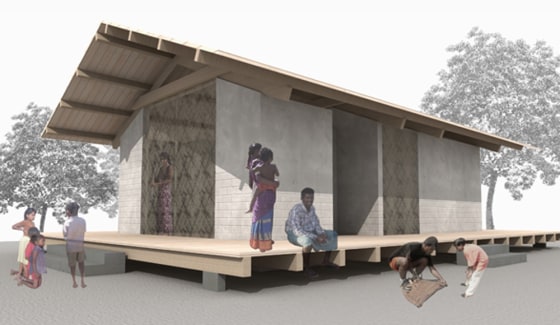
Researchers have designed a house they say is better able to withstand giant waves and are planning to build 1,000 of them in Sri Lanka, one of the countries hit by last year’s deadly tsunami.
Carlo Ratti, a teacher at the Massachusetts Institute of Technology, was at a wedding in Sri Lanka when the tsunami struck the region last December. When he returned to MIT, he worked on the design of the “tsunami-safe(r) house” with colleagues at MIT, Harvard University and the British engineering firm Buro Happold.
“The goal was low-tech construction with high-tech design,” Ratti, a civil engineer who heads MIT’s SENSEable City Laboratory, told Reuters on Thursday. “We came up with a design that is five times stronger than traditional (Sri Lankan) houses.”
Four is better than one
SENSEable and the Prajnopaya Foundation, a Buddhist nonprofit group, plan to build about 1,000 of the houses in Sri Lanka. Using the same type of materials typically used in the construction of traditional Sri Lankan homes, the more robust structures consist of four reinforced concrete pillars supporting a tin or tile roof.
The open design is stronger, Ratti said, because it would not block the flow of water were another tsunami to hit.
“Four small cores are stronger than a big one,” he said.
Safety at lower cost
The tsunami killed more than 180,000 people throughout Asia, with nearly 40,000 dead or presumed dead in Sri Lanka.
It devastated much of the island’s coast and 100,000 people still live in makeshift shelters nearly five months later.
“The problem in Sri Lanka is the government wants to relocate people from the coast further inland,” Ratti said.
“This would come at a huge social, cultural, environmental and economic cost. So the aim of this project is to investigate technological strategies that could guarantee safety at lower cost,” he said.
Each house would cost between $1,000 and $1,500 to build.