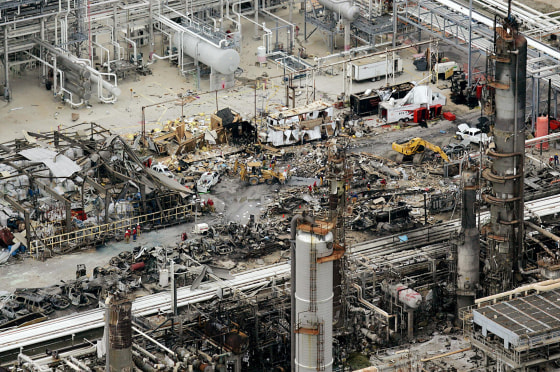
BP PLC, one of the world's largest oil companies, said Tuesday that failures by its staff led to the March explosion and fire that killed 15 workers and injured more than 170 others.
"The mistakes made during the startup of this unit were surprising and deeply disturbing," Ross Pillari, president of BP Products North America Inc., said in a statement. "The result was an extraordinary tragedy we didn't foresee."
The oil company released Tuesday its interim fatal accident investigation report on the March 23 blast at the Texas City plant's isomerization unit, which boosts the octane level of gasoline.
The investigation determined that the fluid level in the tower of the raffinate splitter, which separates chemicals for gasoline production, was 20 times higher than it should have been.
The report also said water or nitrogen in the tower when the isom unit was started may also have caused a sudden increase in pressure that forced hydrocarbon liquid and vapor into the blowdown stack.
But investigators still don't know what ignited the resulting vapor cloud.
Earlier theories have suggested that sparks from a running truck engine in the parking lot near the unit ignited the cloud.