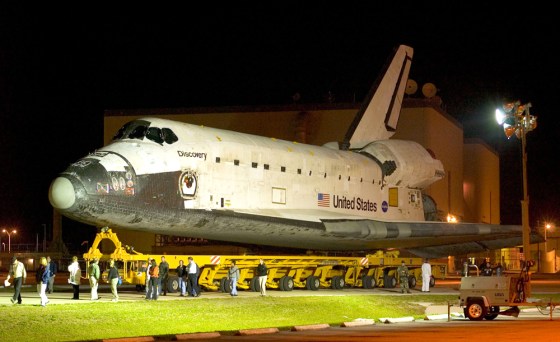
NASA passed a significant milestone in its two-year quest to return the shuttle fleet to flight when shuttle Discovery left its processing hangar early Tuesday and made a quarter-mile journey to the assembly building.
The move was the first tangible sign that NASA is beyond focusing on vehicle improvements after the 2003 Columbia space shuttle disaster and has turned its attention to something it has done 113 times already: prepare a space shuttle for launch.
"The big step is getting out of the (hangar) because now what is in front of us is relatively standard processing," said Kennedy Space Center spokeswoman Jessica Rye.
A newly designed external fuel tank and twin solid rocket motors already are positioned inside the massive assembly building, awaiting Discovery's arrival. Workers plan to attach a harness around the 100-ton spaceship, then use an overhead crane to hoist it into a vertical position so it can be attached to the fuel tank. The booster rockets already have been bolted to the tank.
Completing the dozens of mechanical and electrical connections will take another day, then several days of testing and certification are planned. NASA is scheduled to move Discovery to the launch pad next Monday.
Before Discovery is cleared for flight, however, NASA wants to test how well the new fuel tank does its job. The tank has been the primary focus of NASA's efforts to improve shuttle safety following the Feb. 1, 2003, Columbia accident.
The shuttle was destroyed and its seven-member crew killed because of damage to the ship's wing caused by a wedge of foam insulation falling off the fuel tank and striking Columbia during launch. The damage was undetected until 16 days later, when the shuttle attempted to fly through the atmosphere for landing. Superheated gases ate into the wing breach, dooming the ship and crew.
Upon recommendation of the Columbia Accident Investigation Board, NASA removed the foam wedges and installed heaters instead to keep ice from building up on the outside of the tank once it is filled with cryogenic propellants for launch. The agency has long been wary of ice breaking off the tank during launch and affecting the shuttle.
The tanking test, a 12-hour dress rehearsal for launch, is scheduled for April 14. "We want to let the team see how the new heaters react so they're not seeing something for the first time on launch day," Rye said.