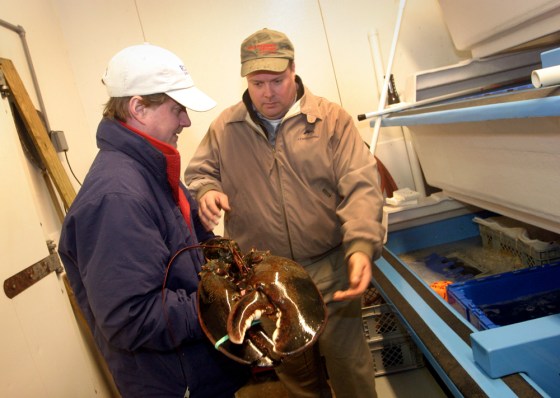
Jeff Grolig ordered a "large lobster" for the tank of his Potomac seafood store three weeks ago, confident he could sell it quickly, and for a handsome profit.
What he got from the seafood distributor was a gargantuan lobster and an outpouring of sentiment from customers who felt sorry for the 15-pound animal crammed into a tank alongside an assortment of its two- and three-pound cousins.
After Grolig spent days kibitzing over the ethics of his trade, the oversized crustacean, estimated to be between 35 and 40 years old, yesterday began a 400-mile journey back to its home waters off the coast of Massachusetts. One of the lobster's admirers purchased it for $150 -- about $30 more than Grolig paid from the wholesaler -- and he agreed to coordinate the animal's liberation with help from his friends.
"I've never had a lobster that big at this store before, and I won't have one that big again," said Grolig, owner of River Falls Seafood Co. and a 21-year veteran of the seafood trade. "About 30 percent of the people who saw him in the tank expressed concern. A few customers were really unhappy. . . . I'm really torn about the whole idea of these big lobsters. Does it really make sense to sell them?"
The question is a common one in restaurants, grocery stores and fish markets, where the meat is typically DOA. Lobsters are the exception, an animal consumers frequently come in contact with before it is killed and prepared for the platter. The large, old ones in particular inspire animal rights activists and seafood lovers alike to come to their rescue. People for the Ethical Treatment of Animals receives so many calls on the topic each week that it launched Lobsterlib.com, with advice on the safest way to transport the animals back to the wild.
How to protect giant lobsters?
But sometimes even the best of intentions backfire. From the business perspective, returning lobsters to the wild could help spur demand for them, said Joe Stofer, seafood manager for Whole Foods Market Inc. in the mid-Atlantic region.
"If a store keeps selling these big lobsters to people who take them out and let them go, the merchants simply think they're selling a lot of lobsters," Stofer said. "So they buy more."
And the rescues do not always work. Earlier this month, 23-pound Bubba attracted national attention when shoppers spotted him in a tank at a Pittsburgh seafood market and urged the Pittsburgh Zoo & PPG Aquarium to intervene. Bubba ended up in a quarantined tank at the zoo on March 1. But he died less than 24 hours later, presumably from the stress of being moved many times.
"Trying to save these really large lobsters that way is kind of a misguided thing to do because so many of them die anyway," said Diane Cowan, a senior scientist at the Lobster Conservancy, a nonprofit group in Maine that studies lobster fisheries. "If you really want to protect these animals, you should not harvest them in the first place."
Seeking 'spectator appeal'
Grolig said he never wanted a lobster as big as the one his niece affectionately calls Donovan. He wanted an eight- to 10-pounder. That size tends to sell -- quickly.
But add five pounds and it becomes a curiosity, he said.
Initially, Grolig thought Donovan's "spectator appeal" might draw customers to the store. However, the feedback turned a bit negative, and even he started feeling sorry for the animal. By the time the customer bought it for release, he was relieved.
The customer, who asked not to be named, wanted Grolig to keep the lobster in his tank at the store. He declined. Keeping the animal meant feeding it, which would create waste and throw off the bacteria levels in the tank. Grolig suggested sending it to Ocean City but learned that the waters along the shore were too shallow. He considered shipping it via FedEx to his in-laws in Maine, where fishermen are banned from keeping large lobsters. But he feared the animal would die en route.
That's when he contacted his seafood supplier, Kurt Friesland at J.J. McDonnell & Co. in Jessup, where Donovan has been since yesterday morning. The plan: Wrap the lobster in 20 pounds of seaweed and drive him today to a trucking company in Baltimore, which will transport him to Boston. He'll be kept at a seafood warehouse until lobster wholesaler John Bump arrives on Friday.
Bump occasionally sets loose lobsters he's not allowed to keep, such as egg-bearing females. Never has he sent one back to the wild at a customer's request, he said. Frankly, he doesn't "get it." But he doesn't mind helping out friends.
"I know when they get that old and that big they tend to get finicky," Bump said. "The fear is if you release them they won't eat or get back into their normal routine. But I think this one has a pretty good chance because I'm releasing him in cold water at a good time of year."
Dan McKiernan, deputy director of the Massachusetts Division of Marine Fisheries, said lobsters with shells longer than five inches (measured from the back of their eyes to the start of their tails) are protected up to 20 miles from shore at Cape Cod Bay. But that doesn't guarantee safety.
"The larger the lobster, the further it walks," McKiernan said. "We wouldn't expect a lobster of that size to remain close to shore forever."
The track record is not good. Aside from Bubba in Pittsburgh, there's 14-pound Hercules, rescued from a supermarket lobster tank last year by a group of schoolchildren in Port Angeles, Wash., who sent it to the Lobster Conservancy for release. Cowan, the conservancy's scientist, said Hercules died in his crate after arriving in Maine, probably because of trauma from the cross-country trip. Of the six lobsters her group has received since 2000, she counts only Freddy from Florida as a success story, she said.
Linda Ziciaula, a seafood lover, spotted Freddy in a tank at her favorite restaurant about three years ago, "fell in love with that ugly, beady-eyed creature," and talked the restaurant owner into giving it to her for free. "He was sympathetic," she said.
Ziciaula nourished him for days before sending him to Cowan, who gradually acclimated him to the correct water temperature, fed him for weeks, and watched over him daily as he learned to catch live food.
"When we released him, he hung out under my wharf for weeks," Cowan said, though she does not know for sure if he is still alive.
Doing his part for the lobster population
Even if he only survived a month, it's worth it to Ziciaula. A 15-pound lobster produces about 20 times as many eggs over three years as a one-pound lobster, according to the University of Maine's Lobster Institute. They can mate only with males of equal size. "So if Freddy got out there and did his part for the lobster population in one month, that's great," said Ziciaula, a dog groomer who ate lobster until she met Freddy.
Chuck C. Anderson, vice president of seafood procurement for Giant Food LLC, said huge lobsters are usually purchased for special occasions by people with a lot of money to spend. And they taste just as good as the more common one-pounder if cooked properly.
"Sometimes the tail gets a little tough because it's so muscular," Anderson said. "It's like a round steak instead of a filet mignon."
Grolig's customer will never know. But she's not turned off lobsters altogether. The day she ransomed Donovan, Grolig said, the woman also ordered 10 pounds of lobster -- smaller ones -- for dinner.
Staff researcher Magda Jean-Louis contributed to this report.