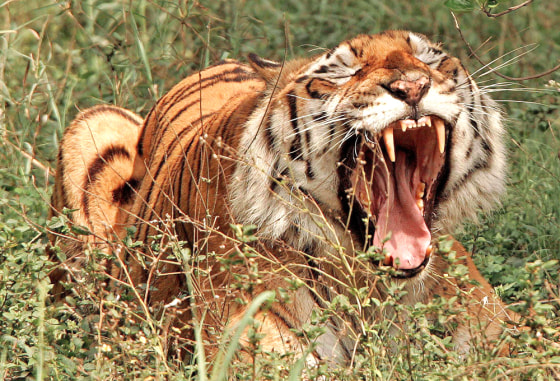
It was once one of the favorite hunting grounds of India’s royalty.
Flamboyant maharajahs combed the sprawling Sariska forest nestled in the low lying Aravali hills in the desert state of Rajasthan, hunting for the many tigers that roamed the jungle.
But, today, there’s an eerie silence in Sariska.
It’s been months since anybody heard a tiger roar in Sariska and activists fear the story may be the same in sanctuaries across India, which has almost half the world’s surviving tigers.
“It’s probably the biggest conservation scandal in modern times,” said Belinda Wright, executive director of the Wildlife Protection Society of India. “There are some parks with none or so few tigers it’s not a viable population. Sariska has been an incredible wakeup call.”
A recent World Wildlife Fund report says there may be no tigers left in Sariska, a rich deciduous forest that until last year was home to about 16-18 tigers.
“The damage to the Sariska Tiger Reserve is likely to have taken place between July and December 2004. If any tigers remain, their numbers are likely to be small,” said the WWF report.
Panic over India’s dwindling stock of tigers really set in after another non-government group said last month that at least 18 of 47 tigers in the famous Ranthambore Park, which is also located in Rajasthan, could have disappeared in the past year.
Then, the Times of India said this month that poachers may have also killed six big cats, including tigers and leopards, in another big sanctuary, Bandhavgarh in the central state of Madhya Pradesh, between last April and December.
Investigation ordered
Alarmed by reports of a rapid fall in tiger numbers, Indian Prime Minister Manmohan Singh has ordered a police investigation and created a new task force to save the endangered species.
He also banned giving tigers to foreign dignitaries and established a powerful wildlife crime prevention bureau.
Tigers are poached for their skin, claws and bones, all used in traditional Chinese medicine, and as coat trims. A single tiger is said to be worth some $50,000.
“Trade in tiger parts is very high,” said Ravi Singh, the World Wildlife Fund's India director. “For a few thousand dollars, people are willing to kill the tiger.”
A shrinking habitat and drought are further pushing India’s tigers towards extinction. According to government figures, the tiger population fell to 3,642 in 2001 from 4,334 in 1989. A century ago, there were an estimated 40,000 tigers in India.
“But we’d be very lucky if it’s even 2,000, going by some recent seizures,” said Wright. “Every tiger reserve in India without exception suffers from habitat pressure and poaching.”
Bandhavgarh, Sariska and Ranthambore, the showpiece of India’s tiger conservation program, are big on the country’s wildlife tourism map. Former U.S. President Bill Clinton spotted a tiger in Ranthambore five years ago.
Villager: No tiger seen in eight years
While the circumstances vary from park to park, animal rights activists say Sariska exemplifies the overall state of the country’s wildlife management.
Wildlife teams scouring the Sariska reserve for tiger pug marks found no foot prints in December compared with 178 in the same month in the previous year.
The number of tiger sightings -- key evidence of tigers along with tiger droppings, the tiger’s kill and the cry of its prey -- also plunged from a peak of 388 in 1998 to just 43 last year.
“When we were young, we didn’t step out of the house in the evening because we were scared of tigers. You could hear them roar at night,” said Ram Babu Maheshwari, a villager living in the sanctuary, as he wrapped his grubby turban around his head. “But now children play around in the evening without any fear. We haven’t seen a tiger in eight years.”
Traffic is heavy as some 2,500 people live inside the sanctuary in 28 villages with about 35,000 cattle. A highway runs through the park bringing in a steady stream of people.
The people have resisted calls by the government to move out of the reserve saying they have been living there for decades.
“So there’s a constant man-animal conflict. Many tigers and leopards have been run over,” said Priya Ranjan, a forest conservationist in Sariska.
Others say it’s hard to comb such a large forest spread over an area of 328 square miles.
“The Sariska reserve is so large that it’s not possible to have commando-style combing,” said S.R. Yadav, another forest conservationist in Sariska. “People expect to walk into the park and see a tiger running after its kill in the next hour, just like on TV. But they don’t realize it’s taken five years to shoot that one-hour film.”