Archaeologists unveiled Sunday the tomb of a member of a powerful family that governed a swath of western Egypt about 2,500 years ago, along with a dozen recently discovered mummies from Roman times.
The mummies are among 400-500 located thus far in what Egypt has dubbed the Valley of the Golden Mummies — grounds where thousands were believed entombed.
The rare limestone sarcophagus that covered Badi-Herkhib — the elder brother of a governor of Bahariya who lived around 500 B.C. — was discovered last week, allowing archaeologists to more closely study a family that ruled this part of Egypt.
"This family was so powerful, so wealthy, that they could import the limestone from about 100 kilometers (62 miles) away," said Mansour Boraik, a senior archaeologist overseeing the Bahariya site.
The large sarcophagus was several inches thick and weighed an estimated 15 tons.
The cemetery, covering about 2 square miles, is located 235 miles southwest of Cairo. Egypt's chief archaeologist, Zahi Hawass, said the discovery of Badi-Herkhib's tomb was unexpected. "As a matter of fact, the family tree did not mention the person we found," Hawass said. He said the tomb was robbed during the Roman era.
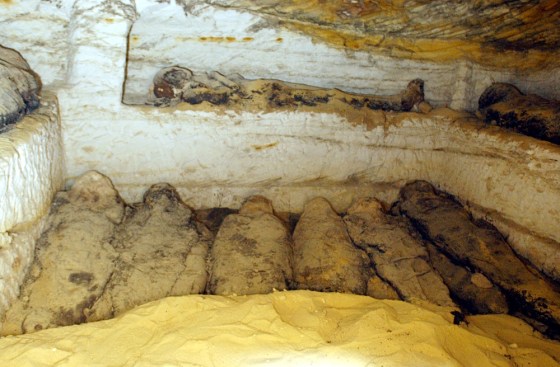
A dozen mummies from middle-class backgrounds also were displayed in their family tomb in a different part of the burial grounds. The mummies, most of them in a deteriorated condition, were found in three burial chambers, lying in neat rows.
The mummies were part of a group of about 20 found last week. Boraik estimated the cemetery holds about 15,000 mummies. The mummies discovered last week were not gilded, according to Boraik. The Egyptian antiquities council said otherwise last week.
Greek gold coins found with the mummies were believed to be left to bribe the ferryman in the afterlife.
X-rays of more than 50 mummies have been taken to allow scientists to examine the causes of death and other details, Hawass said.
The Bahariya site, the largest excavation in Egypt, is known for its relics from the Greco-Roman period.