Editorial Standards

Latest News Today maintains rigorous editorial standards. Our team verifies information from trusted sources and provides context to help readers understand complex stories.

Last Updated: Sunday, May 17, 2026 at 04:05 PM
Category: Id

Editor's Note

Latest News Today provides comprehensive coverage and analysis of breaking news stories. This article is part of our ongoing coverage of wbna6064294, bringing you verified information from trusted sources with added context and expert perspective.

Why This Matters: Understanding the full context of this story helps readers make informed decisions and stay updated on developments that impact our community.

Microscope probes atomic frontiers

Researchers have developed an electron microscope image that can distinguish the individual, dumbbell-shaped atoms of a silicon crystal.
PENNYCOOK
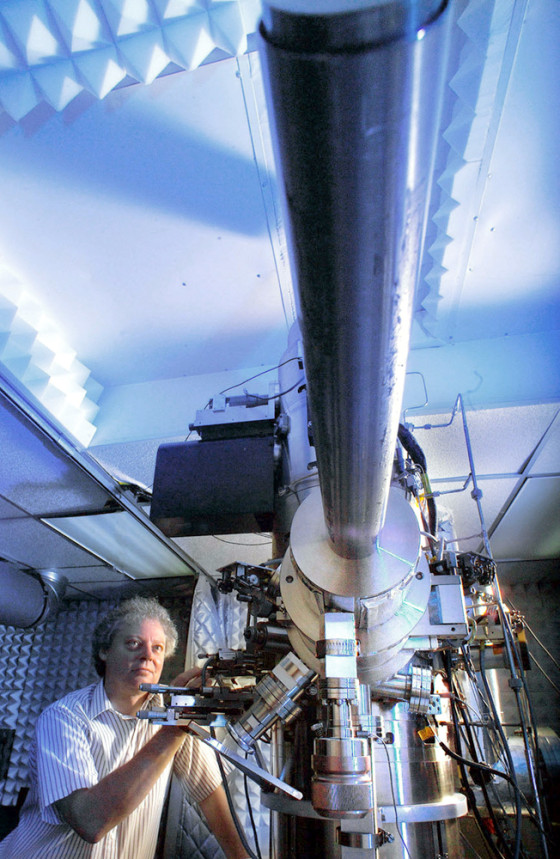
Researcher Stephen Pennycook adjusts an electron microscope on which a world record has been set for viewing the smallest objects at the Oak Ridge National Laboratory in Oak Ridge, Tenn.AP / ORNL

Oak Ridge National Laboratory researchers are peering into the atomic world with record clarity, developing an electron microscope image that can distinguish the individual, dumbbell-shaped atoms of a silicon crystal.

“Every time you see something more clearly you learn some secrets,” said Stephen Pennycook, who heads the lab’s electron microscopy group.

In last Friday's issue of the journal Science, Pennycook and colleagues wrote that they have achieved an image resolution at 0.6 angstrom, breaking the previous record of 0.7 angstrom which the lab set earlier this year.

An angstrom, the smallest wavelength of light, is about 500,000 times smaller than the thickness of a human hair.
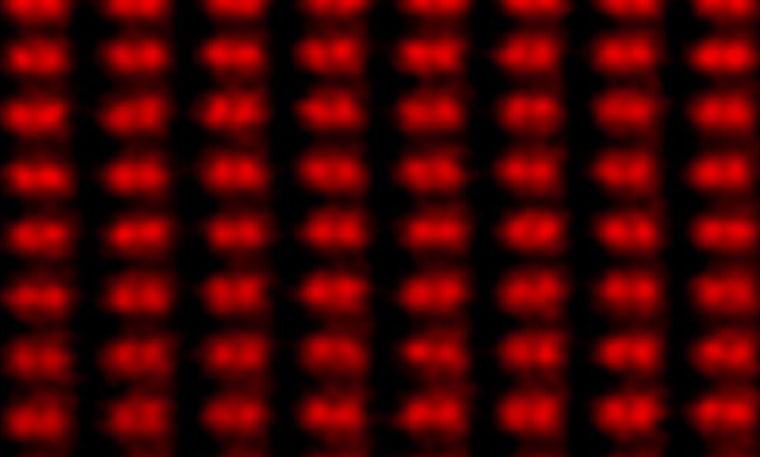
Looking straight down on a silicon crystal, this undated image from the Oak Ridge National Laboratory in Oak Ridge, Tenn., shows dumbbell-shaped rows of atoms at a world record resolution of 0.6 angstrom - about 1 millionth the diameter of a human hair. The results were appeared in a Sept. 17, 2004, article in the Journal Science. (AP Photo/ORNL)
Looking straight down on a silicon crystal, this undated image from the Oak Ridge National Laboratory in Oak Ridge, Tenn., shows dumbbell-shaped rows of atoms at a world record resolution of 0.6 angstrom - about 1 millionth the diameter of a human hair. The results were appeared in a Sept. 17, 2004, article in the Journal Science. (AP Photo/ORNL)Ho / OAK RIDGE NATIONAL LAB

Researchers say being able to see how materials bond together at an atomic level could prove a significant benefit to the semiconductor industry, chemistry and in the development of new materials.

For its latest findings, the Oak Ridge lab used a 300-kilovolt state-of-the-art electron microscope aided by new computerized imaging technology developed by Nion Co. of Kirkland, Wash.

The technology, called aberration correction, fixes imperfections on the microscope’s electron lenses.

“We are crossing that threshold where we can really see atoms clearly for the first time ever,” Pennycook said.

Pennycook compared the resolution correction technology to being able to focus 50 lenses simultaneously.

“That is what makes it really quite a historic achievement because it has been attempted for the last 50 years actually, and only in the last few years has it really proved feasible,” he said.

Five years ago the Oak Ridge lab set a world record with a resolution at 1.3 angstrom without the aberration technology. Researchers said the next frontier will be seeing atoms in three dimensions.