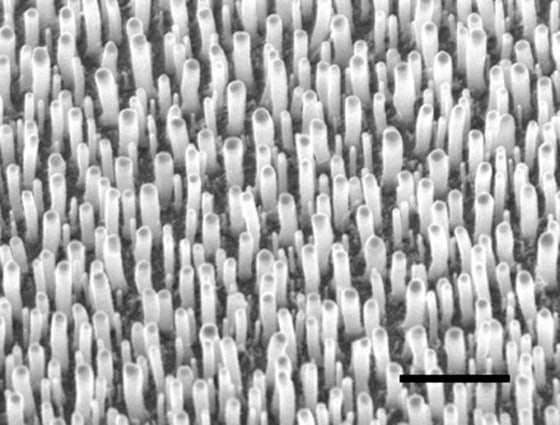
Researchers said Friday they have invented an antenna that captures visible light in much the same way that radio antennas capture radio waves.
They say the device, using tiny carbon nanotubes, might serve as the basis for an optical television or for converting solar energy into electricity, once properly developed.
Radio and television signals are captured using antennas close to the size of the wavelength of broadcast radiation. These are often huge — thus the need for tall antennas. In a receiver, the wave excites electrons into meaningful currents, which are amplified and tuned to carry sound and pictures.
But light is carried by photons — tiny packages that have the properties of waves and particles. They are visible because cells in the eye capture them, but no one had been able to make a device small enough to act as an antenna.
Yang Wang and colleagues at Boston College used carbon nanotubes, which are microscopic structures built out of carbon atoms. The tubes are aligned randomly.
The light excites miniature electrical currents, they write in the latest issue of the journal Applied Physics Letters.
A visible-light antenna might work by receiving a television signal superimposed onto a laser beam sent down an optical fiber, the researchers said.
This technology may improve the efficiency and quality of television signals.
Or it could be used as the basis of an efficient solar energy device that turns incoming light into an electrical charge to be stored in a capacitor, they said.