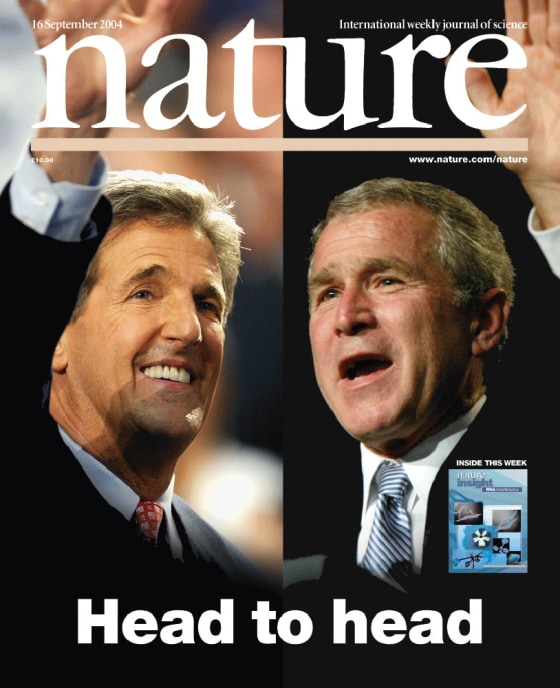
President Bush defended restrictions on stem-cell research on Wednesday and reaffirmed support for nuclear-arms development, but Democratic challenger John Kerry accused Bush of putting ideology over science.
Both candidates in this year's presidential election detailed their science policies in written responses to questions posed to their campaigns by the journal Nature.
During Bush's first term, the United States quit an international pact to reduce the greenhouse gases blamed for global warming, moved to revive a dormant nuclear-weapons program, and made broad changes in environmental policy.
Bush, a Republican, defended these positions and pledged more of the same in his replies to Nature.
He pledged to keep restrictions on federal funding for stem-cell research involving human embryos, despite pressure from hundreds of scientists and both parties in Congress. The restrictions limit federal cash to batches of human cells taken from embryos before August 9, 2001.
"I am committed to pursuing stem-cell research without crossing a fundamental moral line," Bush said. He said the federal government last year had spent $25 million on embryonic stem-cell research, and nearly $191 million for research involving adult stem-cells.
Kerry, a Massachusetts senator, said he would lift Bush's "ideologically driven restrictions" on stem-cell research but ensure rigorous ethical oversight.
Nuclear weapons
Bush said he had increased funding for "nuclear-weapons activities" following a decline since the Cold War's end, while Kerry said he would halt the search for a new generation of nuclear weapons.
Bush also said the United States would find its own solutions to global warming.
He said "considerable uncertainty" remained about the causes and effects of climate change. A Bush administration report in August concluded that warmer temperatures in North America over the last half-century were probably caused by human activity, but Bush said at the time he did not think the report represented a shift in administration position.
Kerry pledged a U.S. return to international talks on global warming and said he would tap the "ingenuity of American industry" to fight the problem.
Kerry also accused Bush of allowing ideology to play a role in the Food and Drug Administration drug-approval process -- an apparent reference to the FDA's decision to disregard the recommendation of an expert panel and withhold approval of a controversial new contraceptive.
Bush countered that the FDA's bureaucratic process was now faster and set a "gold standard" for introducing new therapies and ensuring safety.
Both men pledged a return to space, but Kerry accused Bush of setting "lofty goals" that lacked financing.
Kerry also accused Bush administration of failure to protect the United States from bovine spongiform encephalopathy (BSE), or mad-cow disease, and pledged to improve food safety.
The U.S. Agriculture Department said this month it plans step up testing of slaughtered cattle more than tenfold by the end of 2005.