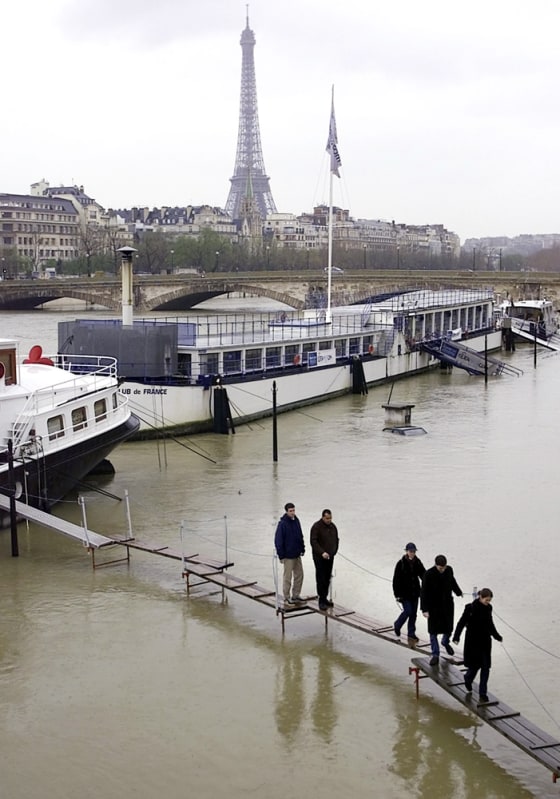
Europe is warming up more quickly than the rest of the world, and cold winters could disappear almost entirely by 2080 as a result of global warming, the European Union's environment institute predicted Wednesday.
Heat waves and floods are likely to become more frequent, threatening the elderly and infirm, and three quarters of the Swiss Alps’ glaciers might melt by 2050, according to a study by the European Environment Agency.
“This report pulls together a wealth of evidence that climate change is already happening and having widespread impacts, many of them with substantial economic costs, on people and ecosystems in Europe,” EEA executive director Jacqueline McGlade said in a statement.
The average number of climate-related disasters per year doubled over the 1990s compared to the previous decade, costing economies around $11 billion a year, according to the report — the first by the agency on the impact of global warming on Europe.
Warmer winters, hotter summers
“Projections show that by 2080 cold winters could disappear almost entirely and hot summers, droughts and incidents of heavy rain or hail could become much more frequent,” the report said.
Climate changes are likely to increase the frequency of floods and droughts like those that hit Europe in the past years, damaging agriculture and making plant species extinct, the agency concluded.
The floods that swept through 11 European countries in 2001 killed about 80 people, while last year’s heat wave in western and southern Europe claimed the lives of more than 20,000.
The EEA findings echo those published last week by U.S. climate researchers who predicted that heat waves might become more common as global warming heats Earth. Those researchers said regions already prone to heat, such as the U.S. Midwest and Europe’s Mediterranean area, could suffer even more.
The concentration of carbon dioxide, one of the heat-trapping greenhouse gases blamed for global warming, in the lower atmosphere is now at its highest level for at least 420,000 years and stands 34 percent above its level before the Industrial Revolution, the EEA report said.
Temperature predictions
According to the agency’s study, temperatures in Europe have risen by an average of 1.7 degrees Fahrenheit over the past 100 years and are projected to climb by a further 3.6 to 11.3 degrees this century due to the rise in greenhouse gas emissions.
That compares to a global rise in temperatures of 0.36 to 1.26 degrees in the past century and a forecast of another rise of 2.52 to 10.4 degrees this century, said the report.
The researchers said glaciers in eight of Europe’s nine glacial regions were at their lowest levels in terms of area and mass in 5,000 years.
They forecast that sea levels in Europe would rise at a pace more than two-to-four times faster than the rise seen in the last century — a threat to low-lying countries such as the Netherlands, where half the population lives below sea level.
Additional background is online at org.eea.eu.int/PR/Newsreleases/.