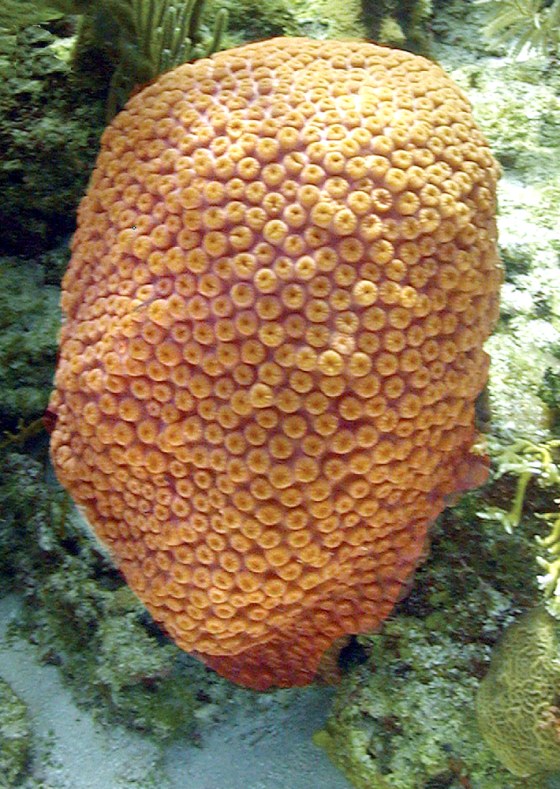
The soft orange glow of a common Caribbean coral comes not from the coral itself but from bacteria that live inside it, scientists said Thursday.
And the bacteria not only give the coral a little night light, but they also break down seawater to help nourish the coral, the researchers said.
Michael Lesser of the University of New Hampshire and colleagues were studying the Caribbean Great Star coral, known scientifically as Montastraea cavernosa.
It grows in formations that resemble large boulders or rock shelves and often emits a fluorescent glow, typical of the algae known as zooxanthellae. These are known to exist symbiotically with coral, providing their hosts with food such as carbohydrates.
But sometimes the coral glows during the day, absorbing blue light and emitting orange. This is more typical of bacteria, the researchers wrote in this week’s issue of the journal Science.
Lesser’s team took a closer look and found both algae and bacteria were living in the coral.
The bacteria, a type called cyanobacteria, were providing the coral with nitrogen, they found.
Corals need nitrogen to grow, but most of the nitrogen in seawater comes in a form that the corals cannot use. The bacteria convert nitrogen in seawater into ammonia, which the corals can use, Lesser found.
And the symbiosis may work three ways. The nitrogen from the cyanobacteria may also help the zooxanthellae algae, which may return the favor by giving the cyanobacteria carbohydrates — in this case, glycerol — as fuel, the researchers said.