The abrupt abort of an ambitious spacewalk from the international space station was caused by a stuck switch and not a dangerous oxygen leak, NASA says.
American astronaut Michael Fincke, making his first spacewalk on Thursday, was outside the airlock for less than two minutes before Russian ground controllers ordered him to return, along with Russian colleague Gennady Padalka.
Mission Control in Moscow detected a drop in pressure from Fincke’s primary oxygen tank, which might have indicated a dangerous leak.
But NASA said on Friday that an auxiliary switch for feeding oxygen to the Russian suit had been left in an “on” position, even though an indicator showed it was “off.”
Fincke tested the switch before leaving the airlock and returned it to the off position, something confirmed by an indicator light in his helmet, NASA said, but for some reason the mechanism stuck.
The result was the shortest spacewalk in U.S. history.
“The Russians completely exonerated the crew of any mistake,” said NASA spokesman Rob Navias.
Meeting set for Tuesday
Mission managers will meet on Tuesday to reschedule the spacewalk, which is tentatively set for that evening.
The success of the mission could prove vital to the space station’s operations. Only two of four large gyroscopes that keep the 200-ton station stable in flight currently work. Another gyro failure would force the station to begin using up precious fuel stores as thrusters took over the job.
The astronauts are to replace a transistorized switch — NASA compares it to a circuit breaker — that has forced one gyro out of service.
The job was originally to have been a mainly American event, with the participation of the Russian Padalka, but the failure of two U.S. spacesuits forced a change of plans.
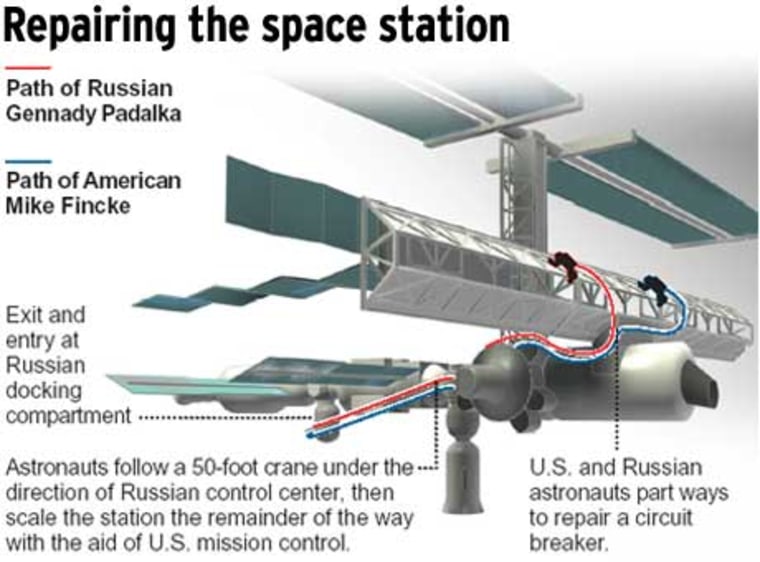
The crew will, as they did on Thursday, exit from the Russian end of the space station. After that, they will work their way over to the U.S. segment, a border crossing that requires mission control centers from both nations to be involved.
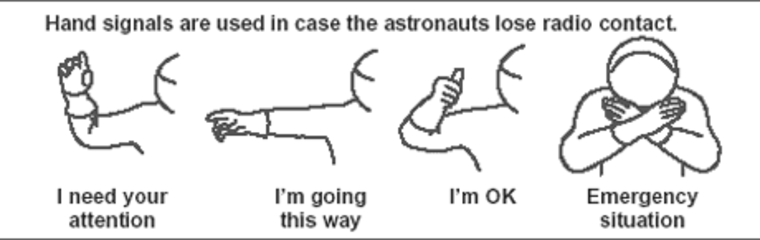
Because they will be beyond the reliable range of Russian antennas, they may be forced to communicate with one another using hand signals.