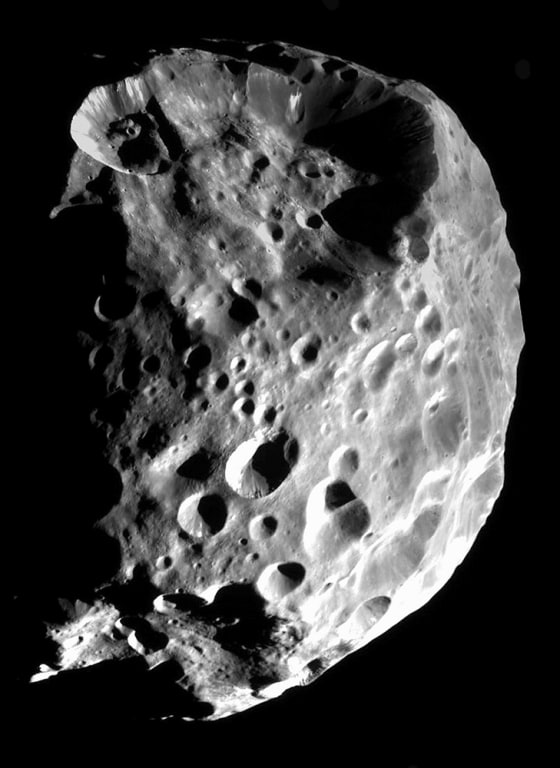
High-resolution pictures taken by the Cassini spacecraft during a flyby of Saturn’s largest outer moon suggest the banged-up rock hails from the outer reaches of the solar system, a mission scientist said Sunday.
Photographs released Sunday show shiny patches, probably ice, on the battered moon Phoebe, which is dotted with overlapping craters. The ice probably was excavated from under the moon’s surface as objects struck Phoebe over the eons.
“My suspicion so far from what we’ve seen is that it’s a body from the outer solar system,” said Carolyn Porco, leader of the Cassini imaging team.
The internationally built Cassini spacecraft came within about 1,300 miles of the dark moon Friday as it prepares to enter a four-year orbit to study Saturn, its rings and 31 known moons.
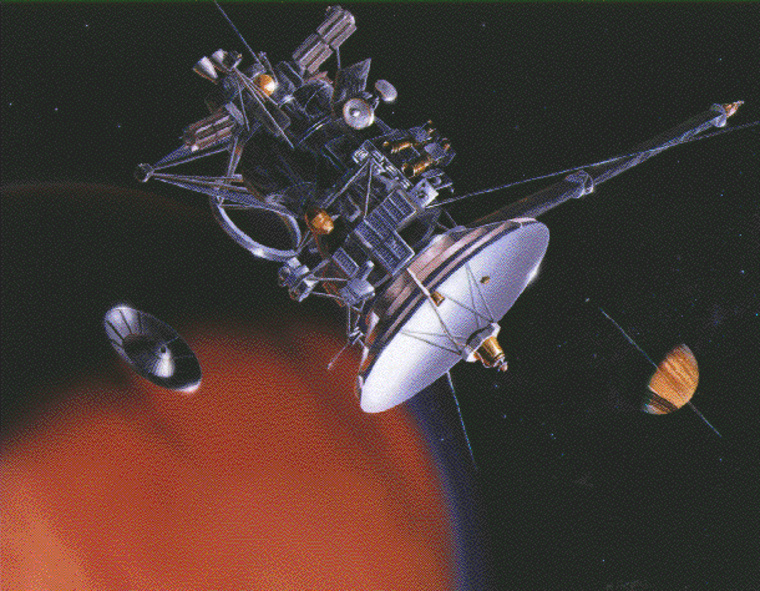
The $3.3 billion plutonium-powered spacecraft, which is carrying 12 science instruments and a probe, transmitted hundreds of images and data that scientists will pore over to determine Phoebe’s mass, density and composition.
The bright patches on Phoebe’s surface are one indication it is an icy body, Porco said.
Phoebe and a few smaller outer moons also orbit Saturn in the opposite direction of the planet’s inner moons. “That alone marks it as a body that was probably captured in Saturn’s orbit early in the life of the solar system,” Porco said.
Up next for Cassini is a trajectory correction scheduled for Wednesday to bring the spacecraft into position to become a satellite June 30.
Cassini also carries the Huygens probe, which is supplied by the European Space Agency and carries six instruments. The probe, set to be released in December, is expected to land on the surface of Titan, Saturn’s largest moon.