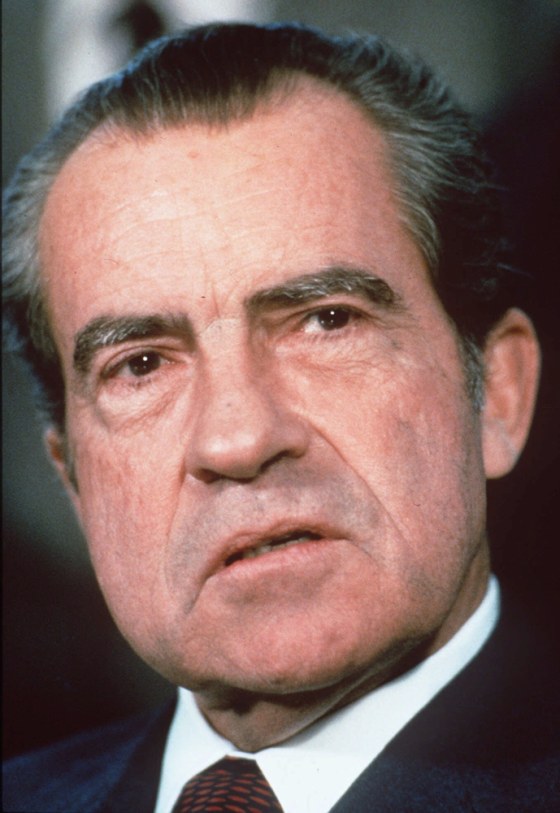
Five days into the 1973 Arab-Israeli war, with the superpowers on the brink of confrontation, President Nixon was too drunk to discuss the crisis with the British prime minister, according to newly released transcripts of telephone calls.
Henry Kissinger’s assessment of the president’s condition on the night of Oct. 11, 1973, is contained in more than 20,000 pages of transcripts of Kissinger’s phone calls as the president’s national security adviser and secretary of state — records whose privacy he had guarded for three decades. The National Archives released them Wednesday.
'He was loaded'
They show the powerful adviser trying to manage world crises even as Nixon’s presidency teetered from the Watergate scandal that would consume his administration in August 1974.
In October 1973, U.S.-Soviet tensions were peaking over the Arab-Israeli war, and British Prime Minister Edward Heath’s office called the White House just before 8 p.m. to ask to speak with Nixon.
“Can we tell them no?” Kissinger asked his assistant, Brent Scowcroft, who had told him of the urgent request. “When I talked to the president, he was loaded.”
Scowcroft replied: “We could tell him the president is not available and perhaps he can call you.”
Call back in the morning
Kissinger said Nixon would be available in the morning.
At the time, Kissinger was both national security adviser and secretary of state, his dual titles testifying to his influence with the beleaguered president.
But it’s clear from the records that Nixon did not tell him everything. The next day, Kissinger knew Nixon would announce a new vice president to replace Spiro Agnew, who had resigned. But Kissinger did not know whom Nixon had chosen.
In a phone call with Nixon aide Alexander Haig, Kissinger said he could go along with New York Gov. Nelson Rockefeller — “that gives me no pain” — or anyone except former Texas Gov. John Connally — “a no-no.”
Instead, Nixon picked Gerald Ford.
The transcripts cover Kissinger’s phone calls with world leaders, politicians, White House aides, celebrities and journalists from January 1969 to the end of Nixon’s presidency in August 1974.