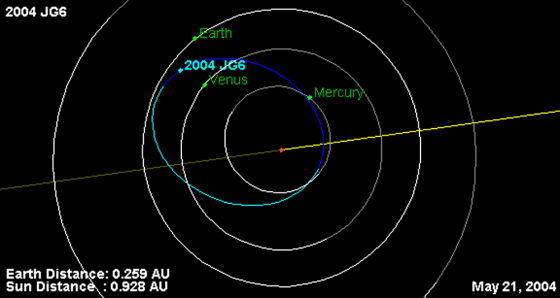
Astronomers announced Thursday the second known asteroid whose orbit is completely inside that of Earth. In a sense, it supplants Venus as the second rock from the sun.
Most asteroids orbit the sun between Mars and Jupiter. But a handful cross the path of Earth on elliptical trajectories. One had previously been found to move completely inside the annual path of our planet.
The newfound rock, named 2004 JG6, is currently between Earth and Venus and orbits the sun every six months. But its elliptical path takes it well inside the circle of Venus and even inside Mercury's path. On average, it is closer to the sun than Venus.
The object was first spotted May 10 by Brian Skiff as part of the Lowell Observatory Near-Earth Object Search in Arizona.
"I immediately noticed the unusual motion," Skiff said in a written statement, "so it was certain that it was of more than ordinary interest."
Follow-up observations by other professional and amateur astronomers helped pin down the asteroid's trajectory.
"What makes this asteroid unique is that, on average, it is the second-closest solar system object orbiting the sun," said Edward Bowell, the search program's director. It passes within 30 million miles (48.3 million kilometers) of the sun.
The asteroid is probably no more than 0.62 miles wide (between 500 meters and 1 kilometer). It poses no danger to Earth, astronomers said, because its path will not directly intersect that of the planet any time in the foreseeable future.
There may be 50 asteroids comparable in size to 2004 JG6 orbiting entirely inside Earth's travels. But because they spend much of their time in the glare of the sun, they are hard to find. The first one, 2003 CP20, was discovered last year.