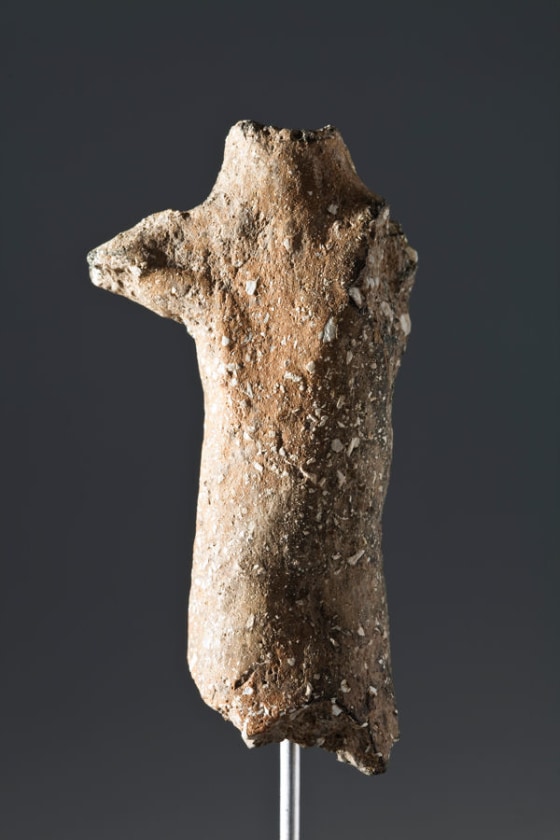
It's missing a head and some limbs, but an "enchanted" ceramic idol recently unearthed near Barcelona is thought to be the most ancient human figurine ever found in Spain, archaeologists say.
The 3-inch (8-centimeter)-long pottery fragment was uncovered over the summer during excavations at Can Sadurní cave in Begues, Barcelona province — a site perhaps best known for the discovery of the oldest evidence of beer-drinking in Europe. Researchers say the statuette is 6,500 years old, making it the most ancient human figurine from Catalonia, as well as the whole Iberian Peninsula.
The majority of Neolithic idols found in the Mediterranean are female, but the lack of breasts on the torso suggests this figurine is male, the researchers said. Holes in the arms indicate it was strung up with a cord or a leather strap to be used as a necklace or to decorate a cave home.
The figure is thought to have had some religious or spiritual importance, and "all its characteristics point towards what, in prehistory, can be defined as an idol," read a statement about the discovery from the University of Barcelona.
Because of its possibly magical significance and the fact that Begues residents are sometimes given the Catalan nickname "Els Encantats" ("The Enchanted"), archaeologists have called the figurine "El Encantat de Begues."
The lower limbs seem to be attached to the torso at an angle, suggesting, the researchers believe, that when the figurine was whole it would have been in a sitting position or would have had its legs bent. From what's left of its arms, the archaeologists believe its upper limbs were outstretched. The team also speculates that the figure's head would have been mobile and interchangeable, fitting into the neck-hole like a puzzle piece.
The dig at Can Sadurní is led by researchers from the University of Barcelona and the organization CIPAG (Collectiu per la Investigació de la Prehistòria i l'Arqueologia del Garraf-Ordal). The team hopes further excavations at the site will turn up other fragments of the figurine.
Follow LiveScience on Twitter . We're also on and .