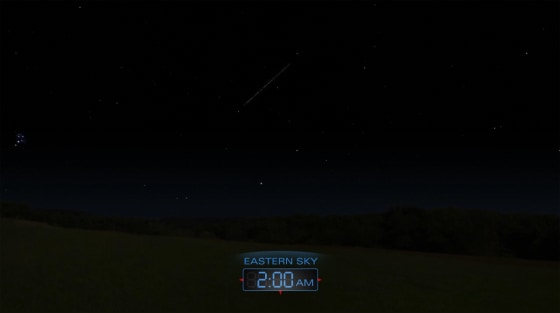
The annual Delta Aquarid meteor shower peaks this weekend, but skywatchers shouldn't get their hopes up for a dazzling show, experts say.
The Delta Aquarids should peak overnight from Saturday to Sunday — bad timing, since the streaking meteors will be sharing the sky for much of the night with a bright moon.
This year's shower is "basically going to suck, as the peak will be only 4 days from the August 2 full moon," Bill Cooke, head of NASA's Meteoroid Environment Office at Marshall Space Flight Center in Huntsville, Ala., told Space.com via email.
While the Delta Aquarids are visible from all over the globe, viewers in the Southern Hemisphere tend to get a better show because the meteors appear to radiate from the sky's southern reaches. Indeed, they seem to originate near the bright star Delta Aquarius (in the constellation Aquarius), which is how the shower got its name.
At its peak intensity this weekend, the shower is expected to generate about 16 meteors per hour in a dark sky, Cooke said. But skywatchers will have to stay up late to get the full effect; the moon won't set until after midnight local time.
Meteor showers are generated when Earth plows through streams of debris shed by comets on their path around the sun. These particles burn up in our planet's atmosphere, leaving behind brief, bright streaks in the sky.
Scientists don't know the identity of the Delta Aquarids' parent comet for sure, but they have a few ideas. The most likely candidate is perhaps 96P/Machholz, a comet discovered in 1986 by amateur astronomer Don Machholz.
While the Delta Aquarids may be somewhat underwhelming this year, skywatchers have another shower to look forward to in just a few weeks. The Perseids, considered by many stargazers to be the best meteor display of the year, are due to peak overnight from Aug. 12 to 13.
Editor's note: If you snap an amazing photo of Delta Aquarid meteor shower and would like to share it with SpaceE.com, send images and comments to Space.com Managing Editor Tariq Malik at tmalik@space.com.
Follow Space.com senior writer Mike Wall on Twitter or Space.com . We're also on and .