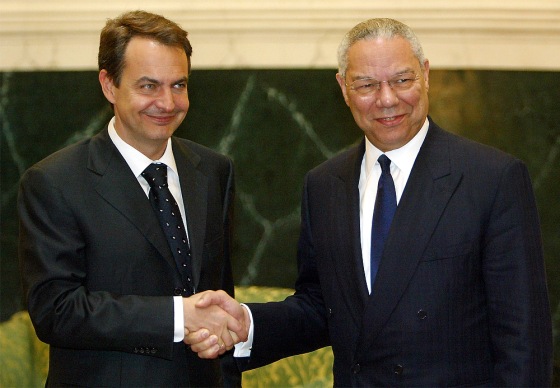
Colin Powell was fuming. The U.S. Secretary of State had been kept waiting for more than 30 minutes for his turn to meet José Luis Rodriguez Zapatero, Spain's prime minister elect.
Across the hallway in the Spanish Cortes, or parliament, Mr. Zapatero was having an intimate tête-à-tête with Jacques Chirac, the president of France. French diplomats accompanying the president were beaming. The two leaders, they said, were discussing how to work together "to forge an ambitious vision of the construction of Europe".
Earlier in the day, Mr. Zapatero and Tony Blair, the U.K. prime minister, had failed to find common ground on the permanence of Spanish troops in Iraq.
For a few hours on Wednesday, Madrid was the capital of international diplomacy, as world leaders attended a memorial service for the victims of the March 11 train bombings.
For Mr. Powell and many European leaders, the trip to Madrid was also an opportunity to meet the leader of Spain's future Socialist government, and witness first hand the seismic shift that is taking place in Spanish foreign policy.
Mr. Zapatero's Socialists defeated the ruling Popular party in a general election three days after Spain's worst terrorist attack. Mr. Zapatero's unexpected victory signaled an end to the pro-U.S. foreign policy carefully nurtured by José Mara Aznar, who is stepping down next month after eight years as prime minister. The tabular content relating to this article is not available to view. Apologies in advance for the inconvenience caused.
Mr. Zapatero immediately announced he would withdraw Spanish troops from Iraq unless the United Nations was given a much wider role in the country, and he promised that Spain would no longer be a divisive factor in Europe.
For a nation obsessed with protocol and symbolic manifestations of power, Mr. Zapatero's decision to meet the French president before the US secretary of state was accorded great significance.
In the event, Mr. Zapatero's meeting with Mr. Chirac was cut short as Mr.Powell threatened to cancel his appointment. The meeting between Mr. Zapatero and the US envoy lasted less than 15 minutes. According to US officials traveling with Mr. Powell, both sides stated their positions on Iraq and "agreed to keep the dialogue open".
Gerhard Schröder, the German chancellor, was the next in line to greet Mr. Zapatero. They know each other well from Mr. Schröder's summer sojourns in Mallorca. They may soon have a lot more in common.
Policymakers within the Spanish Socialist party are floating the idea of redeploying Spanish troops from Iraq to Afghanistan.
In this way, Mr. Zapatero would be able to honor his election pledge to withdraw troops from Iraq without seeming to be soft on terrorism.
Mr. Schröder, who opposed the US invasion of Iraq, has sent peacekeeping troops to Afghanistan.
In spite of the flurry of diplomacy, Mr. Powell and Mr. Blair left Madrid no wiser as to what would persuade Spain's new prime minister to support the U.S.-led occupation of Iraq.