Backers of a Yemeni Islamist party that signed on to a plan to nudge the president from power scuffled with members of a Shiite rebel movement frozen out of the deal on Tuesday, witnesses said.
They said loyalists of the Islah party traded blows with clubs and volleys of stones with members of the Houthi rebel movement, in the Sanaa square that has seen nearly a year of protests aimed at forcing the president from power.
Activists said at least 20 people were injured during the scuffles, which a representative of the Houthis said erupted when Islah backers attacked a tent they had set up to denounce the deal to edge President Ali Abdullah Saleh out of office.
That deal — crafted by Yemen's richer neighbors, and backed by a U.N. Security Council resolution and Washington — offers Saleh immunity from prosecution in exchange for handing power to his deputy, who is to work with a government including Islah and other opposition parties before a February presidential vote.
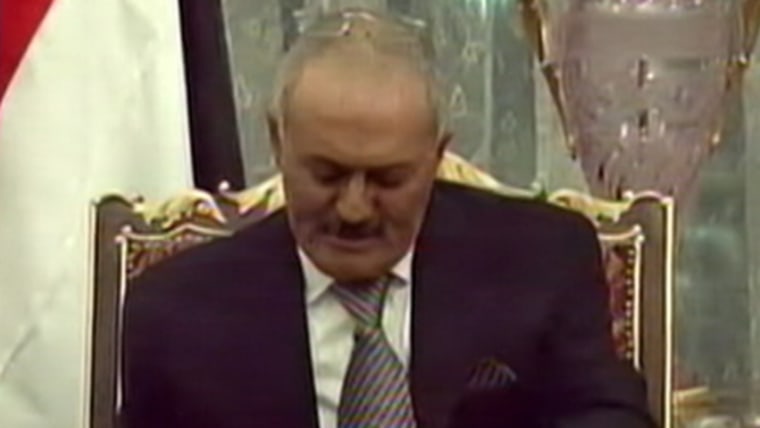
Saleh had backed out of the deal several times before signing it last month in Saudi Arabia, which shares U.S. fears that the struggle over Saleh's fate could descend into civil war and chaos that strengthens al-Qaida's wing in Yemen.
Meanwhile, the Obama administration is considering whether to allow Saleh into the United States for medical treatment.
'To get away from attention'
Saleh, said he planned a U.S. visit Saturday, hours after his forces killed nine people demanding he be tried for the deaths of hundreds of protesters during 11 months of protests against him.
He told reporters his trip would include medical tests. Saleh suffered burns and other injuries in an assassination attempt in June that capped fighting between his forces and those of a tribal faction influential in Islah.
The Yemeni leader characterized his intended trip as one of temporary exile.
"I will go to the United States. Not for treatment, because I'm fine, but to get away from attention, cameras, and allow the unity government to prepare properly for elections," Saleh said.
"I'll be there for several days, but I'll return because I won't leave my people and comrades who have been steadfast for 11 months," Saleh said.
White House spokesman Josh Earnest declined to say when a decision on whether to allow Saleh into the United States would be made. He denied a New York Times report that the embattled Yemeni president's petition was accepted and he could arrive at New York-Presbyterian Hospital as soon as the end of this week.
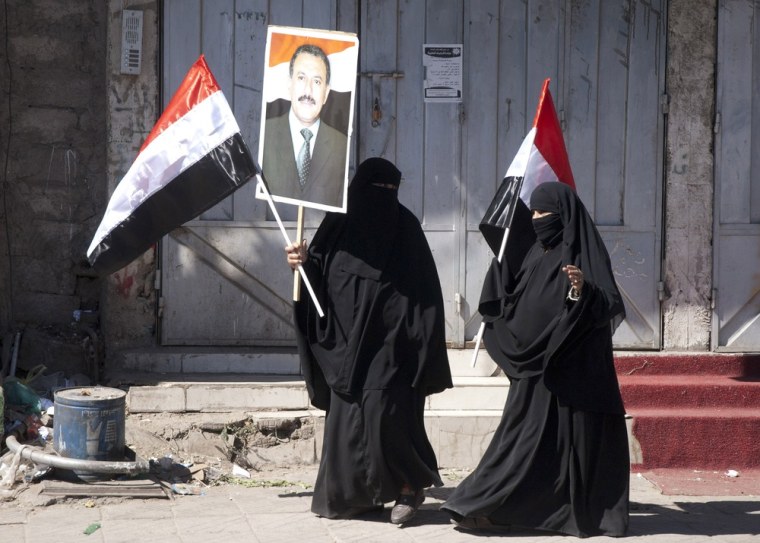
Hundreds of people were killed during months of protests seeking Saleh's ouster. The political deadlock reignited simmering conflicts with separatists and militants, raising fears that Yemen's al-Qaida wing could take a foothold on the borders of Saudi Arabia, the world's top oil exporter.
Allowing Saleh, who ruled Yemen for more than three decades, to get treatment in the United States could undercut Obama's message of supporting pro-democracy movements across the Arab world and condemning crackdowns on protests like those seen recently in Syria.
American officials are deeply concerned that the months of turmoil in Yemen have led to a security breakdown.
Pressure has been mounting in recent weeks for Saleh to leave Yemen altogether. Opponents say he has continued to wield influence through his loyalists and relatives still in positions of power, hampering the transition ahead of presidential elections set for Feb. 21. Many feared he would find a way to continue his rule.
The U.S. has experience with letting unpopular foreign leaders into this country for medical treatment.
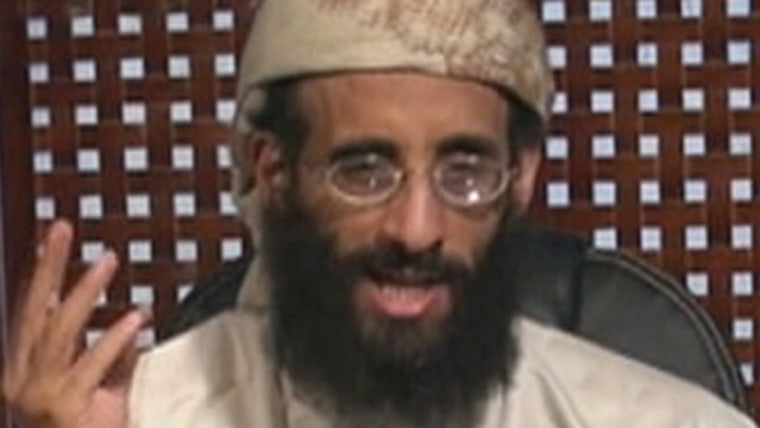
More than three decades ago, President Jimmy Carter allowed the exiled shah of Iran into the U.S. for medical treatment in October 1979, eight months after Ayatollah Ruhollah Khomeini led a revolution that ousted the shah and created the Islamic Republic of Iran.
On Nov. 4, 1979, Iranian students occupied the U.S. embassy in Iran. Fifty-two American hostages were held for 444 days in response to Carter's refusal to send the shah back to Iran for trial.
Any successor to Saleh would face multiple, overlapping conflicts including renewed separatist sentiment in the south, which fought a civil war with Saleh's north in 1994 after four turbulent years of formal union.