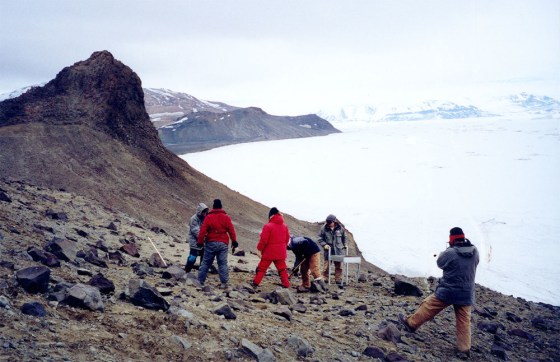
Two new species of dinosaur, one a quick-moving meat-eater and the other a giant plant-eater, have been discovered in Antarctica, researchers said Thursday.
The 70 million-year-old fossils of the carnivore apparently rested for millennia at the bottom of an Antarctic sea, while remains of the 100-foot-long (30 meter) herbivore were found on the top of a mountain.
The two teams of researchers, both funded by the National Science Foundation, said the dinosaurs lived in an Antarctica far different from today's — one that was warm and wet.
The little carnivore — about 6 feet (1.8 meters) tall — was found on James Ross Island, off the coast of the Antarctic Peninsula.
Not yet named, the animal probably floated out to sea after it died and settled to the bottom of what was then a shallow area of the Weddell Sea, said Judd Case of St. Mary’s College of California, who helped find the fossils.
Its bones and teeth suggest it may represent a population of two-legged carnivores that survived in the Antarctic long after other predators took over elsewhere on the globe.
“For whatever reason, they were still hanging out on the Antarctic continent,” Case said in a statement.
A second team led by William Hammer of Augustana College in Rock Island, Ill., found the 200 million-year-old plant-eater’s fossils on a mountaintop 13,000 feet (3,900 meters) high, near the Beardmore Glacier.
Now known as Mount Kirkpatrick, the area was once a soft riverbed.
Hammer and colleagues were scouring the area for fossils after having found other new species there in the 1990s.
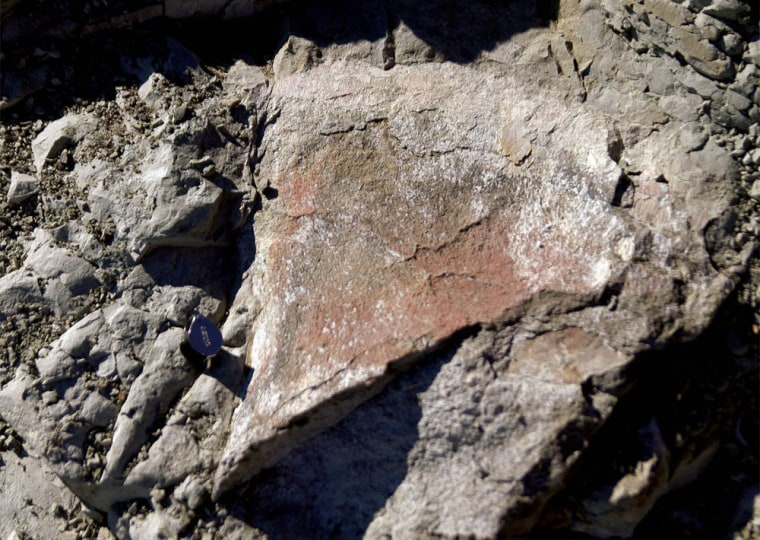
The team included Peter Braddock, a mountain safety guide.
“I jokingly said to him, ‘Keep your eyes down. Look for weird things in the rock,’” Hammer said in a statement. “He had marked four or five things he thought were odd, including some fossilized roots. But I realized that one of these things was bone: part of a huge pelvis and ilium.”
The animal would have been a primitive sauropod — a long-necked, four-legged grazer similar to the better-known brachiosaurs.
“This site is so far removed geographically from any site near its age, it’s clearly a new dinosaur to Antarctica,” Hammer said. “We have so few dinosaur specimens from the whole continent, compared to any other place, that almost anything we find down there is new to science.”