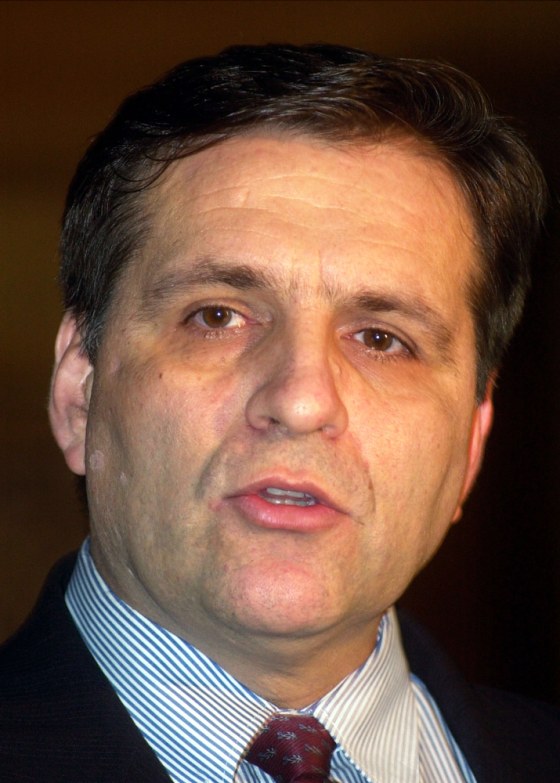
Long-divided Macedonians and ethnic Albanians united Friday in mourning President Boris Trajkovski, who was killed in a plane crash, as searchers cleared a path through mine-strewn Bosnian mountains to recover his body.
Police in a helicopter found the wreckage of Trajkovski’s plane more than 24 hours after it crashed Thursday in heavy fog, said Capt. Dave Sullivan of Bosnia’s NATO-led peacekeeping force. Pieces of the plane were strewn over a 200-yard area near the village of Huskovici, about 50 miles south of Bosnia’s capital, Sarajevo.
Trajkovski was en route to an international investment conference in Bosnia when his small plane crashed Thursday in a remote, mountainous region still sown with mines from Bosnia’s 1992-1995 war.
Explosives experts cleared a path to the wreckage and the bodies of Trajkovski, six other Macedonian officials and the two pilots were recovered Friday and sent to a morgue, officials said. The bodies will be identified before being returned to Macedonia.
Macedonian prosecutor Roksanda Krstevska told Bosnian state radio that searchers found the flight data and cockpit voice recorders, which could provide clues to the cause of the crash.
President was a moderate
Flags flew at half-staff and Macedonia began three days of mourning as Macedonians and ethnic Albanians vowed to maintain Trajkovski’s efforts to quell tensions in the volatile Balkan country.
The death of Trajkovski, a 47-year-old moderate, comes at a critical time for a nation still tense after its mostly Muslim ethnic Albanian minority took up arms in 2001 in a fight for greater rights.
“His death has brought us all closer together,” said Afrodita Halili, 23, an ethnic Albanian. “I hope we find the strength to remain together.”
World leaders expressed hope the country would not lapse into instability.
President Bush called Trajkovski “a distinguished leader and a great friend of the United States” who “showed extraordinary courage in leading his country from the brink of civil conflict to peace.”
European Union foreign policy chief Javier Solana flew to the capital, Skopje, to meet with government leaders and urge all Macedonians to “show courage, unity and maturity ... at this time of great loss.”
Pope John Paul II sent a message saying he was praying that Trajkovski’s “resolute commitment to peace will inspire the nation to continue steadfastly upon the path of dialogue, mutual respect and reconciliation.”
Coalition government vows to keep peace
Macedonian officials and their ethnic Albanian partners in the country’s power-sharing government pledged to respect a Western-brokered peace deal that has kept Macedonia mostly peaceful since 2001.
“Our party will work together with coalition partners to achieve the goals that Boris Trajkovski set,” said Teuta Arifi of the Democratic Union for Integration, a party formed by disbanded ethnic Albanian rebels.
Prime Minister Branko Crvenkovski said his government was “determined to keep Macedonia on its course, to maintain the peace process without any faltering.”
Trajkovski was widely respected for his neutral stance in the former Yugoslav republic. He called for a greater inclusion of ethnic Albanians in state bodies and institutions and was widely hailed for his efforts to get both sides to live together peacefully.
A Methodist minister, Trajkovski studied theology in the United States, where he converted from Orthodox Christianity. In November 1999, he was elected the second president in Macedonia’s history.
His first major challenge came in 1999 when hundreds of thousands of ethnic Albanians poured into northern Macedonia from neighboring Kosovo to flee the Serbian troops of former Yugoslav President Slobodan Milosevic.
Trajkovski promptly called on the international community to aid Macedonia and help the Kosovo refugees. The country opened its borders and allowed NATO to station troops there in preparation for punishing airstrikes against Serbia.
A bigger test came in 2001, when Macedonia’s ethnic Albanians launched their insurgency to fight for more rights for their minority, which comprises 500,000 of the country’s 2 million people.
Through six months of bitter fighting, Trajkovski calmly steered the nation toward the Western-brokered peace deal.
Former rebel leader Ali Ahmeti praised Trajkovski’s courage and called his death a great loss.
“We all have to aim that this country is led by someone who is going to respect all of the people of Macedonia,” he told Voice of America radio Friday.
Macedonia’s parliament speaker, Ljupco Jordanovski, was named acting president. The law requires a vote to elect a new head of state within 40 days, but no date has been set.