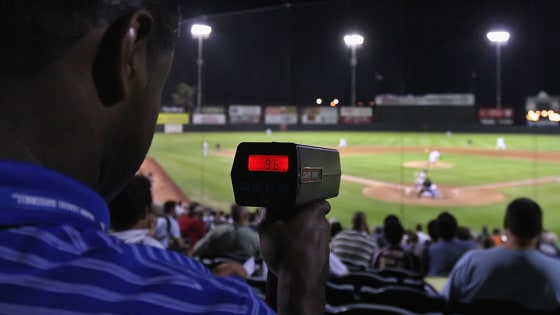
For a couple of days this week, you won't see Damon Iannelli or Jeff Wood at a baseball game somewhere in the Southeast. Which is weird, because that's where you can find them most any other day.
But the annual Major League Baseball draft begins Monday, and more than 1,500 amateur players from the United States, Canada and Puerto Rico will have their names called for an opportunity millions more never receive.
For everything you hear about teams signing high-priced free agents, or general managers pulling off steals in the trade market, the lifeblood of all 30 major-league teams remains their scouting and player development systems.
And in fact, with the ever-escalating costs of doing business, these areas have become more important than ever. Everybody's pouring money into them, and those who do it best win.
The San Francisco Giants won the 2010 World Series behind a dominant, home-grown starting rotation and closer. The Texas Rangers got there with a big boost from products of their farm system. Everybody knows the Tampa Bay Rays' Goliath-slaying story of two division titles and a pennant in three seasons. And the Colorado Rockies, Minnesota Twins and now the Kansas City Royals are three more build-from-within success stories.
And it all starts with the amateur draft, which kicks off the cycle that soon will send high-school graduates and college players to small towns from Casper, Wyo., to Hickory, N.C., to begin their professional careers.
But long before that happens, area scouts like Iannelli and Wood get involved at the game's grass roots. They separate the prospects from the non-prospects, and then the prospects from the top-rounders who are getting increasingly larger signing bonuses.
With teams spending in the low eight-figures each year to sign their drafted talent, the evaluations of Iannelli and Wood and hundreds of other scouts like them have bigger financial implications than ever — not to mention the impact eventually felt in major-league stadiums.
Iannelli left his job as Southern Mississippi's baseball coach 16 years ago to work for the Colorado Rockies. Twelve of his finds have reached the big leagues, some if only for a cup of coffee.
Wood, the son of former Houston Astros general manager Bill Wood, has worked for the Texas Rangers since 2002. On several nights this season, the big-league club's lineup has included as many as three of Wood's signees.
This week, while their general managers and scouting directors are making the ultimate calls on who to pick where in the draft, Iannelli and Wood will be at home and on the phone, touching base with the players they have been scouting — many for a couple of years — checking signability possibilities and providing any other last-minute information they can.
This, after all, is their World Series. And just to get to this point each first week in June, so much more already has been involved:
Iannelli, 44, covers a wide swath of the Southeast from his home in Jackson, Miss. — a territory that stretches from the Florida Panhandle through Alabama, Mississippi, Eastern Louisiana and Arkansas.
He has part-time scouts in the latter two states to help him out, but that doesn't stop Iannelli from spending up to three or four nights a week in a hotel during the February-May peak scouting season, and 100-plus nights a year away from his wife and children ages 10 and 12.
The odometer on Iannelli's company car — a two-year-old Toyota Camry — already is pushing 80,000 miles, and he says, "I'm not alone. Everybody else does the same thing.''
But he says he's addicted to the job, and, "wouldn't want to do anything else.'' What keeps him grinding away every day — other than the cans of Skoal he keeps handy?
"It's a thrill trying to find guys,'' he said. "And when one of your guys gets called up to the big leagues, that's the best feeling a scout could have.''
Ask Iannelli if he has a favorite from among his dozen big-league signees, and he's quick to answer with a story.
"I'm sitting at a game in Atlanta, and I get a call from this weird area code I don't recognize,'' Iannelli said. "I answered it, thinking it was an agent or a coach. It was Brad Hawpe. He had just gotten called up (to the majors), and he thanked me for giving him a chance, for believing in him. That was a big thrill. I don't expect a guy to take the time out to do that.''
The Rockies drafted Hawpe off an LSU team that also included Mike Fontenot and Ryan Theriot, and won the 2000 College World Series. Despite hitting a home run in the semifinal round off Mark Prior, Hawpe slipped to the 11th round, as there were questions about his power and signability.
"We didn't outsmart anybody; we just took him,'' Iannelli said. "I knew that he wanted to go play pro ball. He told me he was tired of hearing that he didn't have enough power, and he was going to prove everybody wrong. I thought he was better than an 11th-rounder. He made me look smart.''
When Iannelli is home in Jackson he's up early, and after his wife (a school teacher) and kids are off to school, he spends his mornings writing reports and checking pitching matchups and weather forecasts before deciding which game to attend. This year's particularly nasty — and at times tragic — weather has had Iannelli dodging squalls and storm patterns all spring.
"All scouts have eyes on the weather,'' he said. "It seems to be getting worse every year. The last thing you want is to drive two-three hours, then get rained out.''
Iannelli's work days are so long and involved, he says he doesn't really have much time to watch major-league games. But that doesn't mean he can't keep tabs on his signees who have reached the show.
His car is equipped with XM satellite radio, and that allows him to check in on games. That really came in handy one Sunday in April, when he was scouting Braves reliever Craig Kimbrel's younger brother in a junior-college game in Alabama.
Iannelli periodically listened to a Rockies game in which one of his signees — right-hander Alan Johnson — was called up from Triple-A Colorado Springs to make an emergency start. Johnson, making his big-league debut at 27, struggled through four innings, allowing five runs on six hits and three walks. That was his only appearance before being sent back down, but he holds a special place in Iannelli's heart because he was signed for $1,000 as an undrafted free agent out of Mississippi State.
"He went under the radar, signed after his senior year,'' Iannelli said. "Upper-80s fastball, good curveball, kind of generic. Sometimes, those guys make it. And when they do, it's an even-bigger thrill. That gives you an extra jolt; it keeps you going.''
In the rare year, there may not even be an Alan Johnson within the scouting territory. That doesn't mean Iannelli and other scouts work any less diligently. It just means they come up empty — prisoners of the talent (or lack thereof) in their area.
"You can't create players,'' Iannelli said. "Sometimes, they're not there. That's just the nature of the business.''
But in other years, you can hit the mother lode. No less than five of Iannelli's finds in the 2004 draft turned out to be big-leaguers — infielder Chris Nelson (first round), outfielders Seth Smith (second round), right-hander Stephen Register (third round), right-hander Jim Miller (eighth round) and outfielder Dexter Fowler (14th round).
And sometimes, prospects are right in your neighborhood. Iannelli says he's known Smith since the outfielder was in high school, and that Smith's high-school coach lived down the street from him.
Smith, who also backed up Eli Manning on the University of Mississippi football team, slipped a bit to the second round in the 2004 draft, in part due to a subpar junior season. Iannelli remembers a crunch-time conversation with Rockies vice president of scouting Bill Schmidt.
"We were skittish, and Billy told me to think about it overnight, and I'll call you in the morning,'' Iannelli said. "It came down to one question: He asked me if I thought (Smith) was a big-leaguer, and I said, 'yes'. He said, 'OK, we're taking him'.
"We just rolled with what we had known about him in the past. I had seen him so many times. I think he was trying too hard to get drafted high. When he tries to hit homers, he gets away from his game, (power to all fields). That's what he was doing that year. He thought he had to hit homers to get drafted higher.''
ABOUT MORE THAN PHYSICAL TOOLS
Every scout in every organization grades the physical tools — arm strength, foot speed, power, etc. But as an organization, the Rockies place extra emphasis on a prospect's character and makeup.
Their big-league clubhouse — from Troy Tulowitzki to Ubaldo Jimenez to Aaron Cook, as well as Hawpe and Clint Barmes in years past — definitely reflects that emphasis.
"I've seen us walk away from good players because of makeup,'' Iannelli said. "Keli McGregor (the late team president), was huge on it. He got us (scouts) in a room and said, 'we want the best players with the best makeup'.
"The first question Dan (O'Dowd, Rockies executive vice president/general manager) will ask me when we're talking about a player is, 'what's his makeup?' We'll go the extra mile to find out what the kid is all about, his work ethic, if he'll fit in our system. It's worked for us.''
It's nothing new for Wood to go the extra mile — literally — driving to see a baseball game. He remembers back to the days when his father was the Astros general manager, and the entire Wood family would pile into a van and drive to places like Asheville, N.C., and Columbus, Ga., to see Astros farm teams in action.
Yes, you definitely can say that Wood, 37, grew up in the game and found his calling early in life. In his high school years, he was an Astros bat boy, and got to spend a lot of time around early-1990s players such as Ken Caminiti, Craig Biggio and Jeff Bagwell.
"Really good guys; they probably thought I was a pain in the …,'' Wood joked.
Wood went to the University of Texas and earned a degree in education/sports management, and one day in his sophomore year, while sitting through a rain delay at the Ballpark in Arlington with his father, Wood said he wanted to work in the game.
It just so happened that Bill Wood's friend Bob Deban, who operates a minor-league club in Eugene, Ore., was sitting nearby, and offered Jeff a job, and a career was launched. Wood's last six college credits were earned by working as an intern in the Rangers' scouting department, then he spent a couple years with the Kansas City Royals, went to scouting school, and landed back in the Rangers front office in 2002 under then-general manager Jon Hart.
"I thought I wanted to eventually become a general manager,'' Wood said. "But I really enjoy scouting. I like to get out and see talent. For me, there's something you can learn every day at the ballpark when it comes to getting a better yardstick of evaluating talent. When you stick your neck out and recommend a player, you really can make a mark for your organization. You can't do that in an office.''
How's this for making his mark? Out of a scouting territory that encompasses Alabama, Mississippi, Tennessee and the Florida Panhandle, Wood's signees include Derek Holland (25th round in 2006), Julio Borbon (sandwich round, 33rd overall in 2007), Tommy Hunter (sandwich round, 54th overall in 2007), and Mitch Moreland (17th round in 2007).
"There's satisfaction when any of your guys reach the big leagues,'' Wood said. "But a lot of it is based on where you pick a guy. The high-round guys are cross-checked by different people in your organization. But when you get a guy later (in the draft), he feels more like your guy. You really feel like you're earning your keep.''
A guy like Moreland, for instance, who went from 17th-rounder out of Mississippi State to big-league regular, and just last week reached a distant catwalk at Tropicana Field with a monstrous home run.
''My dad called me, and told me about it,'' Wood said. "I said, 'I hope they put it in the highlights'. My dad said, "oh, I think they'll put this one in the highlights'. When I saw it later, I was definitely shocked.
"Mitch has come a long way. He's turned into an every-day big-leaguer, and who knows what his ceiling is. He was a very humble kid. Called me 'Mr. Jeff'.''
Home for Wood is Birmingham, Ala., and he says he'd rather drive an extra hour or two to get back there whenever possible, as opposed to spending another night in a hotel. Wood also racks up about 40,000 miles a year on the road, and burns through cell phone minutes just as quickly.
"It seems like half the job these days is finding out pitching rotations, checking weather, schedule changes, etc.,'' Wood said. "Coaches want to get information out there. There's not a lot of hiding out guys any more. They want to get their kids exposed.''
When Wood first saw Holland at Wallace State Community College in Hanceville, Ala., the left-hander had a below-average fastball, and wasn't ready for professional baseball. But the Rangers wanted to stockpile left-handed pitching that year, and after Holland was impressive in a Junior College World Series appearance, they picked him under the old draft-and-follow concept (since changed), which allowed teams until right before the following year's draft to sign a player.
Sure enough, Holland began to develop in his second junior college season, his velocity increased, he gained command of his secondary pitches, and the Rangers had to give him around $200,000 to keep him from accepting a scholarship from Arizona State, or go back into the draft.
"Right away, he said he wanted to buy a condo next to the (Rangers' spring training) complex in Surprise (Ariz.), and get started,'' Wood said. "This kid had it figured out. That was a testament to his makeup.
"They made tweaks to his delivery, slowed it up a bit, and now he's (throwing) 95-96 mph. Nobody who saw him back then (at Wallace State) thought he would throw that hard. He filled out, and he kept getting better and better.''
On Saturday night, Holland ran his record to 5-1 with a complete-game shutout of the Cleveland Indians.
Coming down from the very top of the Rangers' organization — and who would expect anything else, when Nolan Ryan is your club president? — is the philosophy of stretching out starting pitchers to go deep into games. Wood falls right in line, saying he always has preferred durable, big-bodied guys — and he's quick to notes the irony that he's only 5-8.
One look at Tommy Hunter and you know he fits the 'big-bodied' description. He's 6-3 and thick, listed at 280 pounds. But what 2010 World Series watchers found out for the first time, Wood knew back when Hunter was at the University of Alabama: Hunter was a two-time junior judo champion as a kid, and one of the best athletes on the Crimson Tide roster.
Hunter reached the major leagues just 14 months after he was drafted, was in the majors to stay two years later, and is 22-12 in his short big-league career.
"Some guys may have thought he was out of shape; had a bad body,'' Wood said. "But he's just a big-bodied guy.''
But if there's ever a question in Wood's mind, or a problem he hasn't encountered, he knows exactly where to turn.
"My dad is my best friend; I know I can call him if I get in a jam,'' Wood said. "He's been through it all in 30-plus years in the game. He's my model. He's the reason why I'm in the game."