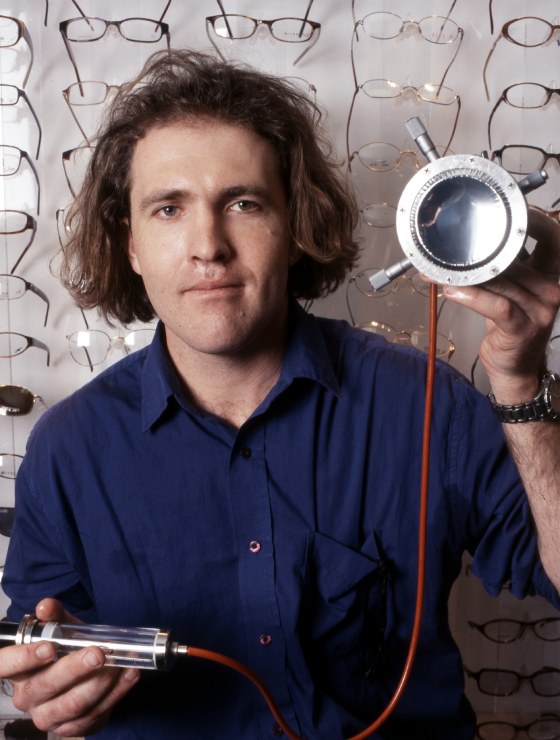
An MIT graduate student won the Lemelson-MIT Student Prize and $30,000 on Thursday for inventing a device that makes low-cost eyeglass lenses within 10 minutes.
Saul Griffith, a 30-year-old doctoral candidate, also created electronic goggles that diagnose vision problems.
Griffith, who grew up in Sydney, Australia, said that as a child he took apart anything he could — from Christmas toys to his mother’s camera — to see how they worked.
He tried a number of what he called “fairly crazy schemes” before coming up with a desktop printerlike device that uses liquid-filled molds to produce low-cost lenses quickly and cheaply.
Griffith became interested the project after a Kenyan official told him that an eyeglass scarcity was one of that country’s biggest problems.
Mass-produced lenses are fairly cheap, but an inventory of thousands of lenses must be kept on hand to meet various vision problems. That’s too expensive in some parts of the world.
Griffith’s invention uses baby oil to shape car window tinting film into a mold. A polymer is poured in between, and the lens is ready in five to 10 minutes.
His prototype electronic goggles offer accurate diagnosis of eye problems by using an electronic sensor to scan the wearer’s eye.
“If you can bring the device’s cost down very low ... you can imagine one in every school and every doctor’s office,” Griffith said.
The Lemelson-MIT Program was established in 1994 by the late inventor Jerome H. Lemelson and his wife.