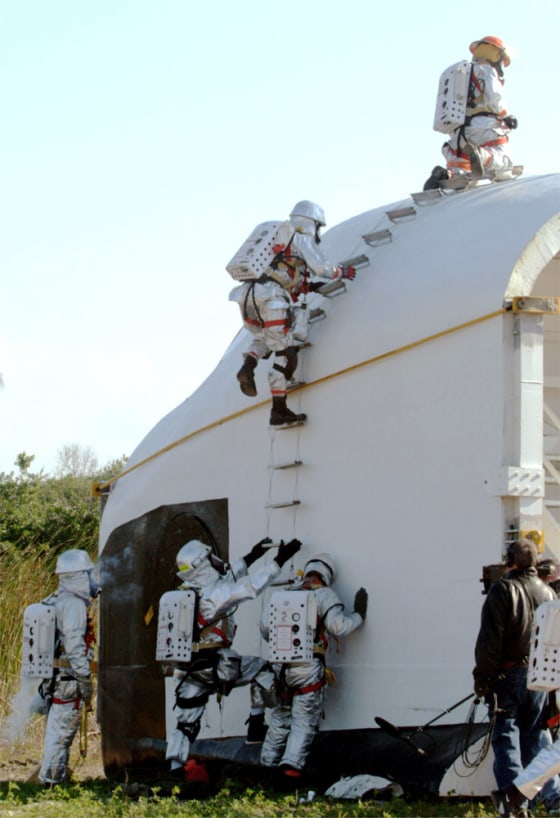
Rescue workers at the Kennedy Space Center conducted a space shuttle crash exercise on Wednesday, the first such drill since the Columbia was lost last year with seven astronauts aboard.
Even though shuttle flights have been suspended since Columbia's fiery break-up high above Texas on Feb. 1, 2003, NASA officials want to keep rescue crews trained for an eventual resumption.
"We know that if it's ever needed, it will be the most important thing we can do," said Robert Holl, the NASA launch recovery director who managed the exercise.
Mock disasters have been staged at Cape Canaveral since 1960, when the spacecraft was a Mercury capsule with a single astronaut.
In the scenario practiced on Wednesday, the shuttle commander's stick malfunctions amid a final landing maneuver, and the shuttle crashes 2.5 miles (4 km) short of the runway.
For the exercise, a mock-up of the shuttle crew compartment sat on high ground surrounded by swamp and scrub brush. Rescue workers, looking like astronauts themselves in silver hazard suits and helmets with oxygen packs on the backs, arrived in U.S. Air Force helicopters.
A rescue would be dangerous because the shuttle carries fuel that can burn the skin, throat and lungs.
Seven civilian employees substituted for astronauts in the exercise and had notes pinned to their flight suits detailing their injuries and symptoms. Their conditions ranged from walking wounded to incapacitated.
It took about 45 minutes for the five rescue helicopters to find the wreck, put fire-rescue workers and paramedics on the ground and free survivors, giving them medical treatment as needed.
Lt. Col. John Bicket, of the Air Force Manned Space Flight Support unit at nearby Patrick Air Force Base, called the exercise successful.
"The goal is always to get them medical attention in what we call the golden hour," Bicket said.
Crashes are practiced about once a year, but last year many of the rescue workers helped in the Columbia search and rescue operation and the drill was skipped. About every two years, they practice an emergency bailout over the ocean.
NASA had hoped to resume shuttle flights in the autumn, but the resumption may be delayed until January or March of 2005, a top NASA administrator said on Tuesday.
A problem facing the rescuers is that none has ever worked a real crash landing of a shuttle.
Norbert Kuhman, the Rescue Operations commander at the Cape, acknowledged search teams would not know whether to expect a crater or a two-story crew compartment buried in mud. Nor are they sure they could spot a mangled crew compartment amid the other wreckage.
"We just have to be prepared for anything," Kuhman said.