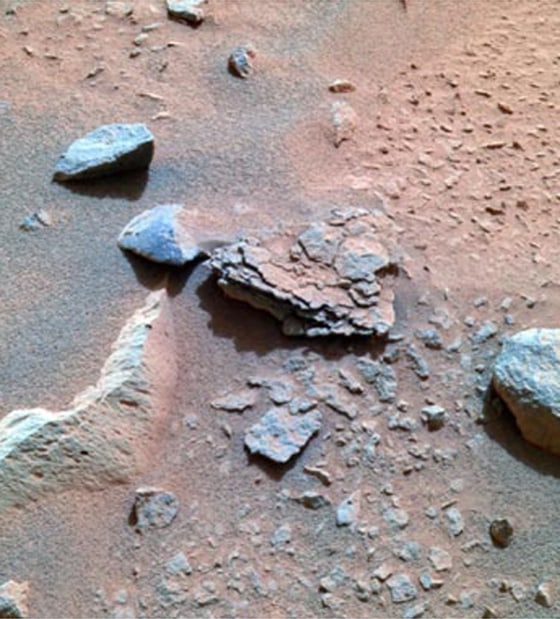
NASA’s Spirit rover stopped to examine an unusual, flaky rock on the surface of Mars Sunday as scientists prepared to send it on a trek that would more than double its one-day distance record.
The Mars Explorer team hopes the rover will travel about 82 feet Monday morning and make the same distance again during the afternoon. Spirit’s longest previous trek was 70 feet in a day, the record for any robot on the Martian surface.
Before setting out on Monday’s trek, Spirit is examining the flaky rock, dubbed “Mimi.”
Mission manager Jim Erickson said scientists would like to know why Mimi is flaky but its neighboring rocks are not. He said flakiness may indicate layering, an indication that a rock was formed over time instead of all at once, as might be the case with rock produced by a volcanic eruption.
Examining a rock’s layers can give scientists hints about the geologic history of the region where it was found.
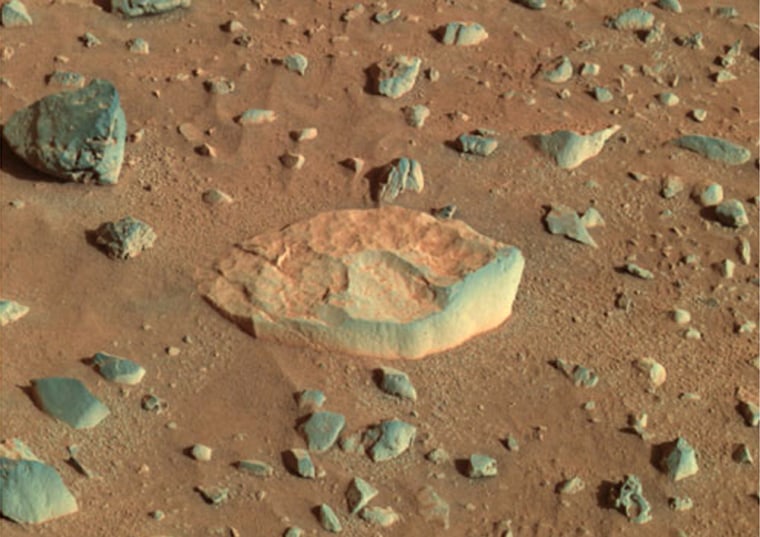
Mimi is just one stop along the way as Spirit moves toward a crater called “Bonneville,” about 800 feet from its landing place. It is expected to take about 18 days to get there, Erickson said.
On the other side of the planet, the twin rover Opportunity was in position to dig a trench Monday in “Hematite Slope,” an area named for an iron-bearing mineral that typically forms in water.
The trench would allow scientists to study soil beneath the surface. Opportunity concentrated on examining the surface soil at the spot Sunday for comparison.
“Anytime you get anything other than a homogenous structure it’s always interesting to the geologists,” Erickson said. “It tells you that the area’s been active and things have changed over time.”