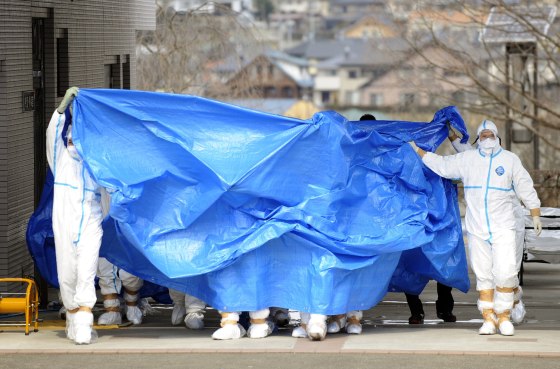
A possible breach in the core of a reactor at the stricken Fukushima nuclear plant could mean more serious radioactive contamination, Japanese officials revealed Friday, as the prime minister called the country's ongoing fight to stabilize the plant "very grave and serious."
A somber Prime Minister Naoto Kan sounded a pessimistic note at a briefing hours after nuclear safety officials announced what could be a major setback in the urgent mission to stop the plant from leaking radiation, two weeks after a devastating earthquake and tsunami disabled it.
"The situation today at the Fukushima Dai-ichi power plant is still very grave and serious. We must remain vigilant," Kan said. "We are not in a position where we can be optimistic. We must treat every development with the utmost care."
The news came as the official death toll from the quake and tsunami passed the grim milestone of 10,000 on Friday. Across the battered northeast coast, hundreds of thousands of people whose homes were destroyed still have no power, no hot meals and, in many cases, no showers for 14 days.
The uncertain situation halted work at the nuclear complex, where dozens of workers had been trying feverishly to stop the overheated plant from leaking dangerous radiation. The plant has leaked some low levels of radiation, but a breach could mean a much larger release of contaminants.
Work was under way Saturday to inject fresh water into one unit, said Hidehiko Nishiyama, a spokesman for Japan's Nuclear and Industrial Safety Agency, or NISA, amid concerns about dumping large amounts of potentially corrosive seawater onto the reactors.
Low levels of radiation have been seeping out since the March 11 quake and tsunami knocked out the plant's cooling system, but a breach could mean a much larger release of contaminants. The most likely consequence would be contamination of the groundwater.
Water with equally high radiation levels was found in the Unit 1 reactor building, Tokyo Electric Power Co. officials said. Water was also discovered in Units 2 and 4, and the company said it suspects that, too, is radioactive. Officials acknowledged the water would delay work inside the plant.
Radioactivity in seawater just outside one unit tested some 1,250 times higher than normal, probably from both airborne radiation released from the reactors and contaminated water leaked into the sea, Nishiyama said Saturday.
But he said the amount posed no immediate health risk.
Plant officials and government regulators say they don't know the source of the radioactive water discovered at units 1 and 3 of the six-unit complex. It could have come from a leaking reactor core, associated pipes or a spent fuel pool. Or it may be the result of overfilling the pools with emergency cooling water.
The possible breach in the plant's Unit 3 might be a crack or a hole in the stainless steel chamber of the reactor core or in the spent fuel pool that's lined with several feet of reinforced concrete. The temperature and pressure inside the core, which holds the fuel rods, remained stable and was far lower than what would further melt the core.
Suspicions of a possible breach were raised when two workers waded into water 10,000 times more radioactive than is typical and suffered skin burns on their feet, the Nuclear and Industrial Safety Agency (NISA) said.
That happened at the turbine building for the Unit 3 nuclear reactor, and the Kyodo news agency on Friday reported that highly radioactive water was also found in the turbine buildings at Units 1 and 2.
The Unit 3 reactor is the only one at the plant to use plutonium, which is more toxic than the uranium used in the other five reactors. The government called for an investigation into why such high levels of radiation had suddenly appeared.
'Risking their lives'
Kan apologized to farmers and business owners for the toll the radiation has had on their livelihoods: Several countries have halted some food imports from areas near the plant after milk and produce were found to contain elevated levels of radiation.
The prime minister also thanked utility workers, firefighters and military personnel for "risking their lives" to cool the overheated facility.
The nuclear crisis has compounded the challenges faced by a nation already saddled with a humanitarian disaster. Much of the frigid northeast remains a scene of despair and devastation, with Japan struggling to feed and house hundreds of thousands of homeless survivors, clear away debris and bury the dead.
"It's still like I'm in a dream," said Tomohiko Abe, a 45-year-old machinist who was in the devastated coastal town of Onagawa trying to salvage any belongings he could from his ruined car. "People say it's like a movie, but it's been worse than any movie I've ever seen."
The official death toll stood at 10,151 Saturday, with more than 17,000 listed as missing, police said. With the cleanup and recovery operations continuing, the final number of dead was expected to surpass 18,000.
Concerns over leak
A breach could mean a leak has been seeping for days, likely since the hydrogen explosion at Unit 3 on March 14. It's not clear if any of the contaminated water has run into the ground. Radiation readings for the air were not yet available for Friday, but detections in recent days have shown no significant spike.
Two of the other reactors are now seen as safe but the other four are volatile, occasionally emitting steam and smoke. But work is advancing to restart water pumps to cool their fuel rods.
Authorities have been using seawater to cool the rectors but that is not ideal as it corrosive and leaves salt deposits that constrict the amount of water that can cool the rods.
TEPCO said it started injecting freshwater into the pressure vessels of Unit 1 and 3 reactors and expected to start injecting freshwater into Unit 2 soon.
The United States has offered to help with two barges with 525,000 gallons of freshwater.
More than 700 engineers have been working in shifts around the clock to stabilize the six-reactor complex.
The confusion was yet another setback to the urgent task of gaining control of the plant 140 miles northeast of Tokyo two weeks after a magnitude-9 quake triggered a tsunami that engulfed the facility and knocked out its crucial cooling system and back-up systems.
The plant has been releasing radiation, with elevated levels turning up in raw milk, seawater and 11 kinds of vegetables, including broccoli, cauliflower and turnips.
Tap water in several areas of Japan — including Tokyo — also tested with radiation levels considered unsafe for infants, who are particularly vulnerable to cancer-causing radioactive iodine, officials said.
The scare caused a run on bottled water in the capital, and prompted city officials to distribute bottled water to families with babies.
In the latest contamination finds, Kyodo reported that radioactive cesium 1.8 times higher than the standard level was found in a leafy vegetable grown at a Tokyo research facility.
Experts say radiation leaking from the plant is still mainly below levels of exposure from flights or dental and medical X-rays.
Humanitarian crisis
Meantime, officials are also grappling with a humanitarian crisis in the northeast, where hundreds of thousands of survivors remain camped out in schools and civic buildings two weeks after the tsunami swallowed up swaths of the coast.
Some 660,000 households do not have water and more than 209,000 do not have electricity.
The estimated $300 billion damage from the quake and tsunami makes this the world's costliest natural disaster, dwarfing Japan's 1995 Kobe quake and Hurricane Katrina in New Orleans in 2005.
In other developments Friday:
- Japan's chief cabinet secretary said 120,000 people living near Fukushima should consider leaving, although he insisted it was because getting supplies to the region was difficult and maintained it was not an evacuation order.
- China said two Japanese travelers arriving in the country were found to have exceedingly high radiation levels. The travelers, who arrived in the eastern city of Wuxi from Tokyo, were given medical treatment and presented no radiation risk to others.
- Police said the official death toll jumped past the 10,000 mark Friday. With the cleanup and recovery operation continuing and more than 17,400 listed as missing, the final number of dead was expected to surpass 18,000, taking into account overlapping figures. Authorities are burying unidentified bodies in mass graves, despite Japan's usual Buddhist practice of cremation.
- Nissan Motor Co. said it may move part of its engine production line to the United States because of damage to a plant.
- German Chancellor Angela Merkel said European Union leaders have agreed on criteria for tests of their nuclear plants that are being implemented in response to the crisis in Japan.