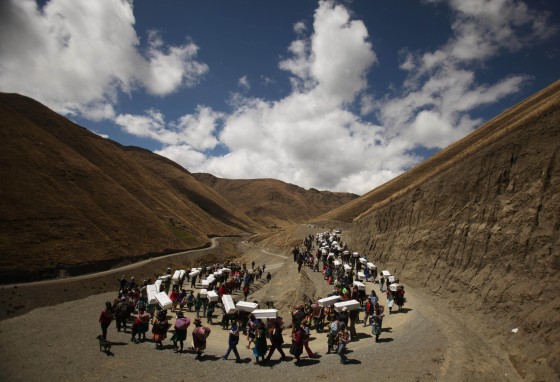
Victims of the worst military massacre during Peru's war with Maoist rebels were laid to rest Saturday, a quarter century after the slaughter in this remote Andean village.
The burials culminated a two-day funeral procession through the southeastern state of Ayacucho, the epicenter of Peru's bloody fight with Shining Path guerrillas from 1980 to 2000.
Dozens of families in traditional dress and carrying flowers walked 30 miles with 92 white coffins, many containing only partial remains.
"I lost nearly 15 relatives in the massacre," Putis Mayor Gerardo Fernandez told The Associated Press during an interview Thursday. "We have two feelings. On the one hand, we are in pain for the dead. But on the other, we're happy that we can finally bury them."
The bodies were recovered from a mass grave last year.
Peru's government-appointed truth commission said at least 123 people were killed in the 1984 massacre in Putis, the largest mass slaying of the government's campaign against the Shining Path.
The peasants — many of them women and children — were shot by members of the armed forces after some were tricked into digging their own mass grave, according to the commission. The military suspected the peasants were collaborating with the Shining Path.
Bullets found with the bodies were inscribed with the acronym FAME, which stands for Military Factory for Arms and Munitions, said Pablo Baraybar, who led the 2008 exhumation as head of the Peruvian Forensic Anthropology Team.
DNA tests conducted on the bones in a U.S. laboratory established the identity of 28 of the 92 bodies found in Putis, a poor village in Ayacucho state where 40 percent of the war's 70,000 victims were killed. Ayacucho means "the Corner of the Dead" in the native Quechua language.
The Shining Path nearly brought the Peruvian government to its knees by the late 1980s, but faded after the capture of its leader, Abimael Guzman, in 1992.
There have been no charges filed in the Putis killings.
"There is no way to get the names of those people," Defense Minister Rafael Ray has said, referring to members of the military stationed in the area at the time of the massacre.