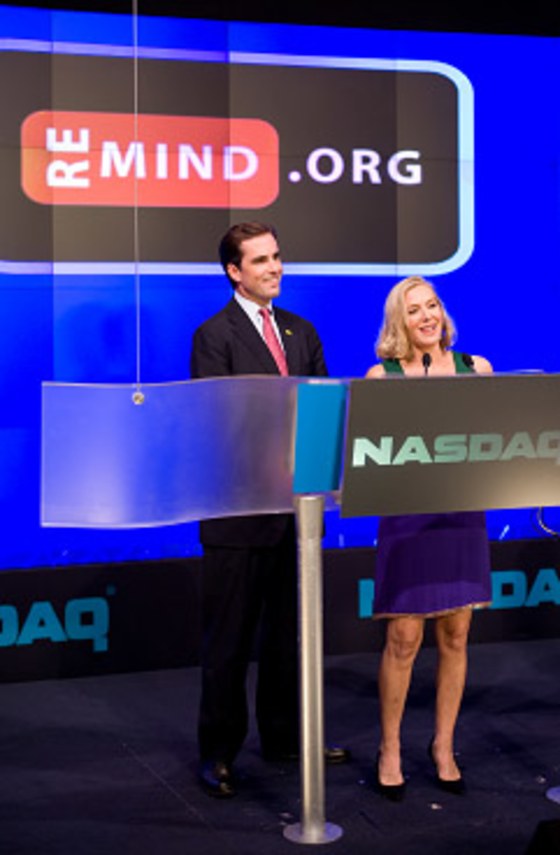
BOB WOODRUFF
Question: How has covering wars influenced your work with ReMIND.org?
Bob Woodruff: I have experienced a lot covering wars. When I was injured, it was the seventh time I was to Iraq. Because I was in ICU [Intensive Care Unit], my life was changed, was saved. I just wanted to make sure ... that the other military who are injured like I was, for long-term rehabilitation, they get the same kind of treatment and attention that I was able to get.
Q: How has surviving a roadside bomb in Iraq affected your outlook on life?
BW: I think it was miraculous that I even survived. I think in some ways now I look at every day as like a free day. I did not think it would actually happen. But, it [my life] has changed in many ways. I look at life, I think that I don’t really [get] quite upset by some things that are in some ways simple.
Q: What do you think about the use of Twitter for social action?
BW: This is something new. The biggest point is to have many people talk about their personal thoughts, the kind of attention that they want and certainly to wake them up about how they can help those who have been injured. That’s very important to us to put that word out to as many as we possibly can.
Q: What has been your most memorable experience working with ReMIND.org?
BW: We have helped so many charities around the country to continue on their mission, which is in their particular community and their town and their city, to try to help as many veterans as they possibly can. As soon as you meet somebody who was injured in the war you really badly want to help and are so moved by them, because so many neighborhoods, so many communities, don’t have many that are hurt or served in the war. You only got about 1.7 million that have been in these wars of Afghanistan and Iraq, far fewer than Vietnam. So, if people do meet them, whether in their town or somewhere else in their country, people want to help. That has been the most emotional experience that I’ve had with this foundation.
Q: Is there one memorable experience that sticks out in your mind, something that was very moving that you would want to share?
BW: I’ve got so many. We’ve met someone in upstate New York whose name — I don’t really like to give out names — but he’s one that was blinded in the war. Only about 15/16ths of his eyesight [was lost] and so he did not get the full amount in terms of his disability money. That’s all changing. I’ve had others that have gone into the VA with kinds of injuries that are relatively new. There are far fewer people, you know, who were killed in this war compared to previous wars. There are so many more ratio-wise, percentage-wise, than the previous war, so some of them, doctors and others, have not been able to figure out exactly what to do for them. We’re just learning faster and faster.
But some of them, they never thought they’d walk again, they couldn’t really communicate anymore. And now we’ve come up with ways, through different kinds of computers and other ways, to teach them how to walk or at least be supported by their families to walk. So even though they say you can never walk again, we’ve seen them now actually walk out of the hospital, which they never expected would happen. So, it’s been incredibly moving for them.
Q: How can people get involved with ReMIND’s campaign, “Tweet to ReMIND”? If they use or don’t use Twitter, how can they get involved?
BW: Well there’s ReMIND.org, certainly getting on the Internet if you make the contacts through that. We have events every year, so they can donate through that. Certainly Twitter is one of the new ones. Facebook, our Web site, is all ways to get information about anything, and connect into it to actually make a donation. It is true, through Twitter, just asking people to donate a dollar, two dollars, three dollars, we’d love to have those who donate large amounts too, but that range is creating a lot of possibilities for people to be involved in this.
LEE WOODRUFF
Q: What made you think to start this organization and the Twitter campaign?
LW: Bob and his brothers and I started it. I think we were just so darn grateful at how well he had recovered, and we sort of got going on it and talking about it a lot when it was kind of clear that Bob’s recovery was going to be really pretty spectacular. I often say when I speak or when I’m out talking to people, that I don’t think I would be out doing so much for so many others if Bob was in a much more infirmed place. I wouldn’t have that luxury. It happened because we tried to find out, we met so many in the hospital that were not as fortunate as us in so many ways, in terms of Bob’s recovery, in terms of the resources that they had at their fingertips.
When we tried to look into group organizations that helped, we found that they were all kind of broken down by the branch of the service. The Marines, they helped Marines, and the Army helped soldiers. But there wasn’t one global organization that didn’t care what bars and stripes you had on you. That you served, that these people have been wounded, and let’s figure out how we can help then. So that’s how we began, just small stuff at first and not trying to reinvent the wheel. We looked for those organizations on the ground and already doing great work for those that were wounded, and they probably didn’t have the awareness or the visibility to be able to raise the money. We wanted to be the organization that could raise money and then turn around, and they would apply for grants, and we could get them grants.
The Twitter campaign is really a brainchild of our PR agency, Porter Novelli. They do pro bono work for us, which is fantastic. Marian Salzman [of Porter Novelli] is really a big proponent of Twitter and a big believer in Twitter, and so she approached Twitter and said that this would be great if we could get everybody over Memorial Day and get a campaign going where we tell the slogan, “If someone risked their life for you, would you give them a dollar?” Which is pretty impactful, thinking about Memorial Day weekend.
Most of us will be barbecuing or by a pool somewhere just yukking it up. Our goal is that we ask every American to think this Memorial Day about what it really means, and the 1.65 million people who have cycled through Iraq and Afghanistan and really put their lives on the line for us. Whether or not we believe in this war, whether or not we think it was the right move for America, these were the people that went.
Q: Has your family’s experience with your husband helped you all better connect with families of service members and veterans and if so, how?
LW: Very much so, because we met so many in the hospital and then continued through our work with the foundation to meet families. Bob is continuing to cover these stories at ABC, among others. Then, when I go out and do speaking, we meet military families, many of them, and make these connections around the country.
Q: You’ve written two books at this point. What do you feel is the most important message for people to take away from your books?
LW: Probably the most important message in both of them, even though they’re different books, is that the human spirit is really resilient. Humans have an amazing capacity to heal and to move beyond difficult and horrible things and to rejuvenate.
Q: Why should people participate in ReMINDS’s Twitter campaign?
LW: We all owe these Americans a debt because they were the ones who were asked to go and they went and especially for those who have come home wounded. I’m sure you’ve seen the Rand Corporation study — 320,000 — and that was a good six or eight months ago now — 320,000 is the estimate of those who have returned with brain injuries. For many of those, their lives will never be the same. These are the people who have sacrificed for us, and we all need to come together as a country and help them heal. We’re asking so little for the Twitter campaign, and that’s what we’re so excited about. If everybody did go and donate a little dollar, we could raise an incredible amount in rehabilitation and training for these guys.