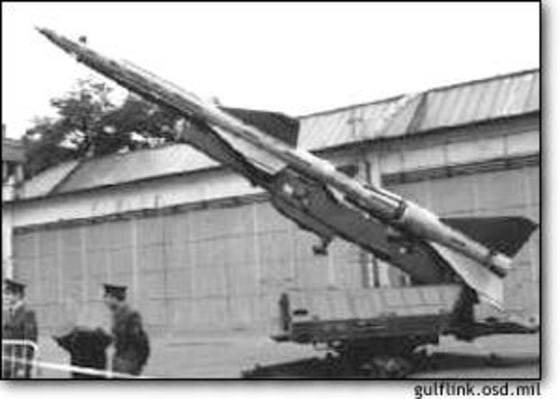
On the first day of May 1960, somewhere near the Siberian city of Sverdlovsk, an SA-2 high-altitude anti-aircraft missile took down the U-2 reconnaissance plane piloted by Gary Powers, igniting an international incident and confirming the SA-2 as the scourge of the American flyers. While modern warplanes have learned to steer clear of these these surface-to-air missiles, they remain a mainstay of Iraq’s defensive arsenal and a threat if, somehow, American or British pilots drop their guard.
Iraqi radar SAMs damaged or destroyed eight coalition fighters in the first six days of Operation Desert Storm and for the remaining five weeks of the war they were only able to hit another five coalition aircraft. U.S.-led forces succeeded in suppressing radar guided surface-to-air missiles through a combination of drone decoys and anti-radiation missiles.
“They can be easily detected by the enemy because of the active radar signals that they use and this has made them almost obsolete today,” says David J. Silbey, a military historian at Alvernia College in Reading, Pa.
The SA-2, which remains Iraq’s primary defense against high-altitude targets, can hit aircraft at altitudes as high as 23 miles. The missile, if it gets a clean lock on its target, is reliable and fast — moving at speeds of up to 2,300 miles per hour and at distances of up to 38 miles from the launch site.
Although there are a variety of arrangement patterns, all sites consist of six launching positions arranged around guidance radar.
The guidance system at an SA-2 site can handle only one target at a time, but can simultaneously direct three missiles against a target. Additional missiles could be fired against the same target after the first batch is released. One of the key advantages is its mobility. While the sites are permanent installations, all operating components of the system are mounted on wheeled vehicles and are capable of movement by road or rail.