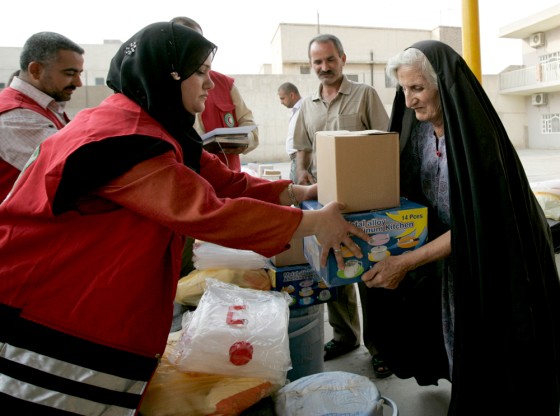
The U.N. refugee agency said Friday it was rushing aid to thousands of Christians who have fled the northern Iraqi city of Mosul, while an influential Shiite cleric called for national unity as lawmakers consider a deal to keep U.S. troops here for three more years.
Some 13,000 Christians have been chased away by threats and extremists attacks in Mosul this month, said Ron Redmond, spokesman for the U.N. High Commissioner for Refugees. That is over half the community in a city where Christians have lived since the early days of the religion.
"Many left with little money and need help," Redmond told reporters in Geneva, where the UNHCR has its headquarters.
He recounted the story of one Christian woman, a nurse, who told UNHCR that the threats started months ago with phone calls, letters and messages left on doors. Another woman named Mariam said she fled when she heard of a Christian who was murdered.
"We were the hard core that never wanted to leave Iraq, even with the tense environment," the woman, who fled to Syria, was quoted by UNHCR as saying.
The agency has delivered relief supplies to over 1,700 Christian families now displaced in the north of the country, Redmond said. Most are living in churches, monasteries and the homes of relatives in nearby Christian villages and towns.
Sunni extremists blamed
Sunni extremists are believed to be behind the campaign, which is occurring despite U.S.-Iraqi operations launched over the summer aimed at routing al-Qaida in Iraq and other insurgents from remaining strongholds north of the capital.
But no group has stepped forward to claim responsibility. Attacks against Christians and other minorities had before this month tapered off amid a drastic decline in overall violence nationwide.
In Baghdad, meanwhile, a hardline Shiite cleric who also serves in parliament called for rational debate on a draft U.S.-Iraqi security pact that would give the United States a legal basis for keeping its forces three more years in Iraq.
Jalaluddin al-Saghir told worshippers at a Baghdad mosque that the government was still tinkering with the deal that would also grant Iraq limited authority to try U.S. soldiers and contractors charged with serious crimes.
"The country is passing through a most critical stage," al-Saghir said. "The politicians should think about Iraq's interests. They should not seek to break the unity of Iraqi society ... This is not a game."
The proposed agreement has faced opposition from a number of critics who consider the deal an infringement on national sovereignty.
Adjustments sought in U.S.-Iraq pact
Al-Saghir's statements carry weight because he is a senior figure in the Supreme Islamic Iraqi Council, which dominates Iraq's government along with the party of Prime Minister Nouri al-Maliki. The council has previously said it wants to make some amendments to the deal.
Worshippers, however, heard a different message in mosques frequented by supporters of the anti-U.S. Shiite leader Muqtada al-Sadr.
Sheik Abdul-Hadi al-Mohammadawi, an aide to the Iran-based al-Sadr, praised those who joined the tens of thousands in demonstrating last week for an end to the American presence in Iraq.
In a sermon at Kufa mosque south of Baghdad, he said the proposed deal had numerous problems. "There is no balance in this pact because it is between a great state and a small one," al-Mohammadawi said.
The head of the Sadrist political commission, meanwhile, told a news conference in the Shiite holy city of Najaf that his movement's criticism of the deal was not part of an Iranian agenda, as some have suggested.
Iran, which is also close to the Shiite parties who dominate Iraq's government, has repeatedly expressed its opposition to any security deal that allows American forces to remain in Iraq.
"We have real and serious fears that the occupier seeks to divide Iraq," Lewa Smeism said, adding that there was opposition across the Iraqi political spectrum.
Senior U.S. defense officials have said the U.S. is still focusing its efforts on getting the agreement signed, even though its acceptance by Iraq's parliament is far from certain. Washington prefers the new deal over an extension of the existing U.N. mandate that gives U.S. and coalition troops the authority to be in Iraq through the end of the year.
U.S. Secretary of State Condoleezza Rice dismissed on Thursday Iran's attempt to quash the accord.